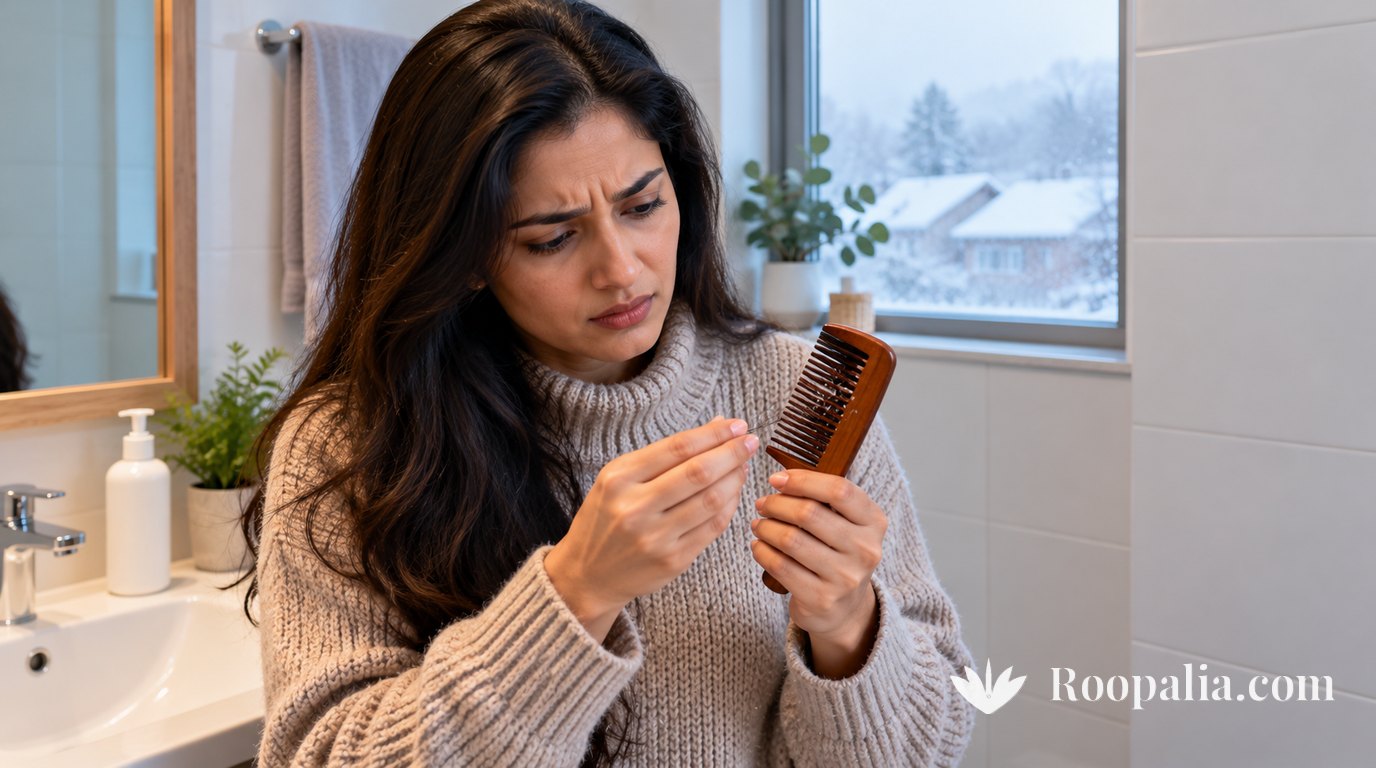
It usually starts in the first properly cold week. The heating goes on, the windows stay shut, you pull on a navy jumper — and by lunchtime there is a fine white dusting across the shoulders. You brush it off. The itch gets worse. And the search begins: dandruff or dry scalp? How to get rid of dandruff permanently? Can it go in one wash?
Those three questions have clear answers, and most of the internet gets at least one of them wrong. I went through the NHS, Mayo Clinic, a controlled trial and an Ayurvedic text in translation to find out which home remedies hold up — and which do not.
Dandruff vs dry scalp: how to tell the difference
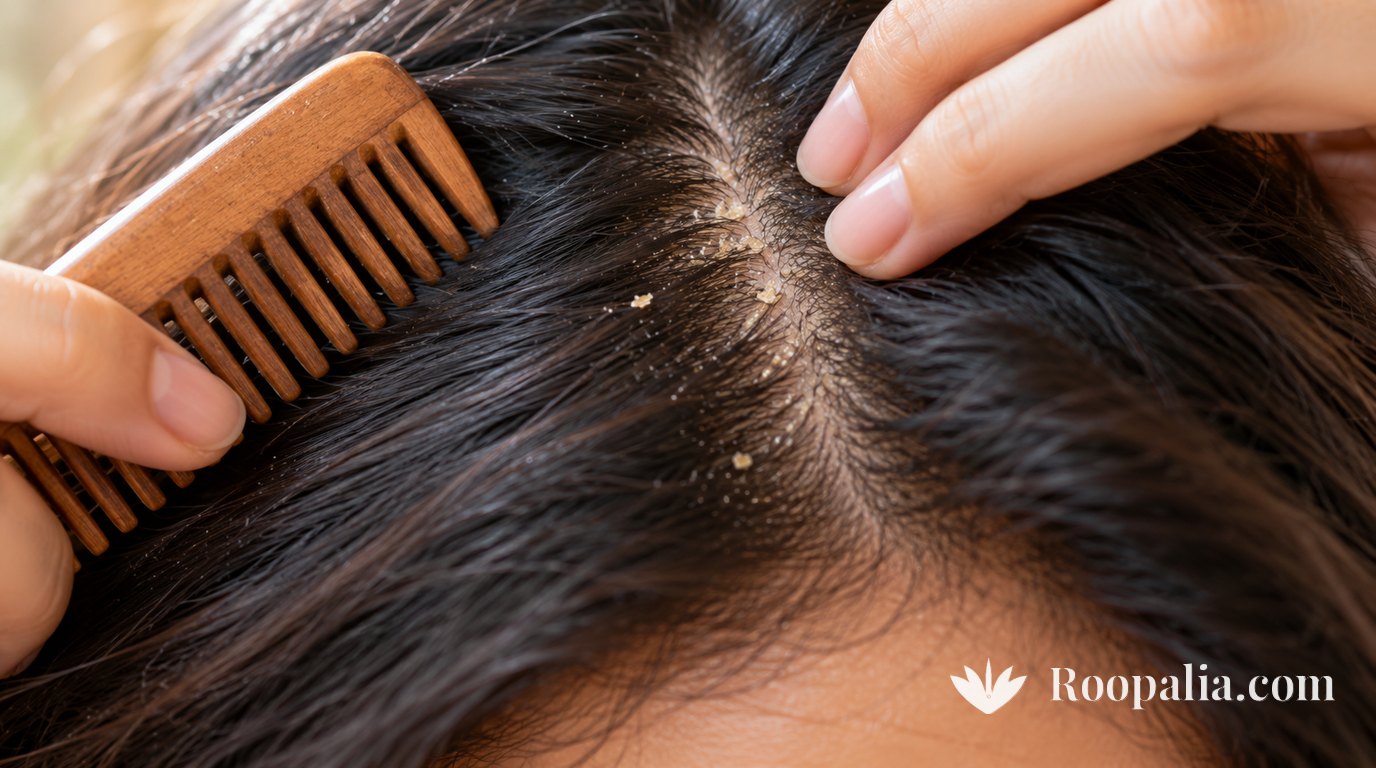
Dandruff and dry scalp look alike but have different causes. Dry scalp is simply dry skin; dandruff is an inflammatory reaction, usually involving a yeast that lives on the scalp. As Wikipedia puts it, “Dry scalp is simply dry skin on the scalp and can usually be easily treated with a skin care regimen.” Here is how they compare with the two other things people most often confuse them with:
| Dandruff | Dry scalp | Head lice | Scalp psoriasis | |
|---|---|---|---|---|
| What you see | White or yellowish flakes, sometimes greasy | Small, dry, white flakes | Brown or white eggs (nits) stuck to the hair; moving lice | Raised red patches with thick silvery scale |
| Brushes off? | Yes | Yes | Nits do not — they cling to the strand | Scale is thicker and more stubborn |
| Main cause | Malassezia yeast, oily or irritated skin (Mayo Clinic) | Dry skin | Head-to-head contact (NHS) | An immune-driven skin disease |
| Improves with | Medicated shampoo over weeks | Moisturising, gentler washing | Wet combing or medicated lotion | A doctor’s treatment |
Two quick checks settle most cases. If flakes slide off when you brush the hair but small pale specks stay glued to the strand, think lice: the NHS says the only way to be sure is “finding live lice”, by combing wet, conditioned hair with a fine-toothed detection comb (NHS — Head lice and nits). If there are thick, raised, red patches, let a doctor look — psoriasis and eczema are both listed by Mayo Clinic as causes of a flaking scalp.
What actually causes dandruff?
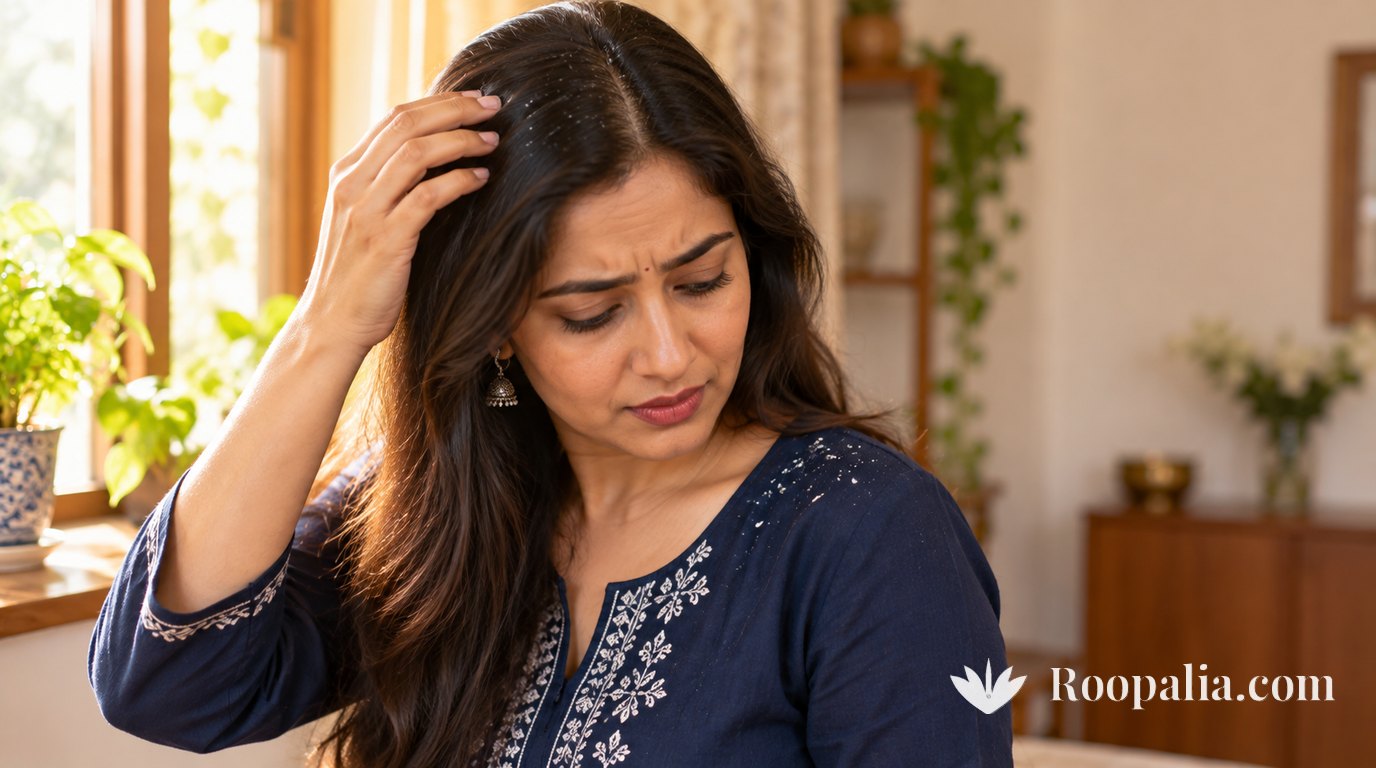
Mayo Clinic lists five causes: irritated, oily skin; dry skin; sensitivity to hair products (contact dermatitis); other skin conditions such as psoriasis and eczema; and, most often discussed, a yeast:
“A type of fungus called malassezia that lives on the scalps of most adults and feeds on natural oils.”
— Dandruff — Symptoms and causes (courtesy: Mayo Clinic)Almost everyone carries Malassezia, so why do only some people flake? Wikipedia explains that the yeast produces oleic acid, which “penetrates the top layer of the epidermis … and evokes an inflammatory response” in susceptible people. The yeast is common; the reaction to it is personal.
Two myths are worth retiring straight away. The NHS is explicit: “Dandruff is not caused by poor hygiene” — although flakes are more visible if you wash less often — and “It’s not harmful and you cannot catch it” (NHS — Dandruff). Wikipedia puts its prevalence at roughly half of adults, more often in men; it usually begins at puberty and becomes less common after 50.
Why is dandruff worse in winter?
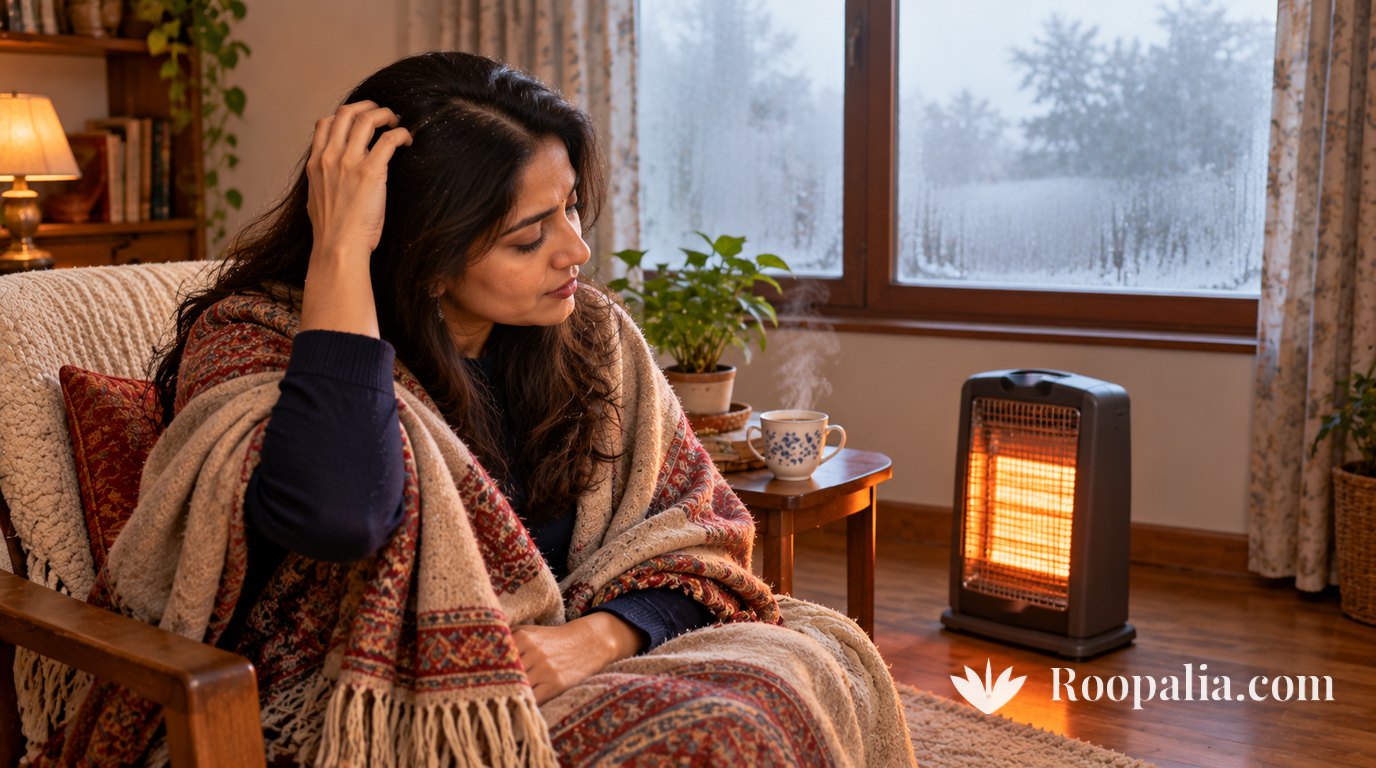
Mayo Clinic says it plainly: “Dandruff may get worse when you’re stressed or during cold, dry weather.” The NHS agrees that cold weather can make it worse. Indoors, heaters strip moisture from the air, very hot showers dry the skin further, and many people wash their hair less often when it is cold — which, as the NHS notes, only makes the flakes more obvious. In winter, keep washing; use warm rather than hot water, and dry your hair properly.
So the cause is a yeast and a reaction, made worse by winter. That brings us to the question everyone types next: can it all be gone after one wash?
Can you get rid of dandruff in one wash — or permanently?
Not according to the medical sources I checked. The NHS advice on anti-dandruff shampoo is to “Use the shampoo for up to 4 weeks to see if your dandruff gets better.” Four weeks, not one wash.
A controlled trial on tea tree oil shows how slow the progress is even when a product works. In 2002, 126 people used either a 5% tea tree oil shampoo or a placebo shampoo every day, left on for three minutes, for four weeks. Scalp scores fell from 91 to 53 with tea tree oil, against 99.7 to 88.2 with placebo. And yet:
“only one patient in each group was completely free of dandruff at four weeks”
— summary of Satchell et al., Tea Tree Oil Shampoo in the Treatment of Dandruff, American Family Physician, 2003 (courtesy: AAFP)As for “permanently”, Mayo Clinic is honest: “For some people, it never goes away.” The realistic goal is control — and control is very achievable with the right routine.
How to wash with anti-dandruff shampoo (the part most people skip)
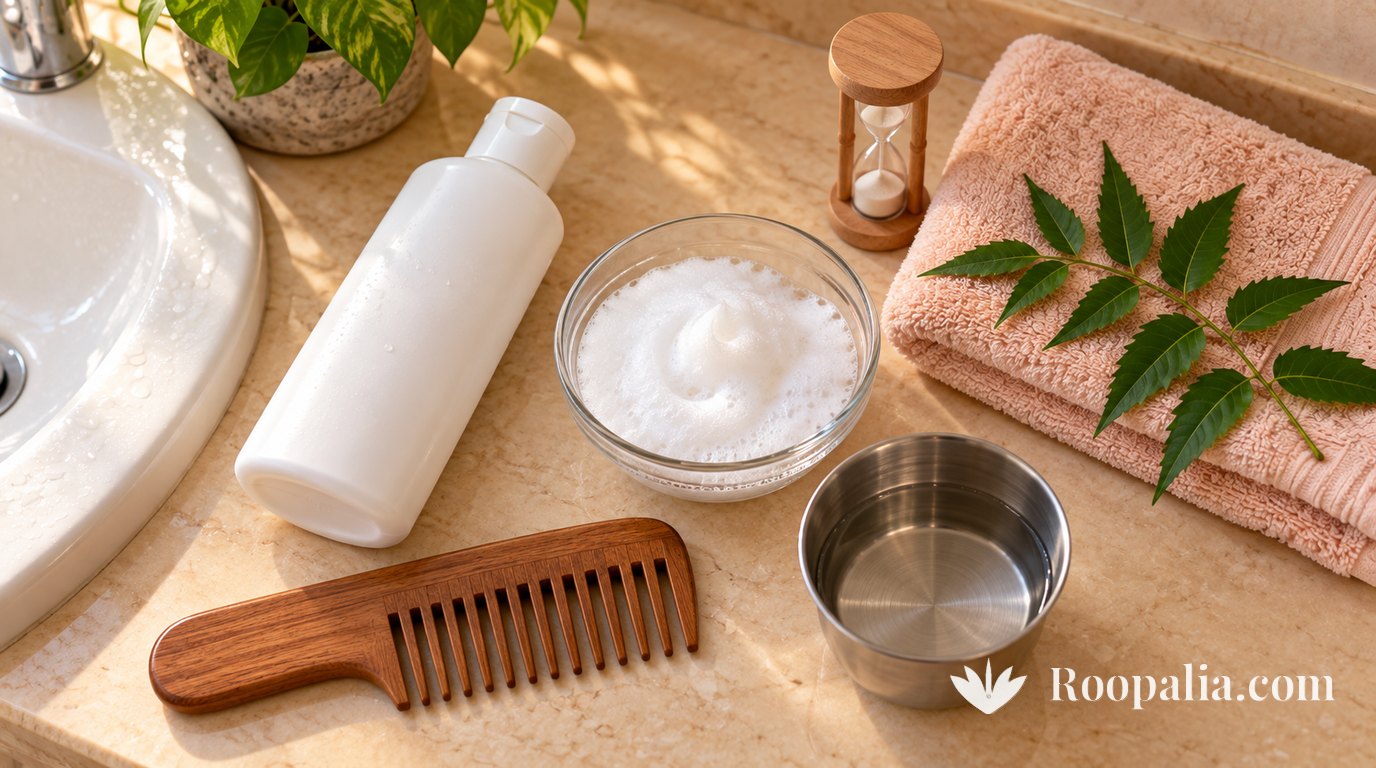
From Mayo Clinic’s treatment guidance:
- Apply it to the scalp, not the lengths. Rub gently with fingertips, not nails.
- Leave it on. Most dandruff shampoos need to sit for several minutes before rinsing. Rinsing straight away is the most common mistake.
- Two to three times a week is tolerated by some people; those with curly, coiled or textured hair may need it less often.
- Rotate if one stops working. Mayo suggests switching between shampoos with different active ingredients; the NHS notes you may need to try more than one.
- Keep going once it clears — at least weekly, to stop it returning.
- Stop if it itches, burns or stings, and get help immediately for a rash, hives or trouble breathing.
What to look for on the label
Ignore the marketing on the front; read the ingredients on the back. These are the actives named by the NHS and Mayo Clinic:
| Ingredient | What it does | Worth knowing |
|---|---|---|
| Ketoconazole | Antifungal — targets Malassezia | Named by both the NHS and Mayo Clinic |
| Zinc pyrithione | Antifungal | Named by Mayo Clinic |
| Selenium sulfide | Antifungal; slows flaking | Named by Mayo Clinic |
| Salicylic acid | Loosens built-up scale | Can leave the scalp drier |
| Coal tar | Slows skin-cell turnover | Mayo: may stain light hair and increase sun sensitivity |
We do not recommend brands. Pick one active, use it properly for four weeks, then judge.
Home remedies for dandruff: what the evidence says
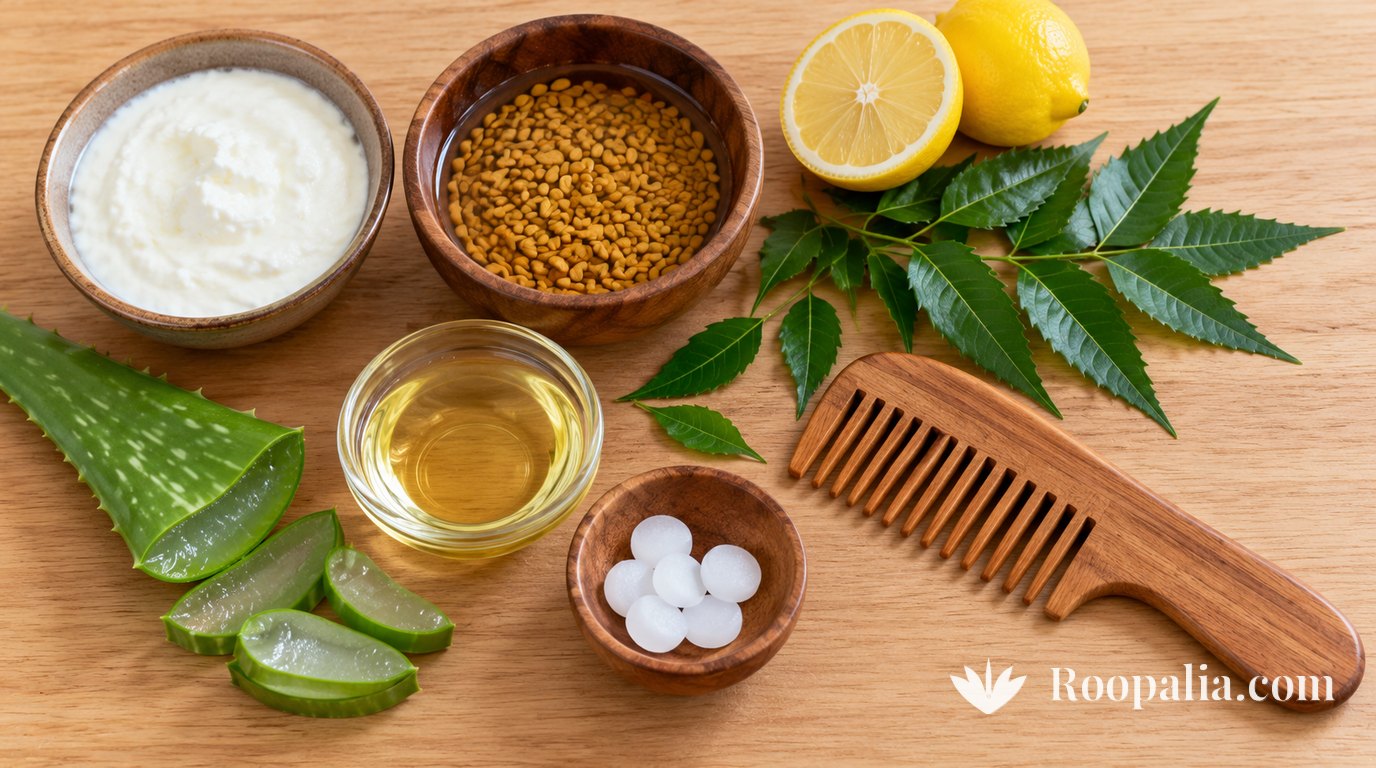
For each popular remedy, I asked one question: has it been shown to help dandruff in people, in a source I could check?
| Remedy | What I found | Caution |
|---|---|---|
| Tea tree oil | One controlled trial (5% shampoo, 4 weeks) showed improvement; Mayo Clinic says “There is no strong evidence that tea tree oil helps with dandruff.” | Mayo: may cause allergic reactions; never undiluted on the scalp |
| Curd / yoghurt | No human study on dandruff found | Rinse thoroughly |
| Fenugreek (methi) paste | No human study found | Patch-test behind the ear first |
| Lemon juice | No study on dandruff found | Acidic; can sting scratched skin — see lemon juice on skin: the evidence |
| Neem | No human study on dandruff found | Neem oil is strong; dilute it |
| Camphor | No study on dandruff found | Keep away from young children; not on a baby’s scalp |
| Coconut or other oils | No study showing oil clears dandruff found; Mayo says the yeast feeds on natural oils | Do not treat an overnight oiling as the cure — wash it out |
| Aloe vera | No reliable study on dandruff found | Patch-test first |
“Not found” is the result of my search, not a final verdict. If curd or fenugreek soothes your scalp without irritation, there is no harm in it — just do not rely on it alone for more than four weeks.
Beard dandruff
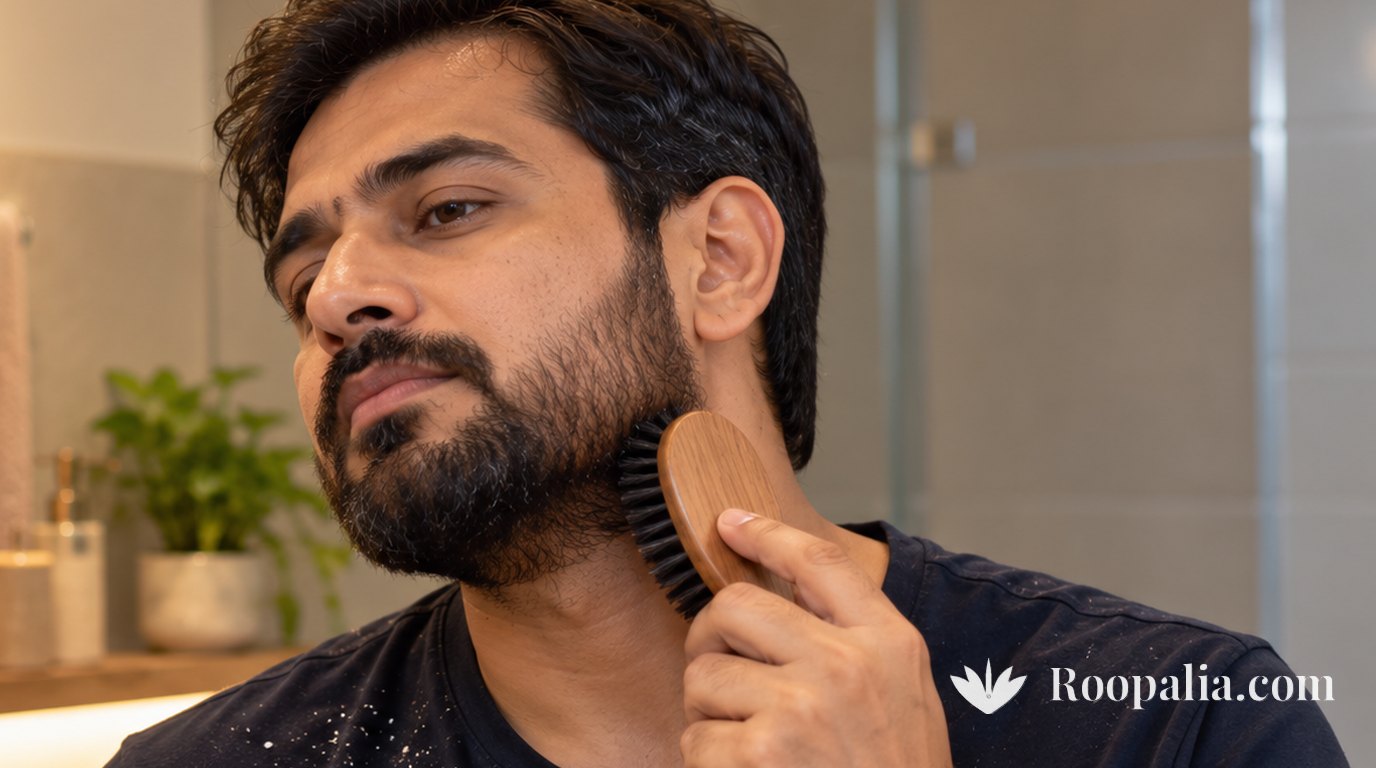
Mayo Clinic describes dandruff as “Skin flakes on your scalp, hair, eyebrows or shoulders”, and notes it is more common in men — so flaking in a beard is no surprise. I did not find a separate, authoritative beard-dandruff protocol. The NHS advice applies: if you have flaky, itchy patches on your face, see a doctor rather than putting scalp products on facial skin, which is thinner. Those patches may be seborrhoeic dermatitis, which also answers another common search: I found no direct evidence that dandruff causes pimples — for breakouts, see why you get pimples.
Dandruff in children and babies
In babies, a greasy, scaly crust on the scalp is cradle cap. The NHS calls it “a harmless skin condition that’s common in babies”; it is not itchy and usually clears within a few months (NHS — Cradle cap). The NHS suggests rubbing in an emollient or coconut oil to loosen the scales, brushing gently with a soft brush, then washing with baby shampoo. It advises against picking the crusts, adult shampoos, soap, perfumed products, olive oil and peanut oil. See a GP if it has not improved after a few weeks, spreads over the body, or bleeds, oozes or swells.
In school-age children, check for lice before assuming dandruff — the NHS notes lice are not caused by dirty hair and spread through head-to-head contact, and it does not recommend plant oils such as tea tree for lice.
What Ayurveda says: Darunaka

Ayurveda calls a dandruff-like condition Darunaka and lists it among the minor diseases. I checked the translation of the Sushruta Samhita:
“The disease in which the hairy parts of the body (roots of hairs) become hard, dry and characterised by an itching sensation is called Darunaka. The disease is due to the action of the deranged Kapha and Vayu.”
— Sushruta Samhita, Nidanasthana, Chapter 13 (verses 26–33), tr. Kaviraj Kunja Lal Bhishagratna (courtesy: wisdomlib.org)For treatment, the Chikitsasthana translation says “Anointment and fomentation of the diseased patches are the (preliminary) remedies in a case of Darunaka” (Chapter 20, verses 17–19, tr. Kaviraj Kunja Lal Bhishagratna, courtesy: wisdomlib.org) — and then goes on to washing with an alkaline solution of burnt kodrava. The same passage also describes bloodletting from a vein in the forehead, which is a physician’s procedure from another era and not something to attempt. The useful takeaway is the sequence: oil was the first step, and washing followed. It squares with the modern point that the yeast feeds on oil.
Living outside India? Winter-proofing your scalp
- At the pharmacy, ask for the active, not a brand — ketoconazole, zinc pyrithione, selenium sulfide, salicylic acid or coal tar. Pharmacists in the UK, Canada and the US are used to that question.
- Heated air — many people in centrally heated homes use a humidifier. I found no study on its effect on dandruff, but it is a common way to counter dry indoor air.
- Hats and wool scarves trap sweat and rub the scalp; wash them regularly.
- The four-week rule still applies — after that, book your GP or family doctor.
More on winter at home far from India: how to set curd in cold weather.
When should you see a doctor about dandruff?
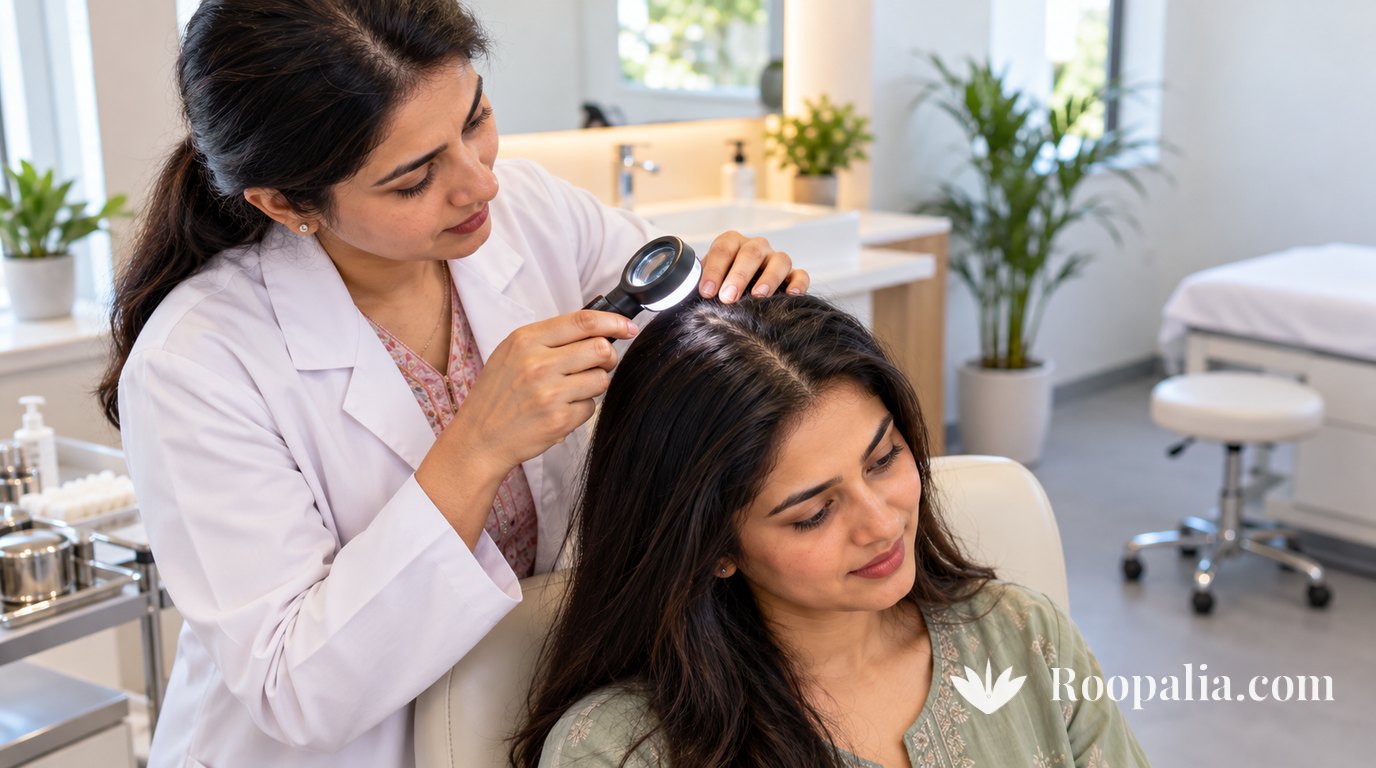
The NHS says to see a GP if you still have symptoms after at least four weeks of anti-dandruff shampoo; if the dandruff is bad or your scalp is very itchy; if your scalp is red or swollen; or if you have flaky, itchy patches on your face or other parts of your body. Mayo Clinic adds that a doctor may prescribe a stronger shampoo or a steroid lotion. If hair is shedding heavily at the same time, read hair fall in women: causes and treatment — Wikipedia notes emerging research on a possible link between dandruff and hair loss, but it is not yet established.
What I found — and what I did not
| Question | Result |
|---|---|
| Dandruff vs dry scalp | Different — yeast-driven inflammation vs simply dry skin (Mayo Clinic, Wikipedia). |
| Caused by poor hygiene? Contagious? | No and no — NHS. |
| Worse in winter | Found — Mayo Clinic, NHS, Wikipedia. |
| Gone in one wash, or permanently | Not found — NHS says up to 4 weeks; Mayo says it never goes for some. |
| Tea tree oil | Partial — one trial positive; Mayo: no strong evidence. |
| Curd, fenugreek, lemon, neem, camphor, aloe | No human studies found. |
| Ayurveda | Found — Darunaka, Sushruta Nidana 13 and Chikitsa 20.17–19. |
| Dandruff causing pimples | No direct evidence found. |
The bottom line. If the flakes brush off and the scalp itches, it is most likely dandruff — not dirt, not contagious, and very often worse in winter. The routine that works is unglamorous: a shampoo with a proven active, massaged into the scalp, left for several minutes, two to three times a week, for four weeks — then weekly to keep it away.
Use curd or fenugreek if you enjoy them, but drop the “one wash” promise. And if four weeks pass with no change, or patches appear on your face, it is time for a doctor, not another remedy.
Frequently asked questions
What is the difference between dandruff and dry scalp?
What causes dandruff?
Can you get rid of dandruff in one wash?
How do I get rid of dandruff permanently?
Do home remedies like curd, lemon or tea tree oil work for dandruff?
Is oiling good for dandruff?
How do I tell dandruff from head lice?
When should I see a doctor about dandruff?
Sources consulted — NHS (Dandruff; Head lice and nits; Cradle cap), Mayo Clinic (Dandruff: symptoms and causes; diagnosis and treatment), Wikipedia (Dandruff), and the American Family Physician (2003) summary of Satchell et al.’s 2002 tea tree oil trial. Textual references: Sushruta Samhita Nidanasthana 13 and Chikitsasthana 20.17–19, tr. Kaviraj Kunja Lal Bhishagratna (courtesy: wisdomlib.org). Three things should be said plainly. First, I did not find human studies showing curd, fenugreek, lemon, neem, camphor, aloe vera or oil clearing dandruff, or direct evidence that dandruff causes pimples; that is the result of a search, not a final verdict. Second, the classical procedures (such as bloodletting) are quoted, not recommended. Third, this is not medical advice; see a doctor if there is no improvement after four weeks, if the scalp is red or swollen, if patches appear on the face, or for any skin problem in a baby. No brand or shop is recommended.