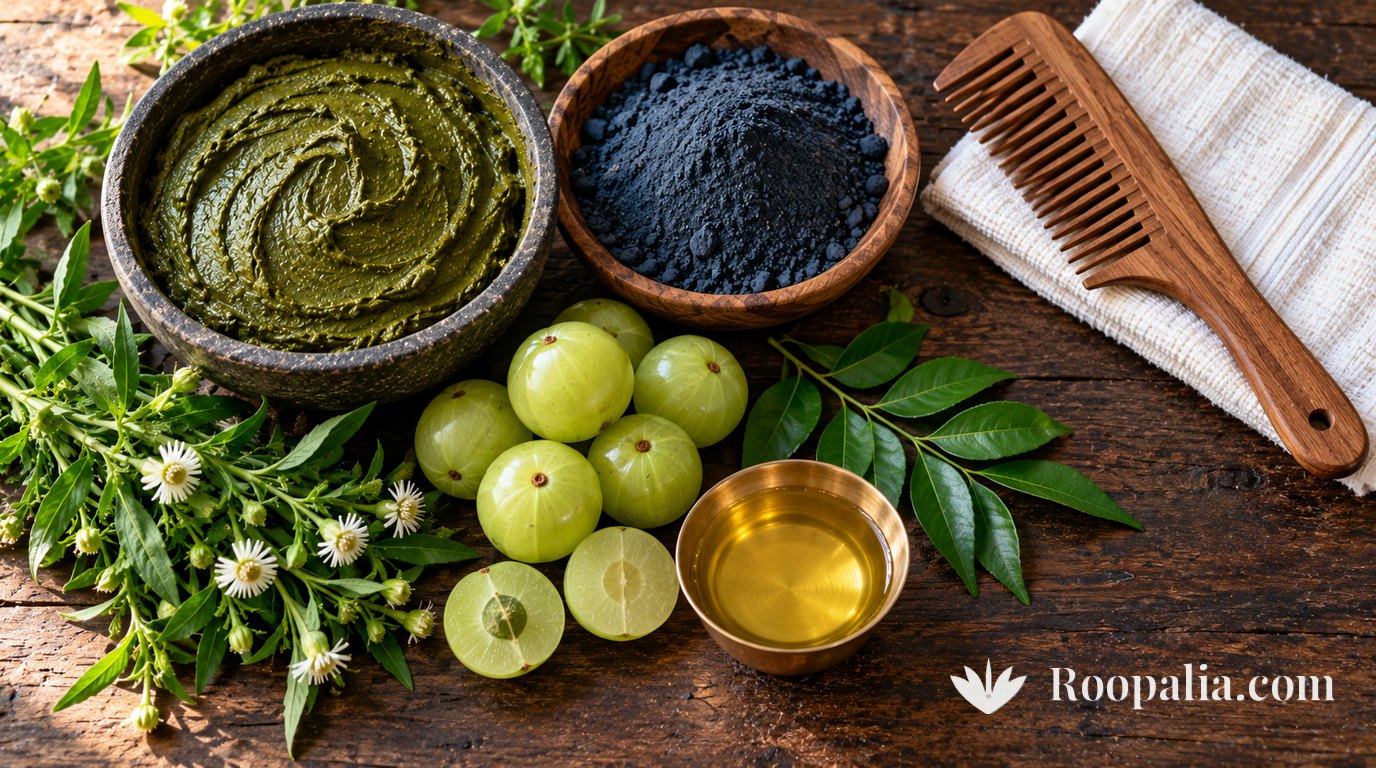
The searches tell the story. How to turn grey hair black naturally permanently. Can grey hair turn black again at a young age. Overnight. With coffee. Reddit. Somewhere between the first silver strand at the parting and the tenth, most of us type one of these — and get back a wall of videos promising that amla, bhringraj or a coffee rinse will bring the black back “from the roots”.
I wanted to know whether any of that holds up. So I went to the sources: the Indian Association of Dermatologists (IADVL), Cleveland Clinic, a study of 71 Indian patients, two recent medical reviews, the Harvard and Columbia stress studies — and the Charaka, Sushruta and Ashtanga Hridaya texts that these remedies are sold on. Here is what I found, and what I went looking for and did not find.
Can grey hair turn black again?
Mostly, no. A hair that has fully lost its pigment does not usually get it back. India’s dermatologists put it in six words:
“once a hair turns gray, it stays gray”
— Premature greying of hair, Indian Association of Dermatologists, Venereologists and Leprologists (courtesy: IADVL)Cleveland Clinic agrees: “You probably won’t be able to reverse any gray you already have.” And a 2025 review in Clinical, Cosmetic and Investigational Dermatology concludes that “no conclusive evidence exists that any specific food or supplement can reverse graying once it has occurred.”
That is not the whole answer, though. There are three real exceptions, and they are worth knowing before you spend months on a remedy:
- Greying from a treatable cause may improve. IADVL says greying linked to a vitamin deficiency, thyroid imbalance or autoimmune condition “might improve with the right treatment.”
- Some recently greyed hairs can regain colour — the stress study below.
- Colour can be added. Plant dyes — henna with indigo — can make grey hair brown to black. That is colouring, not reversal, but it is the only “natural” method I found that reliably works.
The study that watched grey hairs turn dark again
In 2021, researchers at Columbia University (first author Ayelet Rosenberg, senior author Martin Picard, published in eLife) mapped colour along the length of individual hairs from 14 volunteers, so that each hair worked like a timeline. In one person, “five hairs on that person’s head reverted back to dark during the vacation.” Greying and its reversal tracked periods of stress.
Before that becomes a headline, here is the senior author’s own caution:
“we don’t think that reducing stress in a 70-year-old who’s been gray for years will darken their hair.”
— Martin Picard, Columbia University Irving Medical Center (courtesy: CUIMC)A year earlier, a Harvard team had shown in mice that acute stress makes sympathetic nerves release norepinephrine, which drives the pigment stem cells to exhaust themselves. Senior author Ya-Chieh Hsu: “Once they’re gone, you can’t regenerate pigments anymore. The damage is permanent.” (courtesy: Harvard Gazette)
Put together: a hair that has just turned grey may, sometimes, come back if the stress lifts. A hair that has been grey for years will not. Neither study is a treatment.
So if the colour rarely comes back, the more useful question is why it left early in the first place — because some of those reasons can be tested and treated.
What deficiency causes premature grey hair?
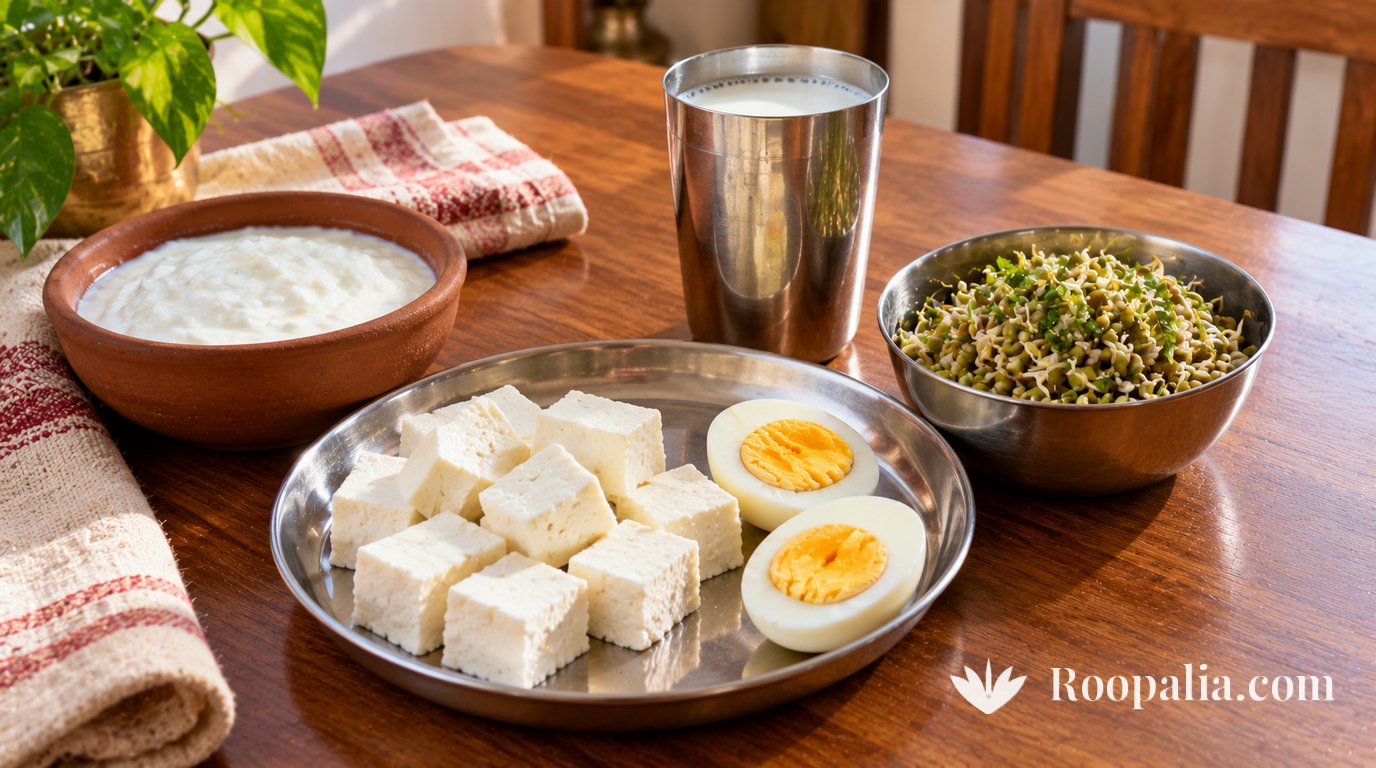
Hair gets its colour from melanin, made by pigment cells (melanocytes) in the hair follicle. When they make less, the hair comes in grey or white. IADVL lists the nutrients whose low levels “can affect melanin production and speed up graying”: vitamin B12, folic acid, biotin, iron and copper.
The strongest Indian evidence I found is a 2017 study in the Indian Journal of Dermatology of 71 patients who went grey before 25:
- Low vitamin B12 and hypothyroidism both showed a significant association with premature greying.
- Iron stores (ferritin) and anaemia did not. So the common advice that grey hair means “low iron” did not hold in this group.
- The authors’ recommendation: “Screening for serum Vitamin B12 levels and thyroid functions should be undertaken.” It was a retrospective clinic study without a control group, so treat it as a strong pointer, not proof.
One point matters especially in vegetarian Indian homes. The U.S. National Institutes of Health notes that B12 comes from milk and dairy, eggs, fish and meat, and that “Plant foods have no vitamin B12 unless they are fortified” (courtesy: NIH Office of Dietary Supplements). Dal, vegetables and sprouts will not fix a B12 shortfall. A blood test will tell you whether you have one; please do not start supplements on a guess.
Other causes
- Genes, first. IADVL: “If your parents or grandparents went gray early, you’re more likely to as well.”
- Smoking. IADVL: “smokers are more than 2 times as likely to develop gray hair early.”
- Thyroid disorders, both under- and over-active.
- Stress — “not the sole cause, but may accelerate graying in genetically prone individuals.”
- Autoimmune conditions such as vitiligo and alopecia areata.
Grey hair at a young age — in women, teens and children
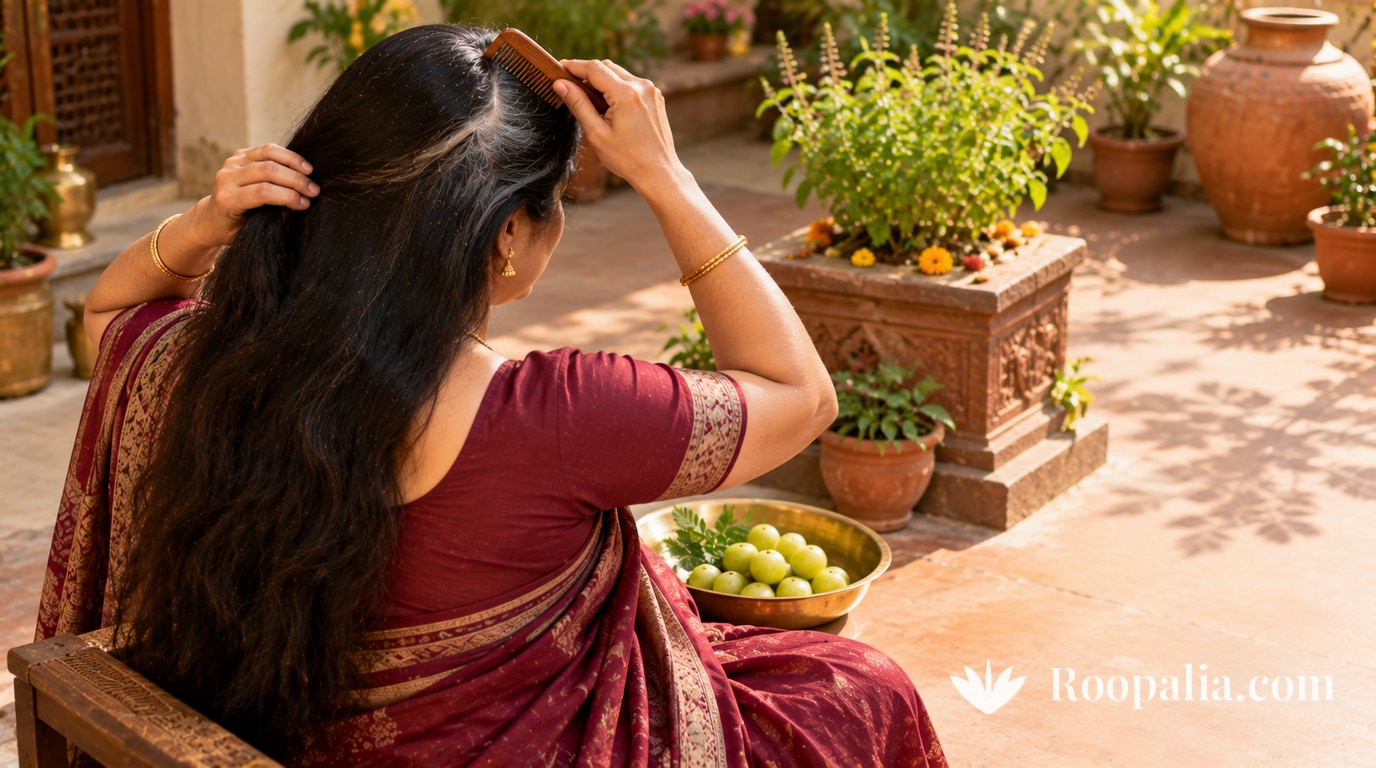
For people of Asian descent, greying before 25 is conventionally called premature (IADVL; the 2017 study used the same cut-off while noting that there is no settled threshold for Indians). The causes in women are the ones above. The searches for “in teens” and “in children” deserve one plain answer: if a child or teenager is going grey, see a paediatrician or dermatologist before trying any remedy, so that B12, thyroid and vitiligo can be checked. There is no home substitute for that check.
How to turn grey hair black naturally: henna and indigo
This is the one natural method that does what people want it to do. It colours the hair; it does not restore the hair’s own pigment.
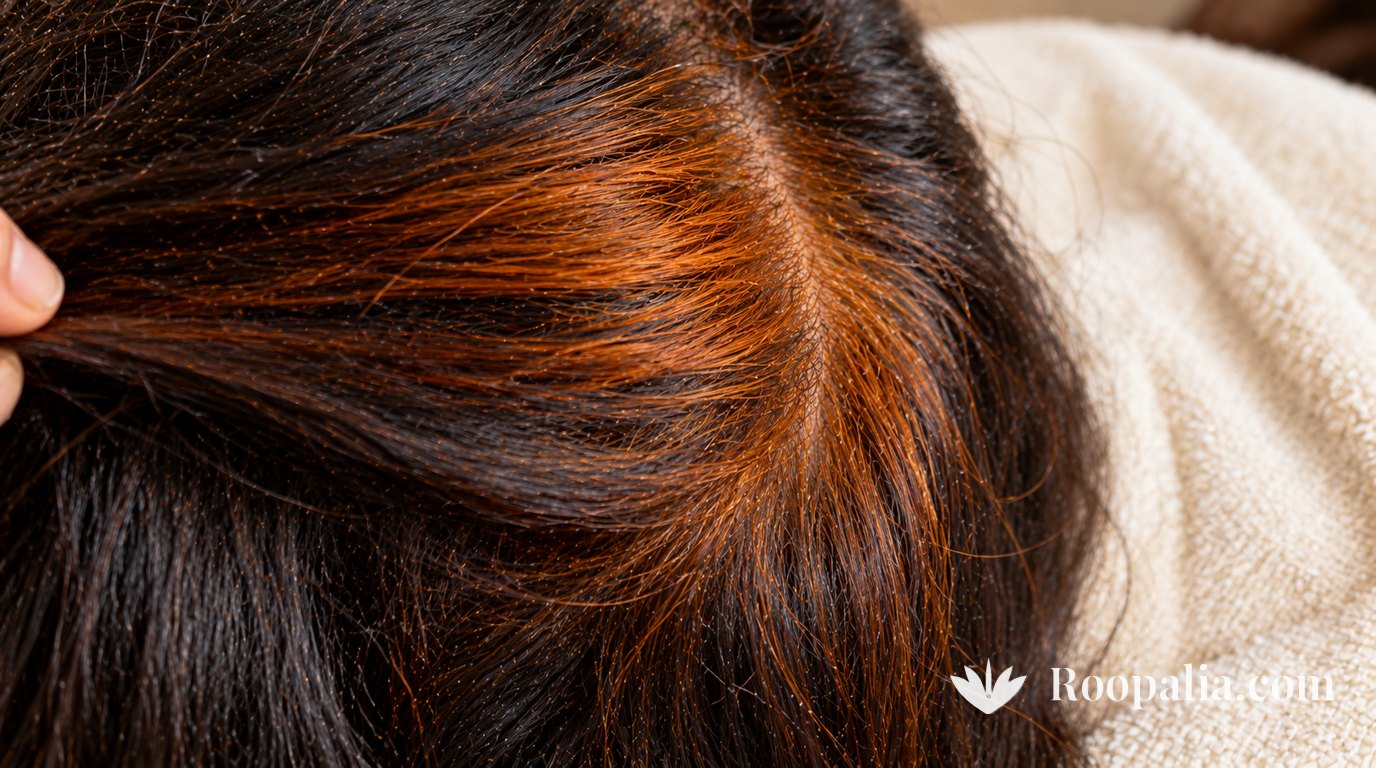
Henna leaves contain a dye called lawsone — about 1 to 2% of the dried leaf, according to the European Commission’s scientific committee on consumer safety (SCCS, 2013). It bonds chemically to the hair’s keratin and gives an orange colour. On dark hair that reads as a red glint; on grey hair it turns plainly copper-orange. To get brown or black you need indigo as well:
“The combination of both henna and indigo is used to create different brown to black shades”
— Dallmann, Vill & Straske, Cosmetics 12(3):99, 2025 (courtesy: MDPI)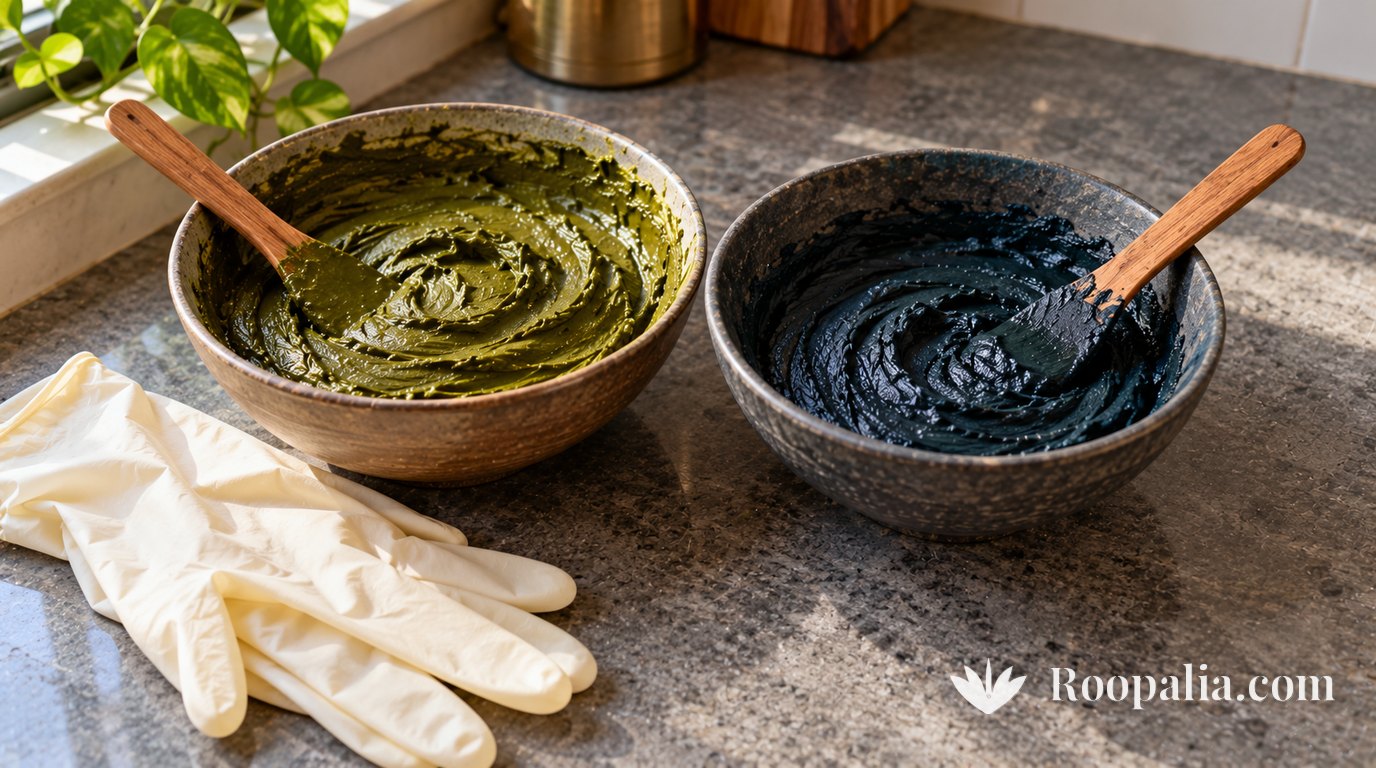
Henna and indigo: one-step or two-step?
Both are widely used at home:
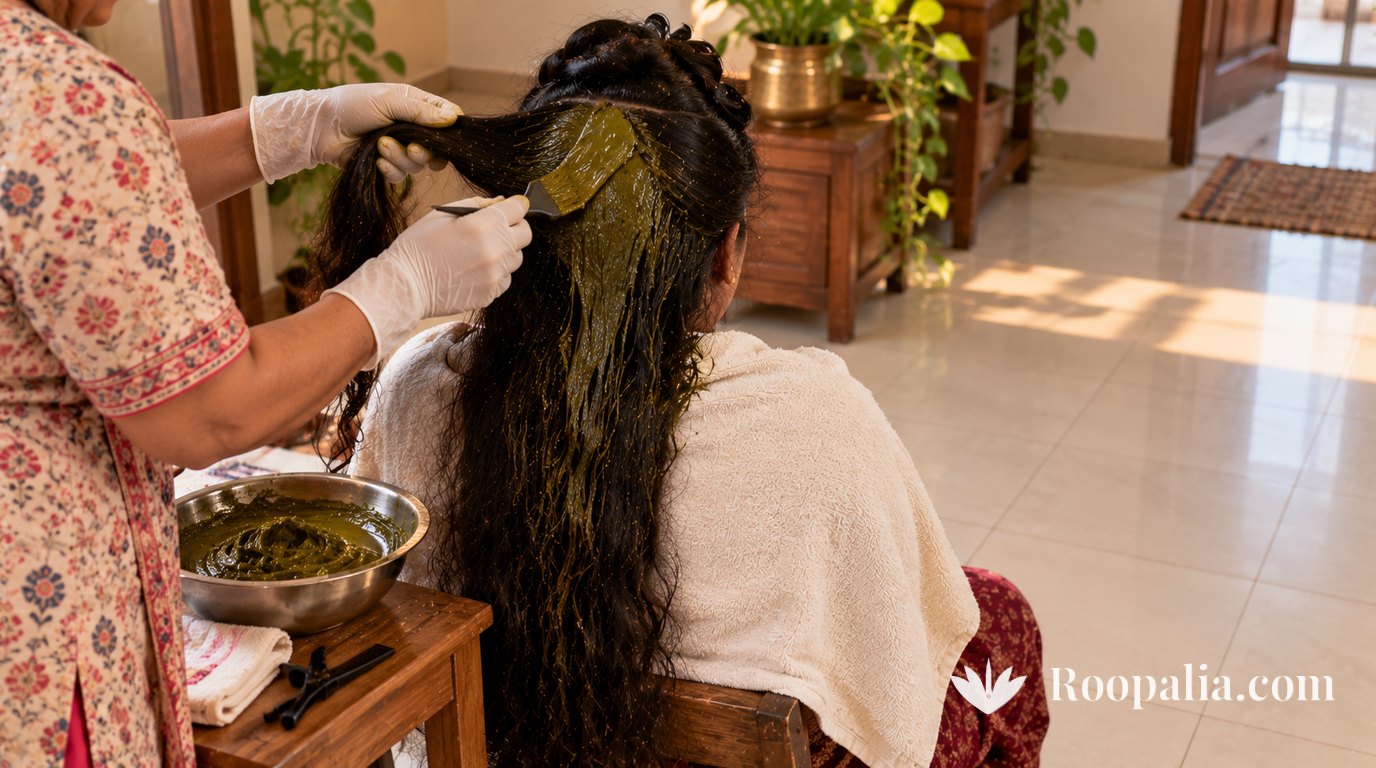
- Two-step: henna first, rinsed out, which turns the grey to copper; then indigo on top, which deepens the copper to dark brown or black.
- One-step: henna and indigo powders mixed into a single paste and applied once. The proportion decides how dark the result is.
I looked for an authoritative source — regulatory, medical or research — giving the order, ratios and timings for either method, and did not find one. What exists is blog posts and seller pages, and I am not going to turn those into hours and spoonfuls. The research confirms only that the combination produces brown to black. The SCCS assessment describes henna paste being left on the hair “for a period of 15 min to 2h”; for more on timing see our guide to how long to leave henna on. Beyond that, follow the instructions on the pack you are actually using.
Black henna is not henna
Anything sold as “black henna” that colours in minutes deserves suspicion. The U.S. Food and Drug Administration explains why:
“The extra ingredient used to blacken henna is often a coal-tar hair dye containing p-phenylenediamine (PPD), an ingredient that can cause dangerous skin reactions in some people.”
— Temporary Tattoos, Henna/Mehndi, and “Black Henna” Fact Sheet, FDA (courtesy: FDA)DermNet adds that after a reaction to a black henna tattoo, “lifelong sensitisation to PPD is likely” — which can make ordinary hair dye a problem for the rest of your life. Three habits protect you:
- Read the ingredient list. If it says p-phenylenediamine or PPD, it is not pure henna.
- Test every time. The FDA says to “Do a patch test on your skin every time before dyeing your hair”; the NHS suggests testing the dye on a strand of hair “at least 48 hours” before use.
- Never on brows or lashes. The FDA warns that dyeing them “can hurt your eyes and may even cause blindness.”
Coffee, amla, bhringraj, onion, curry leaves — tested
My test for each remedy was simple: did any reliable, openly available source report a human study in which it turned grey hair dark again?
| Remedy | The claim | What I found |
|---|---|---|
| Coffee / black tea rinse | Turns grey hair black, even overnight | No reliable source on colouring or reversal found. The 2025 review mentions caffeine only for hair growth. |
| Amla | Reverses grey from the roots | IADVL notes its traditional Ayurvedic use “to slow graying”, citing no human trial. No reversal study found. |
| Bhringraj (Eclipta alba) | Turns grey hair black | Listed in the 2025 review only as a natural dye source. No reversal study found. |
| Onion juice | Reverses greying | Discussed only for hair growth. Nothing on colour found. |
| Curry leaves | Boosts melanin | IADVL calls this “traditionally believed”. No evidence found. |
| Henna + indigo | Makes grey hair black | Yes, by colouring — brown to black (MDPI, 2025). Needs repeating. |
“Not found” is a report of a search, not a verdict that a remedy is useless. If amla in your diet or bhringraj oil on your scalp feels good, there is no harm in it. Just do not wait months for it to undo grey.
What Ayurveda actually says about grey hair (palitya)
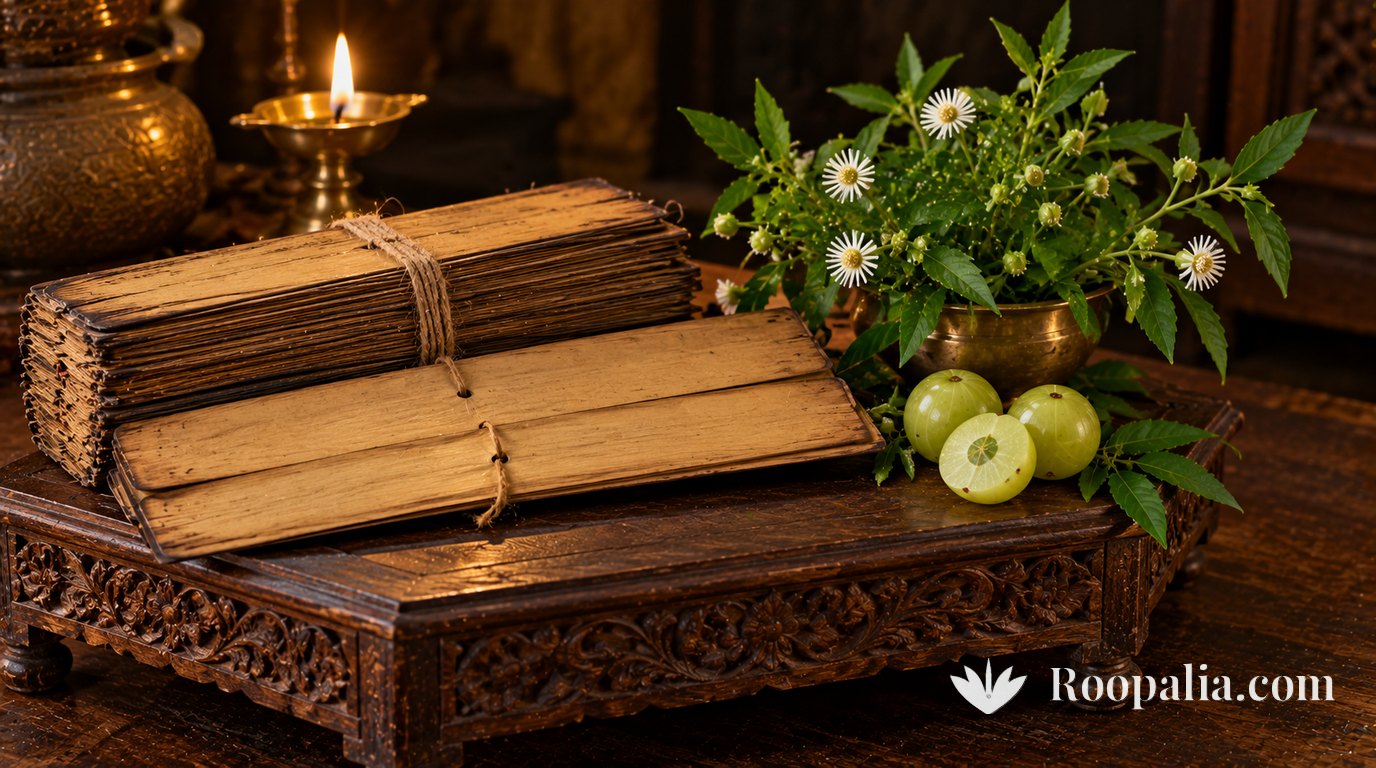
These remedies are usually sold “according to Ayurveda”, so I read the texts in translation on wisdomlib.org. The cause given by Sushruta is strikingly modern:
“The heat and Pitta of the body having recourse to the region of the head owing to overwork, fatigue … tend to make the hair prematurely grey”
— Sushruta Samhita, Nidanasthana 13 (“Palita”), tr. Kaviraj Kunja Lal Bhishagratna (courtesy: wisdomlib.org)He also names excessive grief and anger. On treatment, the texts say something the remedy videos leave out:
- Charaka Samhita, Chikitsasthana 26 (tr. Shree Gulabkunverba Ayurvedic Society, courtesy: wisdomlib.org), under “Treatment in Alopecia and Grey hair”, gives a “Great Black Oil” containing indigo, henna and amla juice, called “unsurpassed as a cure for grey hair” (verses 268–275½). A few verses later (281½) another preparation is described plainly as “an excellent hair-dye.”
- Sushruta Samhita, Chikitsasthana 25.18 describes an oil of bhringraj juice, triphala and indigo leaves that “arrests a premature greyness of the hair” (courtesy: wisdomlib.org).
- Ashtanga Hridaya, Uttarasthana 24 uses the verb for colouring: a paste of sesame, amla, lotus stamens, liquorice and honey “bṛṃhayedrañjayeccaitat keśān” — “it nourishes and colours the hair” (24.41); an iron-powder, bhringraj and triphala preparation “samūlaṃ palitaṃ rajet” — “colours the grey hair to the root” (24.43) (Sanskrit text courtesy: wisdomlib.org; meanings are Roopalia’s own, as I could not find a published translation that opens).
Not for your kitchen. The Great Black Oil also lists marking nut, iron sulphide and steel, and the Ashtanga Hridaya preparation keeps iron powder in sugarcane juice for a month. They are quoted here so you know what the texts say — not as recipes.
The one daily habit Charaka recommends
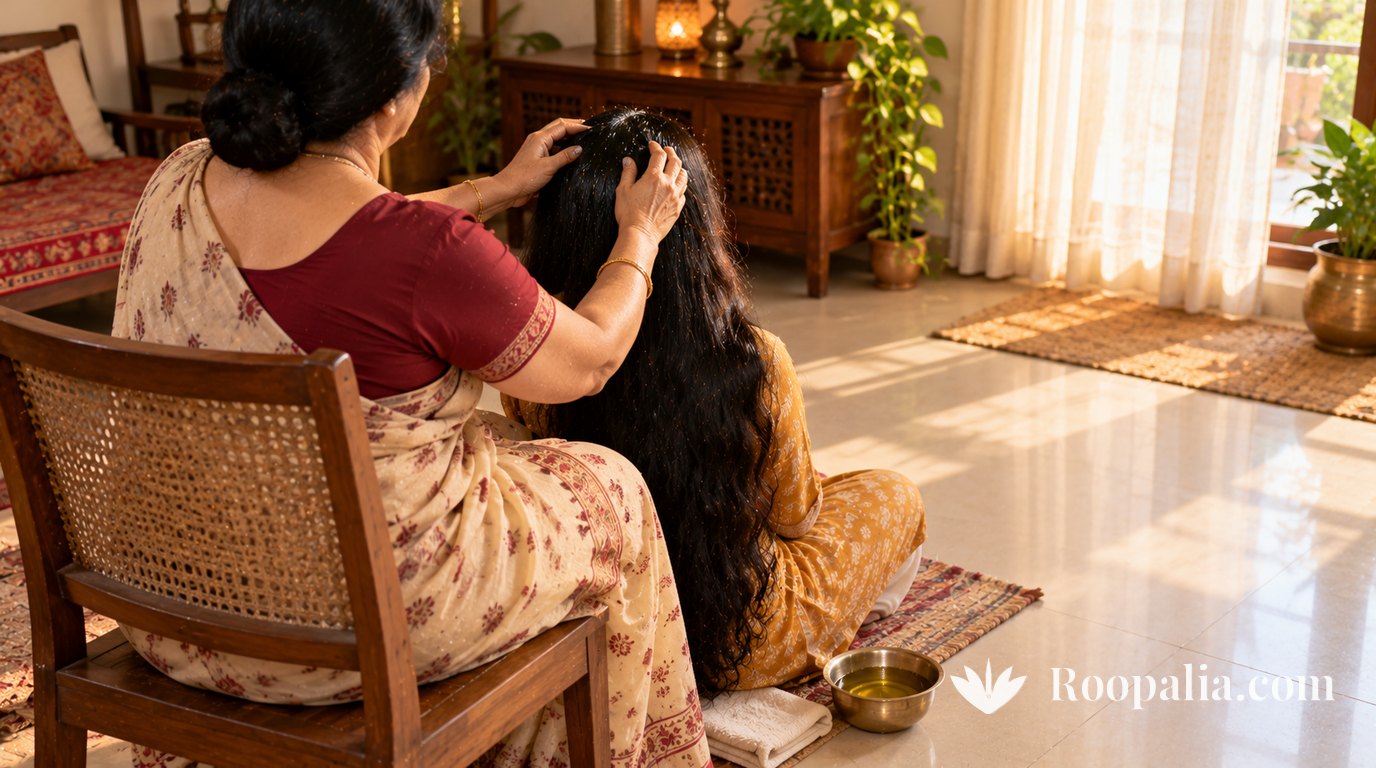
“One who has his head well oleated daily, does not get headache, baldness and grey hair nor does his hair fall off.”
— Charaka Samhita, Sutrasthana 5.80½–83, tr. Shree Gulabkunverba Ayurvedic Society (courtesy: wisdomlib.org)That is about prevention, not about turning existing grey black. I did not find a modern human study showing that head-oiling prevents greying, but a gentle scalp massage is pleasant and harmless on a healthy scalp.
Living outside India: henna, labels and the holiday “black henna” stall
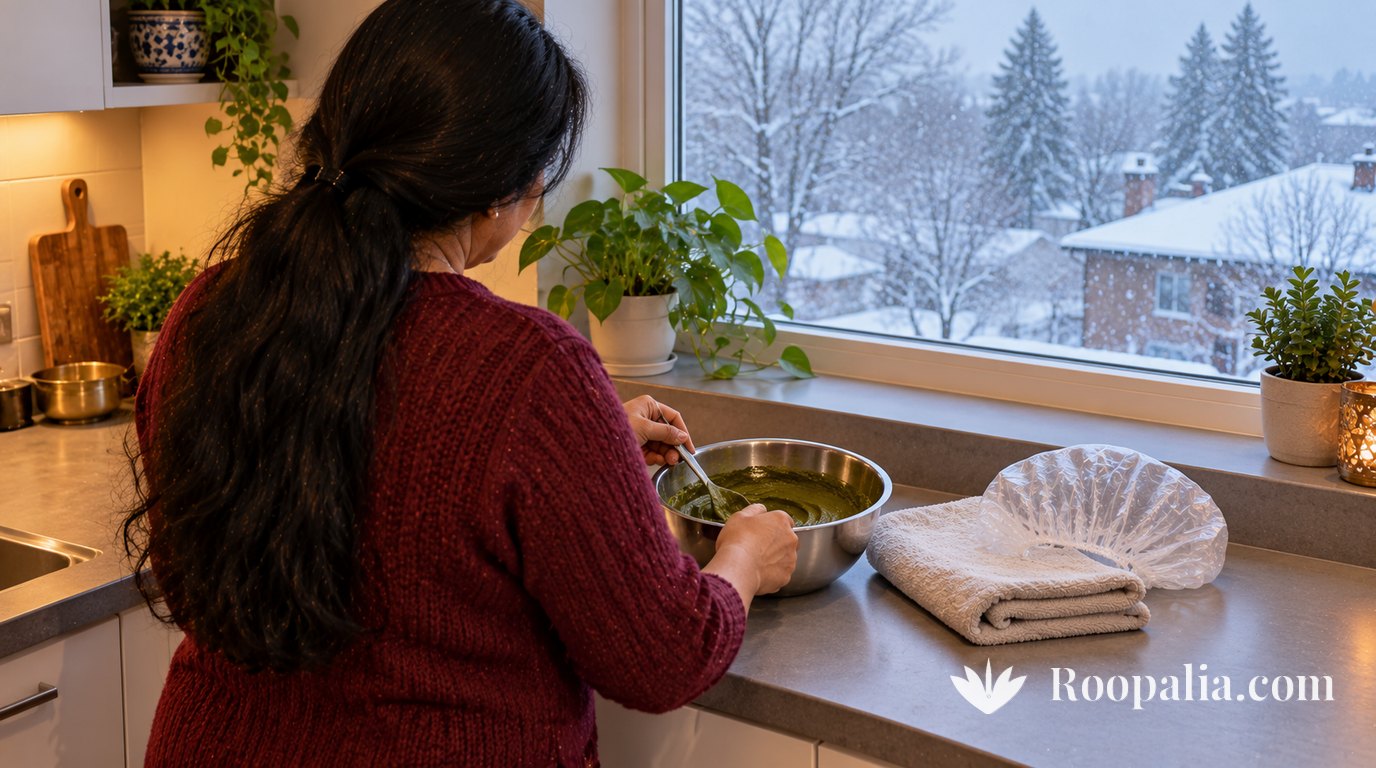
- Holiday stalls. The NHS warns that black henna tattoo paste contains “high levels of PPD”, which can make you react to hair dye later. Skip the ten-minute beach tattoo, and keep your children away from it too.
- Labels in English are your friend. In the US, the FDA approves henna only as a hair dye, not for direct use on skin. Check imported packs for p-phenylenediamine before use.
- A new pack means a new test — the 48-hour strand test, especially if you have changed product or country.
- Ask your GP or family doctor about B12 and thyroid tests if you went grey early. They are routine almost everywhere.
- Rented flats: henna stains pale grout, tiles and tubs quickly. Lay down an old towel and newspaper first.
More on keeping home rituals abroad: puja at home without a temple nearby.
When to see a dermatologist
- Greying is rapid, or comes with tiredness or weight gain (IADVL).
- It started before 25 — ask for B12 and thyroid tests (Indian Journal of Dermatology, 2017).
- A single patch of hair turns white — a 2024 Indian review advises checking the skin beneath for vitiligo.
- Itching, swelling or a rash after henna or dye. If your lips, tongue or throat swell or you struggle to breathe, the NHS treats that as an emergency.
What I looked for — found and not found
| Question | Result |
|---|---|
| Can grey hair turn black again permanently? | Rarely — IADVL, Cleveland Clinic, 2025 review. Deficiency-linked greying may improve. |
| Stress-related reversal | Partial — 14-person study; permanent in mice. |
| B12 and thyroid link | Found — 71 Indian patients, 2017. No link with ferritin. |
| Human study on coffee, amla, bhringraj, onion, curry leaves reversing grey | Not found. |
| Authoritative one-step / two-step henna-indigo method | Not found — blogs and sellers only. |
| Henna + indigo colouring grey hair brown to black | Found — MDPI 2025. |
| Palitya in Ayurveda | Found — Sushruta, Charaka, Ashtanga Hridaya; the texts themselves speak of colouring. |
The bottom line. I found no home remedy, modern or classical, shown to turn grey hair permanently black “from the roots”. What works naturally is colour: pure henna with indigo, patch-tested every time, never “black henna”.
If you went grey before 25, quickly or in a patch, the first step is a doctor and a B12 and thyroid test, not the spice cupboard. If your hair is thinning too, read hair fall in women: causes, diet and treatment.
Frequently asked questions
Can grey hair turn black again naturally?
How to turn grey hair black naturally and permanently at home?
Can grey hair turn black again at a young age?
What deficiency causes premature grey hair?
Does coffee turn grey hair black?
Should I use henna and indigo in one step or two steps for grey hair?
What causes premature grey hair in women?
Is black henna safe for grey hair?
Sources and cautions: the health information was checked against the sources cited — IADVL (Indian Association of Dermatologists, Venereologists and Leprologists), Cleveland Clinic, the Indian Journal of Dermatology 2017 study of 71 patients, the 2025 review in Clinical, Cosmetic and Investigational Dermatology, FDA, NHS, DermNet, NIH Office of Dietary Supplements, the EU SCCS opinion on henna (2013), Cosmetics (MDPI, 2025), Harvard Gazette and Columbia University Irving Medical Center. Textual references: Charaka Samhita Sutrasthana 5 and Chikitsasthana 26, tr. Shree Gulabkunverba Ayurvedic Society; Sushruta Samhita Nidanasthana 13 and Chikitsasthana 25, tr. Kaviraj Kunja Lal Bhishagratna; Ashtanga Hridaya Uttarasthana 23–24 (Sanskrit only; meanings Roopalia’s) — all courtesy: wisdomlib.org. Three things should be said plainly. First, I did not find a human study showing coffee, amla, bhringraj, onion or curry leaves turning grey hair dark, or an authoritative source for one-step or two-step henna-indigo methods; that is the result of a search, not a final verdict. Second, the classical preparations (with marking nut and iron) are quoted, not recommended. Third, this is not medical advice; see a doctor for early, rapid or patchy greying, greying in children, or any reaction to dye. No brand or shop is recommended.