
Why Indian families oil-massage their babies
In much of India a newborn is massaged with oil once or twice a day, often by a grandmother, often in the winter sun before the bath. The beliefs that come with it are familiar to most Indian parents:
- that oil keeps the baby warm in winter and the skin soft;
- that massage makes the bones and muscles strong and helps the baby walk early;
- that it helps the baby sleep and settles the tummy;
- in some homes, that a few drops of oil in the nose and ears keep colds away.
The oil depends on the region: mustard oil across much of north India and Nepal, coconut oil in the south, sesame oil in many homes in winter. Some families also rub the newborn with bukwa, a coarse paste of mustard oil with grains and herbs. Some of these beliefs hold up, some do not, and one of them is dangerous. That is what the rest of this article sorts out.
What the health bodies say
Read them in the original: NHS, Bathing your baby, NCT, Baby massage and Pregnancy, Birth and Baby (Healthdirect Australia). Notice that none of them says “don’t massage”. The disagreement with grandma is about the oil and the first four weeks, not about the massage itself.
Is mustard oil safe for baby massage?
Mustard oil is the oil most studied for baby massage, because so many South Asian families use it. The short answer: it is not poison, but on a newborn’s thin skin it is not the best choice.
- In the lab: a 2002 study on mice (Darmstadt and colleagues, Acta Paediatrica) found that sunflower oil sped up the repair of damaged skin, while mustard, olive and soybean oil slowed it down. Researchers now at Stanford Medicine also saw damage to the skin’s main cell type with mustard oil.
- In Uttar Pradesh, India: a trial of more than 26,000 newborns in rural villages from November 2014 to October 2016 swapped mustard oil for sunflower oil in half the villages. Babies who got only sunflower oil had 36% fewer hospital admissions and 44% less illness in the first month, but across all babies, deaths did not differ between the groups (Stanford Medicine Children’s Health).
- In Sarlahi, Nepal: a trial across 340 communities (Katz and colleagues, BMJ Global Health, 2024) found no overall effect of switching from mustard to sunflower oil. A related study of 995 babies (Summers and colleagues, BMC Pediatrics, 2019) concluded that the type of oil may still affect skin health.
The researchers in India were clear that the aim was never to stop the massage, only to change the oil and make the strokes gentler, and to keep mustard oil and bukwa scrubbing away until after the newborn period. That is a useful line to quote at home.
Coconut oil or olive oil: which is better for babies?
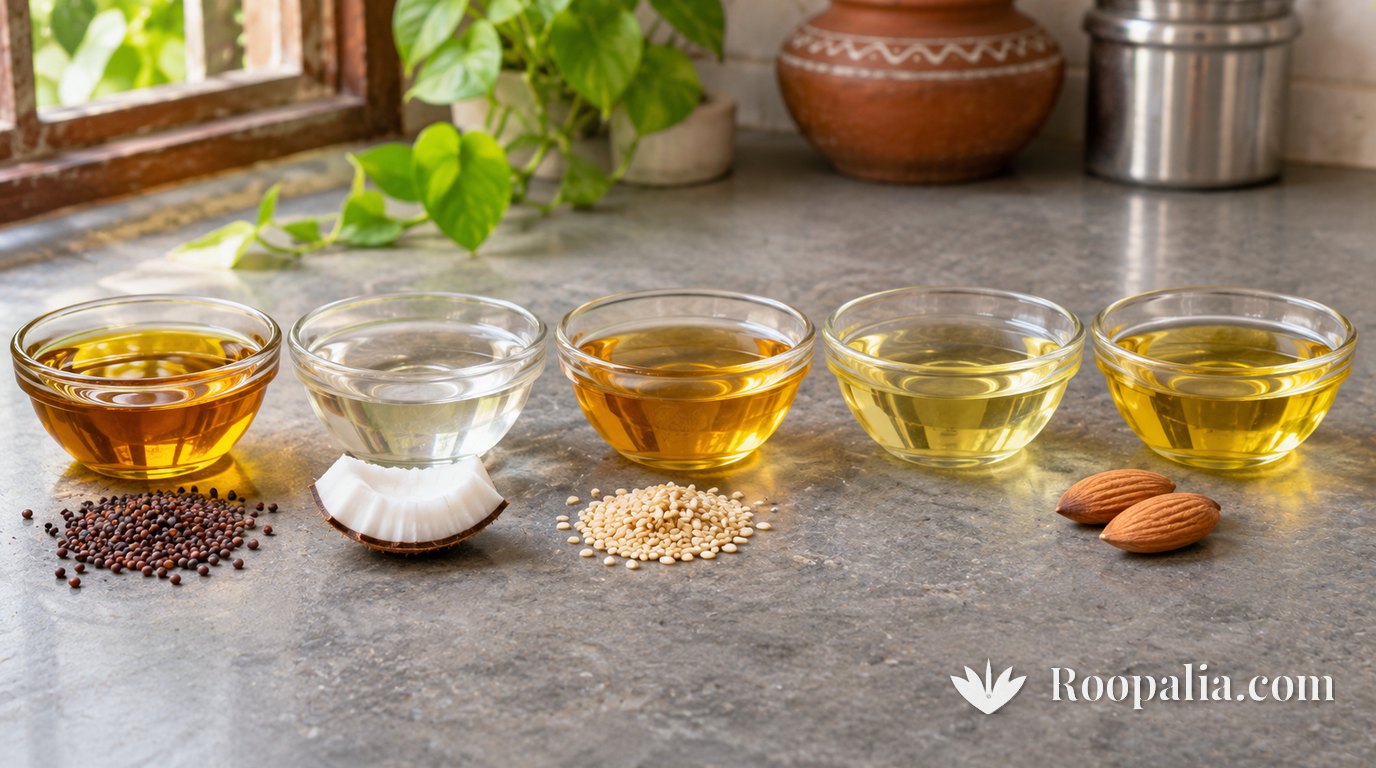
Olive oil is the oil many parents abroad reach for, because it is in every kitchen. The evidence leans against it for newborns. In a 2015 University of Manchester pilot trial, 115 newborns had a few drops of olive oil, sunflower oil or nothing applied twice a day for 28 days. Both oil groups developed their skin barrier more slowly than the no-oil group, even though their skin was better hydrated, and the lead researcher, Alison Cooke, advised that the two oils should be avoided on newborn skin until more is known (University of Manchester). NCT also lists olive oil among the oils to avoid.
Coconut oil has better support from Indian hospital studies. At AIIMS, New Delhi, coconut oil applied to very low birth weight premature babies reduced water loss through the skin without increasing bacteria on it (Nangia and colleagues, Journal of Tropical Pediatrics, 2015). An earlier study in an Indian teaching hospital (Sankaranarayanan and colleagues, Indian Pediatrics, 2005) found better weight gain with coconut oil massage than with mineral oil or powder. These were small studies, but they point in a reassuring direction.
Notice that sunflower oil appears on both sides: good in the India and lab studies, not good in the Manchester trial. The honest summary is that no single oil has been proven best for a healthy full-term baby, which is exactly why the first month without oil is the safest common ground.
What to keep and what to change
The last row matters most. A 1973 study from South India in the British Medical Journal (Balakrishnan) described pneumonia caused by oil getting into the lungs as a common cause of illness and death in infants there, linked to the custom of cleaning the baby’s nose and mouth with oil. In 2015, doctors at Sir Ganga Ram Hospital, New Delhi reported a ten-month-old girl with severe breathing failure after baby massage oil went down her throat (Indian Pediatrics). Oil is for the skin only.
How to talk to the elders about it
Most of the friction is not about oil at all; it is about who knows best. A few things that tend to help:
- Start with what you are keeping. “We want you to massage the baby every day” lands better than “not that oil”.
- Give a date, not a ban. “From next month, once the baby is four weeks old” sounds like a plan, not a rejection of the tradition.
- Use the Indian research. The sunflower oil trial ran in villages in Uttar Pradesh, with Indian doctors and community workers. It is not a foreign idea imposed on Indian babies.
- Make the nose and ears a firm line, and explain why in one sentence. Everything else can bend a little.
Massaging a baby through a winter abroad
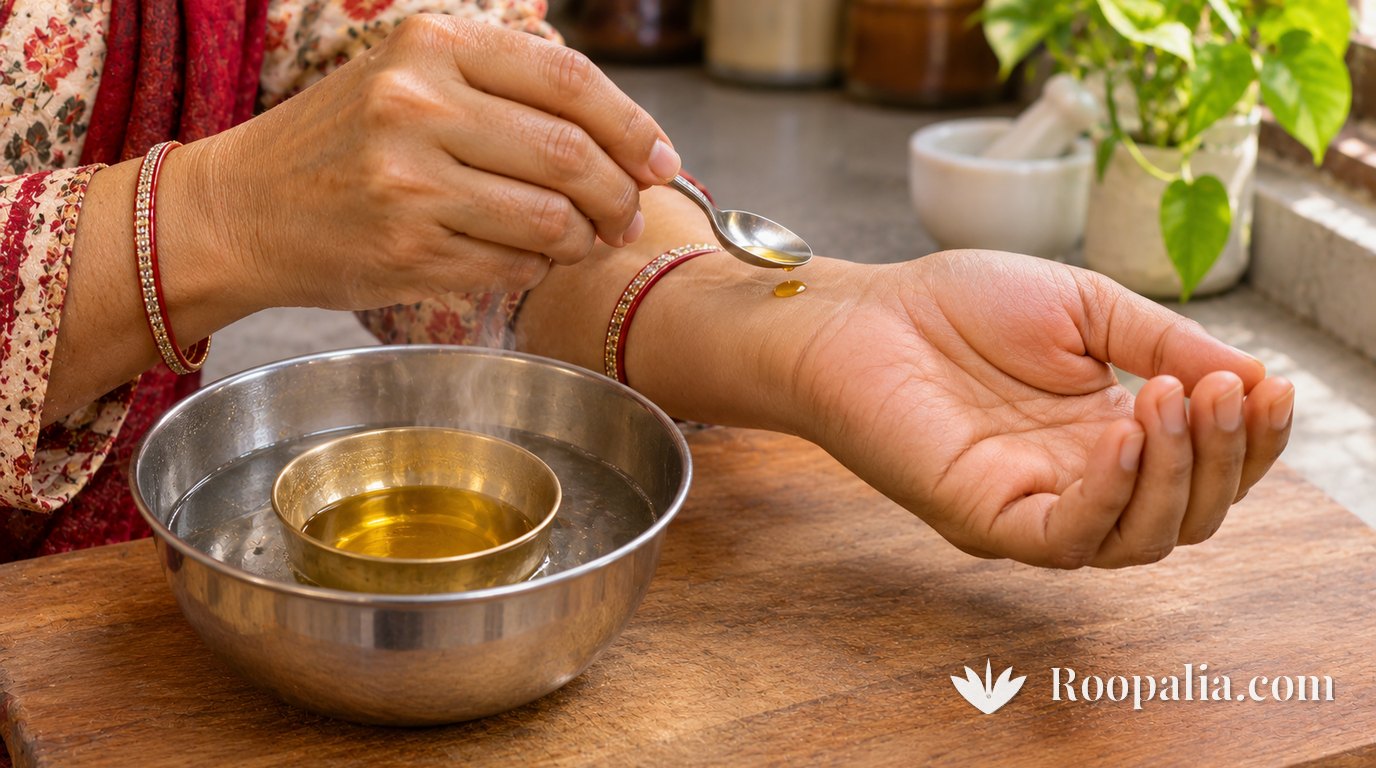
- Warm the oil, not heat it. Stand the bowl in hot water for a few minutes; coconut oil that has set in a cold kitchen melts the same way. Test a drop on the inside of your wrist.
- Patch-test any new oil on a small area of the leg and wait a day before using it all over.
- Keep the room warm and the baby away from heaters and radiators. Have clothes and a towel within reach so the baby is covered as soon as you finish.
- Pick a calm moment: not straight after a feed, and not when the baby is hungry, tired or unwell.
- Strokes: legs from thigh to ankle, gentle clockwise circles on the tummy once the cord has healed, chest out towards the shoulders, back from neck to bottom. Keep oil off the face and hands, which go straight into the mouth.
Born early, very small, or with eczema or another skin condition? Then the oil and massage plan is a question for your baby’s doctor, not for this article.
The Indian maalish is touch, warmth and a grandparent’s attention given every day, and none of the health bodies quoted here asks you to give that up. What the evidence asks is smaller: wait a month for oil, choose a light plain oil, keep the hands soft, and keep everything out of the nose and ears.
Frequently asked questions
Can we use mustard oil for baby massage in winter?
Is it okay to massage a baby every day?
Can I massage a baby with coconut oil in winter?
Should I put oil in my baby’s nose or ears?
Is almond oil safe for baby massage?
How long should a baby massage be, and until what age?
Sources: NHS (Bathing your baby); NCT (Baby massage); HSE Ireland; Pregnancy, Birth and Baby (Healthdirect Australia); Cooke et al., University of Manchester, Acta Dermato-Venereologica 2016; Uttar Pradesh trial, PLOS Medicine 2021 and American Journal of Clinical Nutrition 2022 (courtesy: Stanford Medicine Children’s Health); Katz et al., BMJ Global Health 2024; Summers et al., BMC Pediatrics 2019; Darmstadt et al., Acta Paediatrica 2002; Nangia et al., Journal of Tropical Pediatrics 2015; Sankaranarayanan et al., Indian Pediatrics 2005; Balakrishnan, British Medical Journal 1973; Sachdev et al., Indian Pediatrics 2015. General information only; for a premature, low-weight or unwell baby, please ask your doctor. The images in this article are AI-generated illustrations to explain the topic.