The kheer is ready, the grandparents are on a video call, and someone has just asked whether the baby’s first spoonful should have a little honey in it “for luck”. It is the most important question of the day, and the answer is a firm no.
Annaprashan — literally “feeding of grain” — is the Hindu ceremony in which a baby eats solid food for the first time. This guide covers the questions families actually search for: what to feed, whether honey or sugar is safe, which month for a boy or a girl, who feeds the baby, and how to hold it simply at home.
One finding surprised me: an old Vedic rite asks for the first food to be mixed with an ingredient that paediatric guidance now forbids before the first birthday. It is the first thing below.
Can a baby have honey or sugar at annaprashan?
No honey, and no added sugar. The NHS states: “Do not give your child honey until they’re over 1 year old,” because honey can contain bacteria that produce toxins in a baby’s intestines and cause infant botulism, a very serious illness. It also notes that babies do not need sugar, and that salt is not good for their kidneys (courtesy: NHS).
Here is the surprise: the Śāṅkhāyana Gṛhya Sūtra (1.27), in Hermann Oldenberg’s translation, describes preparing the baby’s first food with curds, honey and ghee (courtesy: sacred-texts.com). Nobody then knew about botulism; we do now. Keep the spirit of the rite and leave the honey out.
| Food | At about 6 months | Why (NHS / WHO) |
|---|---|---|
| Mashed rice, moong dal water or soft khichdi | ✅ Yes | Soft and easy to swallow; WHO advises starting with mashed and semi-solid foods |
| A little unsweetened rice kheer, mashed | ✅ Yes, a little | The traditional first spoonful |
| Mashed banana, soft-cooked sweet potato or carrot | ✅ Yes | The NHS suggests soft-cooked vegetables and fruit as first foods |
| Honey | ❌ No | Not before 12 months — infant botulism risk |
| Sugar | ❌ No | Babies do not need it |
| Salt | ❌ No | Not good for a baby’s kidneys |
| Whole nuts, raw carrot, whole grapes | ❌ No | Choking risk; nuts only ground |
| Tea or coffee | ❌ No | WHO: avoid low-nutrient drinks |
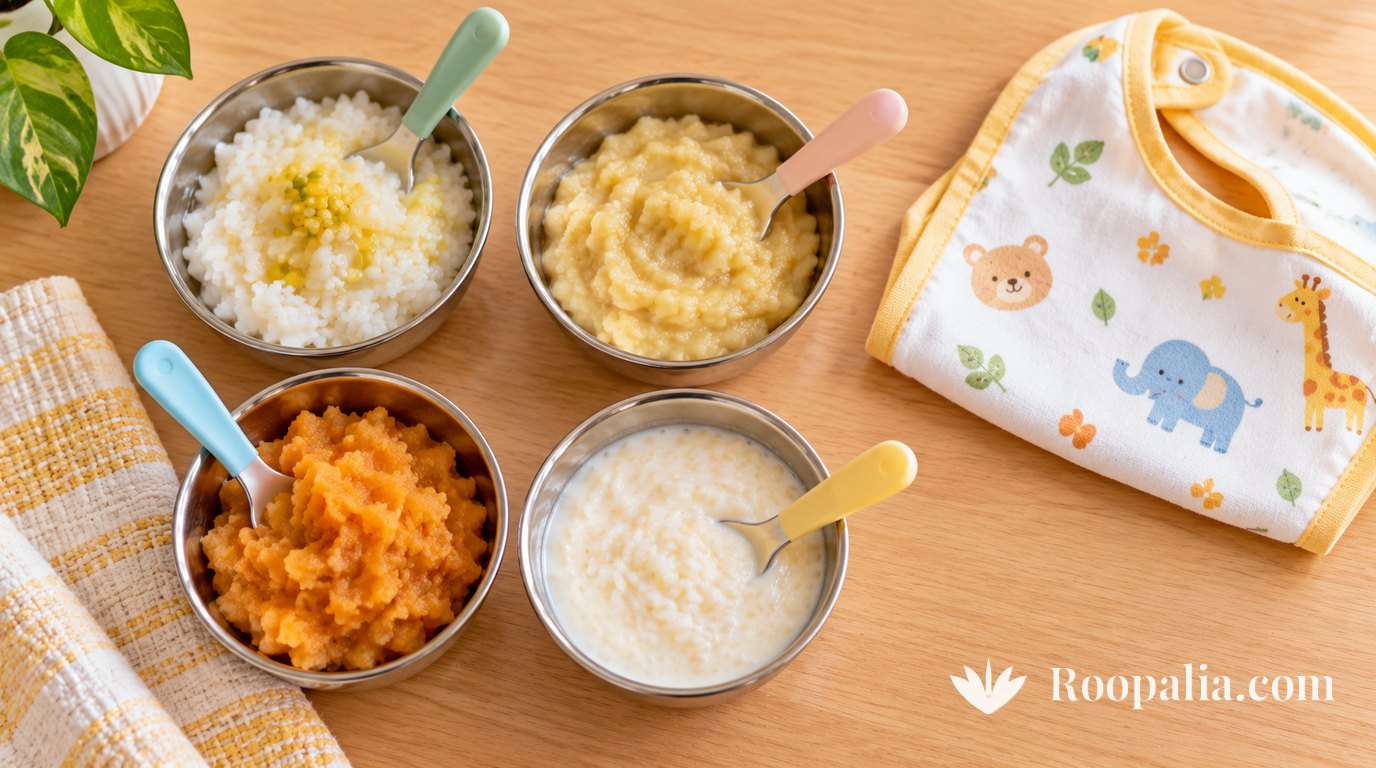
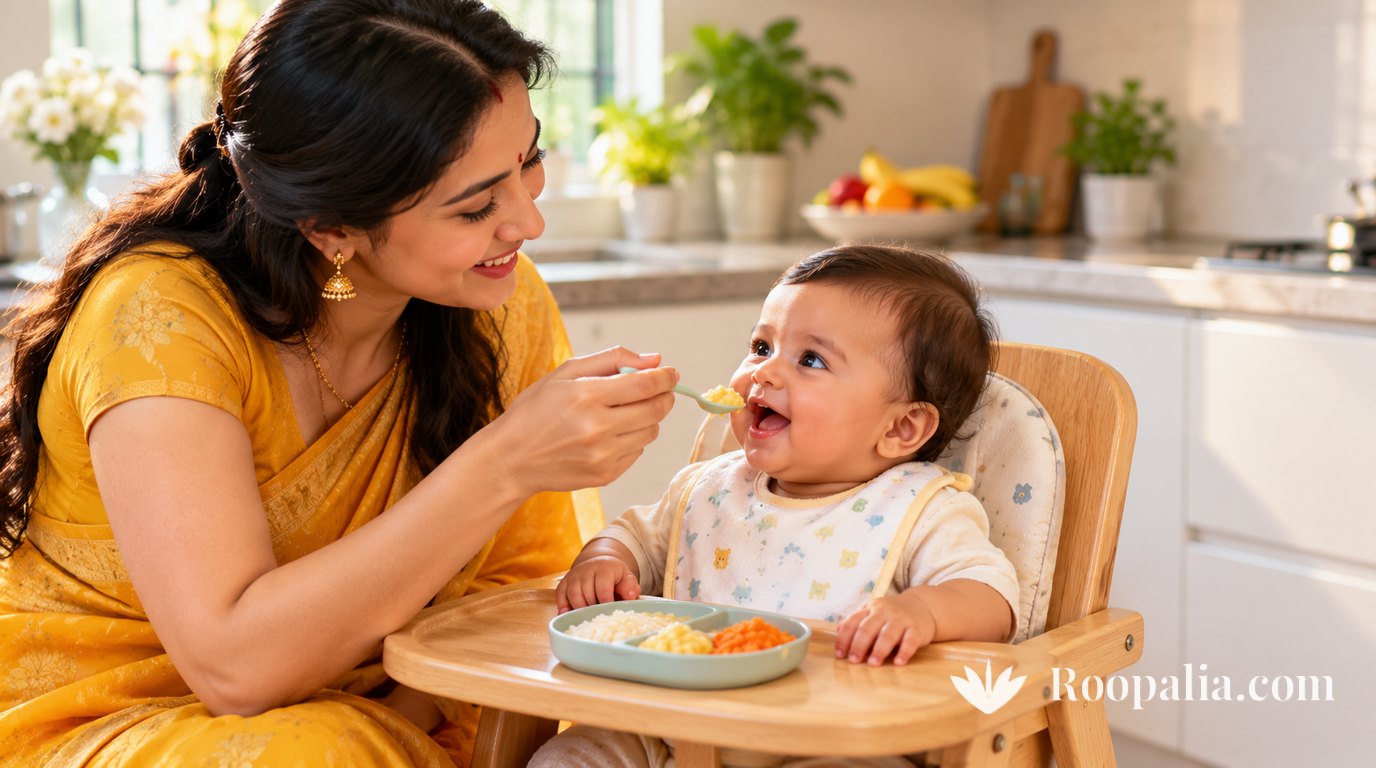
Making the baby’s kheer: cook rice in milk until very soft, mash it well and add no sugar; stir in mashed banana if you want sweetness. Make a separate, sweetened kheer for the puja offering and the guests. One or two small spoonfuls are plenty for the baby, and someone should stay right beside them while they eat.
Is my baby ready? Which month is right?
The WHO recommends that babies start complementary foods at 6 months, alongside breast milk (courtesy: WHO). Both Grihya Sutras I checked also place annaprashan in the sixth month — a neat agreement between tradition and modern advice.
The NHS lists three signs of readiness that should appear together: the baby can sit up and hold their head steady, can coordinate eyes, hands and mouth, and swallows food rather than pushing it out (courtesy: NHS). If your baby was born early or has a health condition, check with your paediatrician first.
Annaprashan month for a baby boy or girl
| Tradition | Girl | Boy |
|---|---|---|
| Bengali and Telugu families | Odd month — 5th or 7th | Even month — 6th or 8th |
| Kerala (Malayali) | 5th month | 6th month |
| Grihya Sutras (Pāraskara, Śāṅkhāyana) | The sixth month for both | |
Regional customs from Wikipedia (courtesy: Annaprashana); the sutras I checked make no distinction by sex. If the ceremony falls in the fifth month, keep the first spoonful to a token taste and begin regular solids at around six months.
Who feeds the baby at annaprashan?
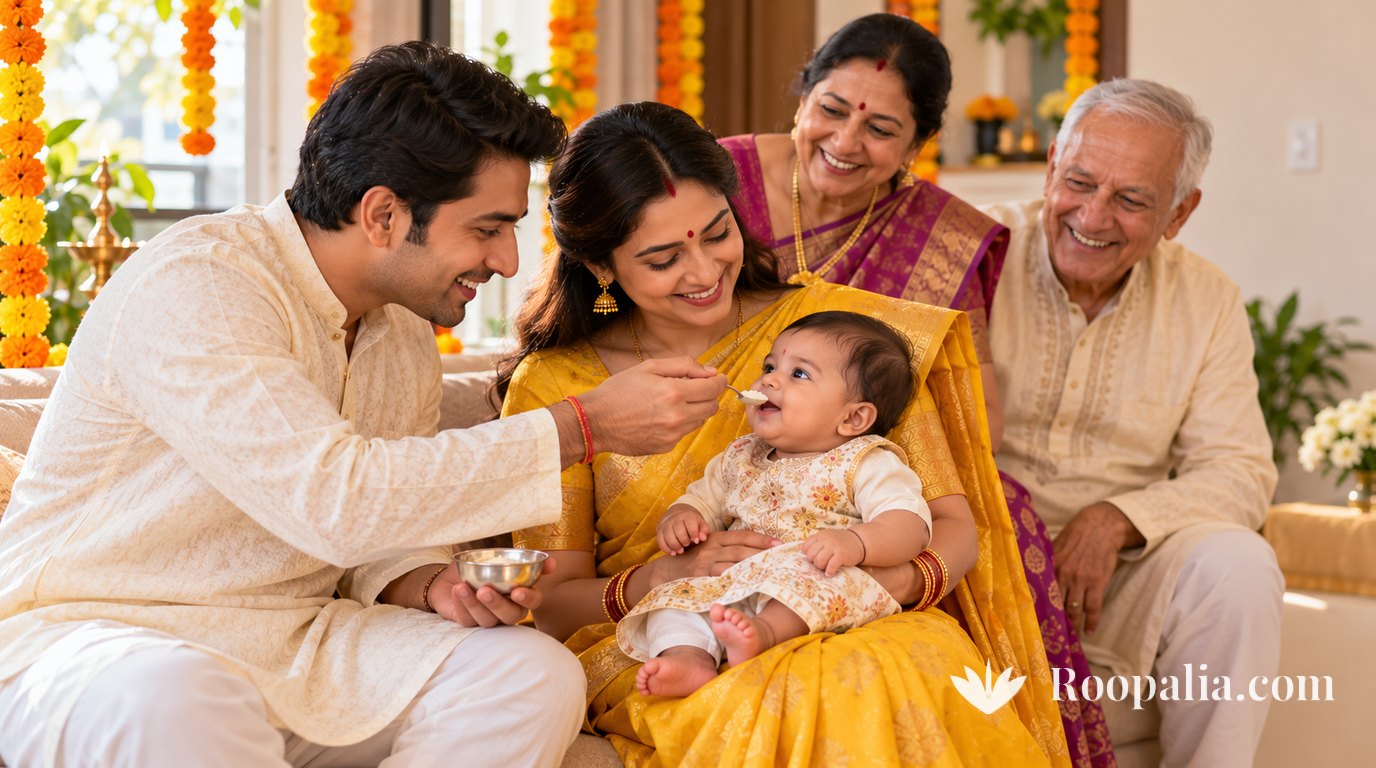
In the Pāraskara Gṛhya Sūtra (1.19) it is the father, who eats first and then sets aside food of every kind and flavour for the child. In the Śāṅkhāyana version, the mother eats what remains. Today it varies by region: in Bengal and many other places the maternal uncle gives the first bite — one Bengali name for the day, mamabhat, means “the uncle’s rice” — while other families honour a grandparent or the eldest relative. Whatever your family does is right; just keep each person’s taste tiny.
Then comes the moment every camera waits for.
The annaprashan plate: book, pen, coins and soil
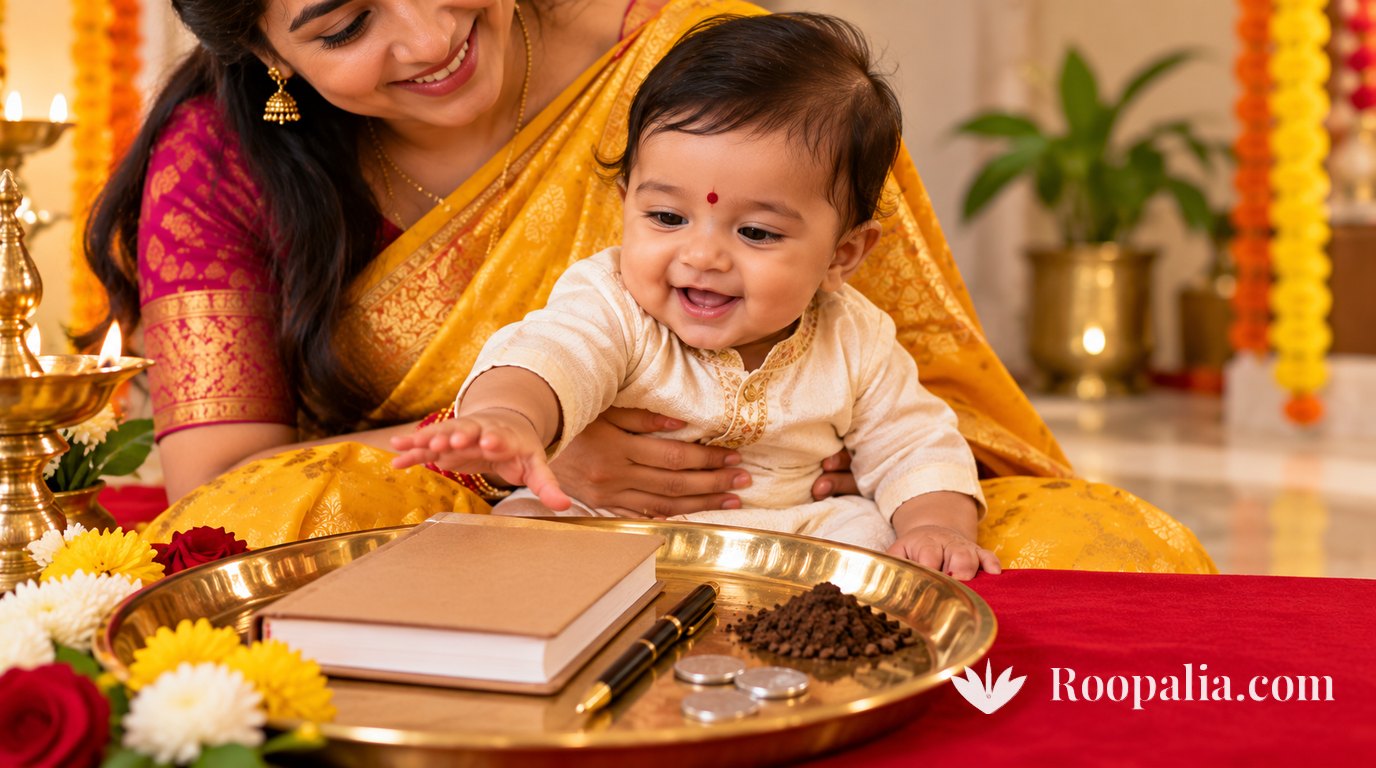
In Bengali tradition the baby is offered a plate holding soil (property), a book (learning), a pen (wisdom) and coins (wealth); whatever the baby grabs first is said to hint at their future (courtesy: Wikipedia). It is a playful blessing, not a prophecy, and I did not find it in the Grihya Sutra passages I checked. Keep a hand close — coins and pen caps are choking hazards — and put the plate away straight after.

A simple annaprashan at home
- Timing: bathe and dress the baby in soft new clothes, and pick a time after a nap — a tired or ravenous baby will cry.
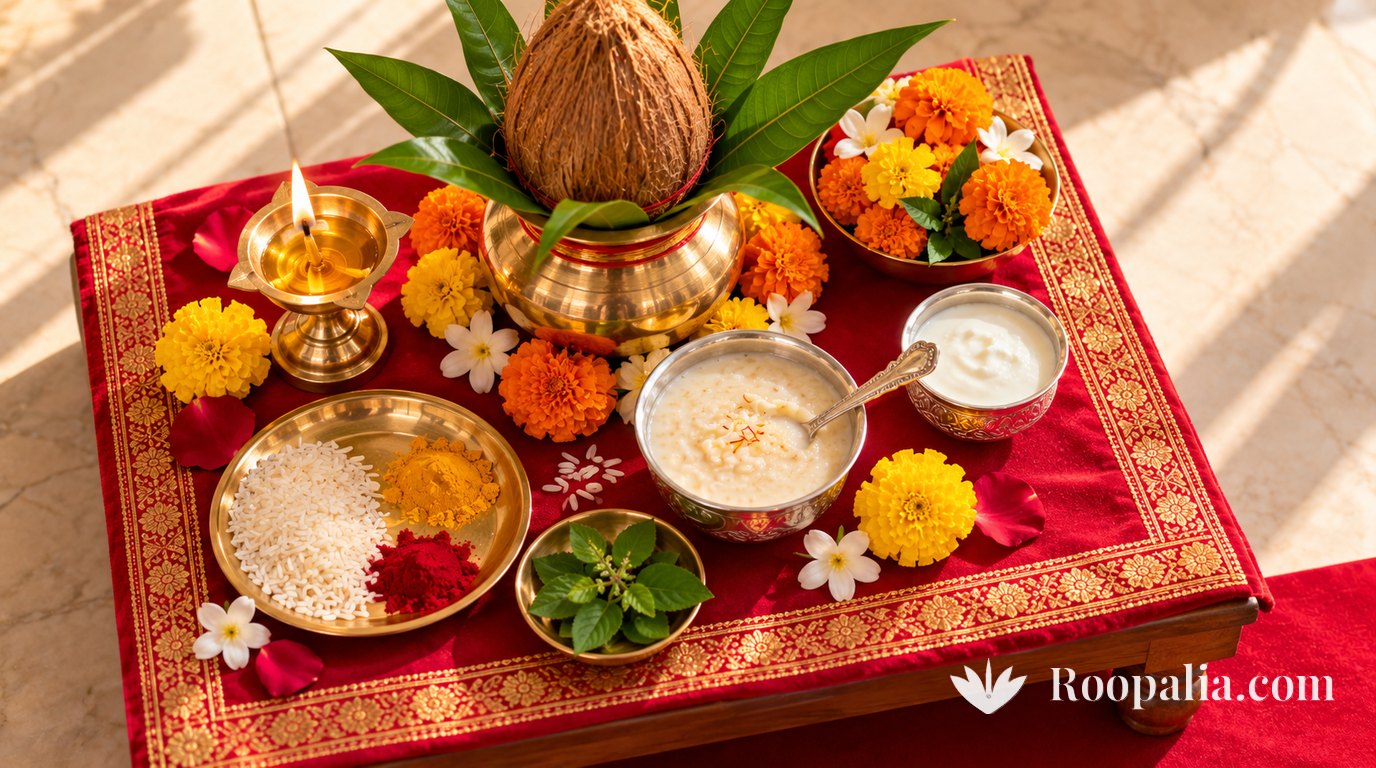
- Puja: place a kalash, a picture of Ganesha or your family deity and a ghee diya on a low stool, and pray together. For a small fire ritual, see havan at home without a pandit.
- Seat the baby on the mother’s lap or a soft cushion; the Śāṅkhāyana rite seats the child on kusha grass, so some families tuck a blade under the cloth.
- The first bite: the father, maternal uncle or eldest gives one small spoonful of plain kheer, taking God’s name — the sutra’s prayer is “Lord of food, give us food.”
- Blessings from the rest of the family, with only a token taste or none at all.
- The plate game, if you wish.
- Feed your guests — the old rite also ends with a meal.
Samagri: kalash, water, mango leaves, coconut, sacred thread; a deity picture, red cloth and stool; rice, turmeric, kumkum, flowers, tulsi, ghee diya, incense; a small bowl and spoon for the baby; plain kheer or mashed rice; book, pen, coins and soil for the plate.
Annaprashan outside India
- Keep it small: no priest is needed for the simple version above; see also puja at home without a temple nearby.
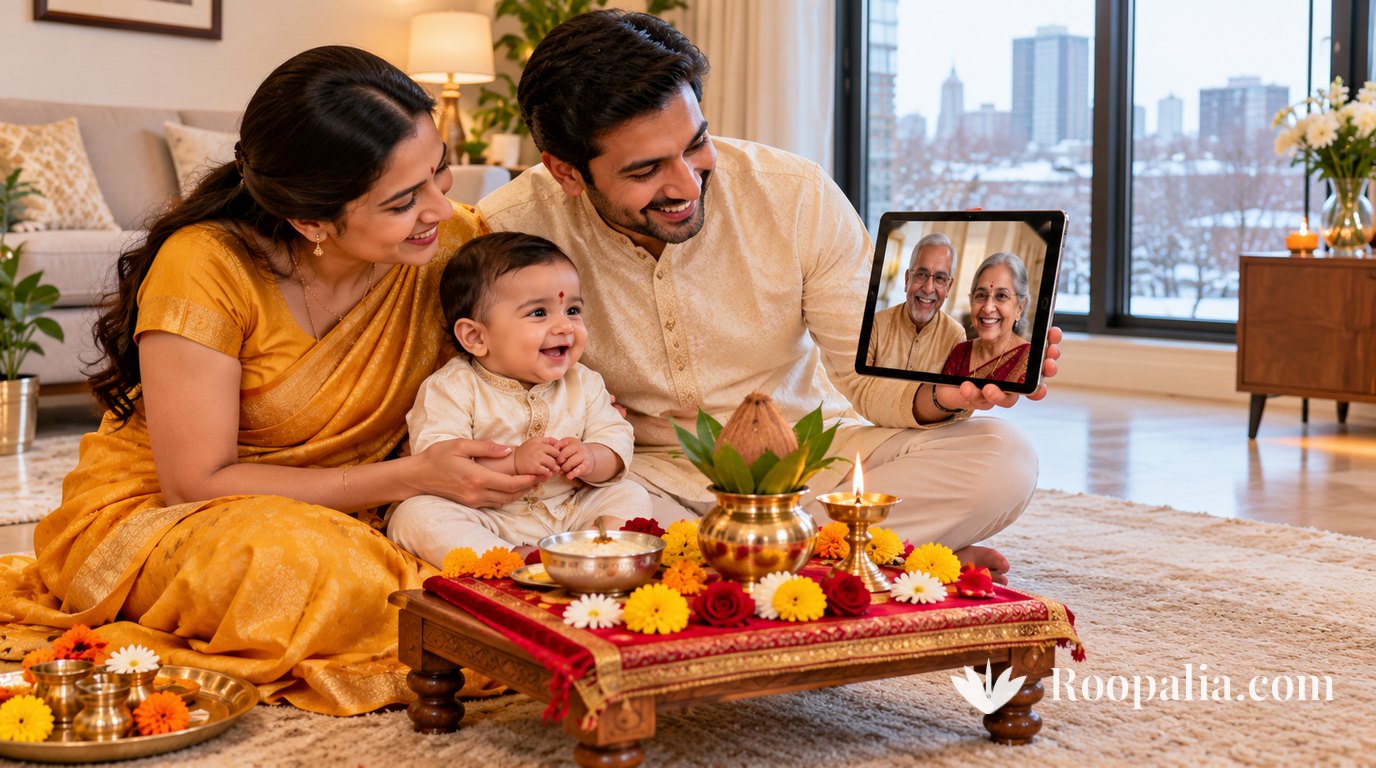
- Bring in the grandparents: schedule it for a time that works in India so they can bless the baby on a video call.
- Ask your health visitor or paediatrician about starting solids — routine baby checks in the UK, US and Canada are a good moment.
- Diyas: mind smoke alarms and lease rules; an LED diya works fine.
- No silver spoon? A plain baby bowl and spoon carry the same blessing.
After the ceremony: the WHO advises 2–3 meals a day at 6–8 months and 3–4 at 9–24 months, starting with mashed and semi-solid foods and moving to soft finger foods by about 8 months, with breastfeeding continuing. The NHS suggests introducing allergenic foods such as ground nuts and egg one at a time, in small amounts. For other childhood rites, see our guides to the naming ceremony and the mundan.
What the Grihya Sutras actually say
Pāraskara Gṛhya Sūtra 1.19 (tr. Oldenberg, courtesy: sacred-texts.com): in the sixth month, offerings are made — the first with a verse to the goddess of Speech, then for breath, sight and hearing. The father eats, then gives the child food of every kind and flavour, silently or saying “Hanta”. The text also lists optional foods for particular wishes, including the flesh of certain birds and fish, and ends with feeding Brahmans.
Śāṅkhāyana Gṛhya Sūtra 1.27: in the sixth month, options include goat’s flesh, partridge, fish or rice with ghee, prepared with curds, honey and ghee; an offering with “Lord of food, give us food”; the child is set on northward-pointing kusha grass with “Be soft, O earth”; and the mother eats the remainder.
Most families today use a vegetarian kheer or rice. The meat and fish options above are given as historical record, not as a recommendation — follow your family custom and your baby’s doctor.
What I found and what I did not
| Claim | Result |
|---|---|
| Annaprashan in the sixth month | Found — Pāraskara 1.19, Śāṅkhāyana 1.27; WHO also says 6 months |
| The father feeds the child | Found — Pāraskara 1.19 |
| The mother eats what remains | Found — Śāṅkhāyana 1.27 |
| First food with curds, honey and ghee | Found — Śāṅkhāyana 1.27; but NHS: no honey before 1 year |
| Odd months for girls, even for boys | Regional custom (Wikipedia); not found in these sutras |
| Book, pen, coins and soil plate | Bengali custom (Wikipedia); not found in these sutras |
The bottom line: hold annaprashan at about six months — the one point where the sutras and paediatricians agree. Give the first spoonful only when the baby can sit up and swallow, and keep it soft, plain and free of salt, sugar and honey. Who feeds, which month and what goes on the plate are lovely family customs; enjoy them, with the baby’s health first.
Disclaimer: This article is for general information. References have been checked against published translations and reliable sources, and customs vary by family and region — follow your elders or family priest. All images in this article are AI-generated as examples for illustration only; they do not show real people, places or events. It is not medical, legal or astrological advice.
Frequently asked questions
What is the annaprashan ceremony called in English?
Can a baby have honey at annaprashan?
Can babies have sugar at 6 months?
When should annaprashan be done for a baby boy or girl?
Who feeds the baby at annaprashan?
What is kept on the annaprashan plate?
What should I feed my baby for annaprashan?
How do I do a simple annaprashan at home?
Sources and cautions: sources consulted — Pāraskara Gṛhya Sūtra 1.19 and Śāṅkhāyana Gṛhya Sūtra 1.27 (The Grihya Sutras, Part 1, SBE 29, tr. Hermann Oldenberg, courtesy: sacred-texts.com); regional months, names and the objects plate: Wikipedia (Annaprashana); complementary feeding: WHO; first solid foods and foods to avoid: NHS. Three things should be said plainly. First, separate months for boys and girls and the book-pen-coins plate were not found in these sutra passages; they are regional customs. Second, the sutras list honey and meat or fish options for the first food; they are given here as historical record, not advice. Third, this article is not medical advice; ask your paediatrician when and what to start feeding. No brand or shop is recommended.