
The call usually comes at an odd hour. If you live in London, Toronto or New Jersey, the news of a death in the family arrives across time zones, and with it a flood of questions you may never have had to answer before: How many days do we mourn? Can I eat normally? Do I fly home? What happens on the thirteenth day? This guide answers them calmly, one by one.
One detail surprised me while checking the texts: the day the scripture treats as most important is not the thirteenth at all. And in one Rajasthan village, families stopped immersing ashes in rivers generations ago. Both are further down.
How long is the Hindu mourning period?
The Hindu mourning period is usually 10 to 13 days. The Manusmriti, in G. Bühler’s translation, sets ten days of ritual impurity for close family (5.59). The Garuda Purana prefers the twelfth day for the rite that joins the departed to the ancestors (chapter 13). The name “terahvi” — the thirteenth-day gathering that closes mourning — comes from family custom. Which number your family follows depends on its community, so the honest answer is: ask your elders, and expect 10, 12 or 13 days.
At a glance:
- Mourning (sutak / ashaucha): 10 days in the Manusmriti; 12 or 13 days in many communities.
- Avoid: meat, celebrations, weddings and new purchases; sleep simply and eat simple food.
- Abroad: if the news reaches you after ten days, a bath in your clothes is the purification the Manusmriti gives.
- Ashes: collected on the fourth day in the Garuda Purana; carrying them to India needs papers from the crematorium and the Indian embassy or consulate.
- Pagdi: the eldest son is given a turban as the new head of the family, on the fourth, twelfth or thirteenth day.
What not to do (and what not to eat) after a death in a Hindu family
I checked the Manusmriti (chapter 5, tr. G. Bühler, courtesy: sacred-texts.com) and the Garuda Purana (tr. Ernest Wood and S. V. Subrahmanyam, courtesy: sacred-texts.com). Here is what they say, separated from what is family custom:
| Do not | Where it comes from |
|---|---|
| Eat meat | Manusmriti 5.73 |
| Eat food with “factitious” (manufactured) salt | Manusmriti 5.73 |
| Sleep in your usual bed — sleep separately on the ground | Manusmriti 5.73; Garuda Purana, chapter 11 |
| Hold weddings, thread ceremonies or other auspicious rites before the twelfth-day rite | Garuda Purana, chapter 13 (verses 31–33) |
| Eat food already cooked in the house on the day of the cremation | Garuda Purana, chapter 10 (verse 62) |
| Celebrate festivals, buy new clothes or jewellery | Family custom |
What to eat: simple vegetarian home food. The Garuda Purana asks the son performing the rites to eat once a day (chapter 11). Many families eat plain dal, rice and vegetables with little or no spice. A specific clock time for meals during sutak, which many people search for, was not found in the chapters I checked.
Who is not bound by mourning? Manusmriti 5.93 says ritual impurity does not fall on a king or on someone in the middle of a vow or sacrifice. It also gives shorter periods for those outside the household: three days for a teacher (5.80), one day for a fellow student (5.71), one night for a maternal uncle, pupil or family priest (5.81).
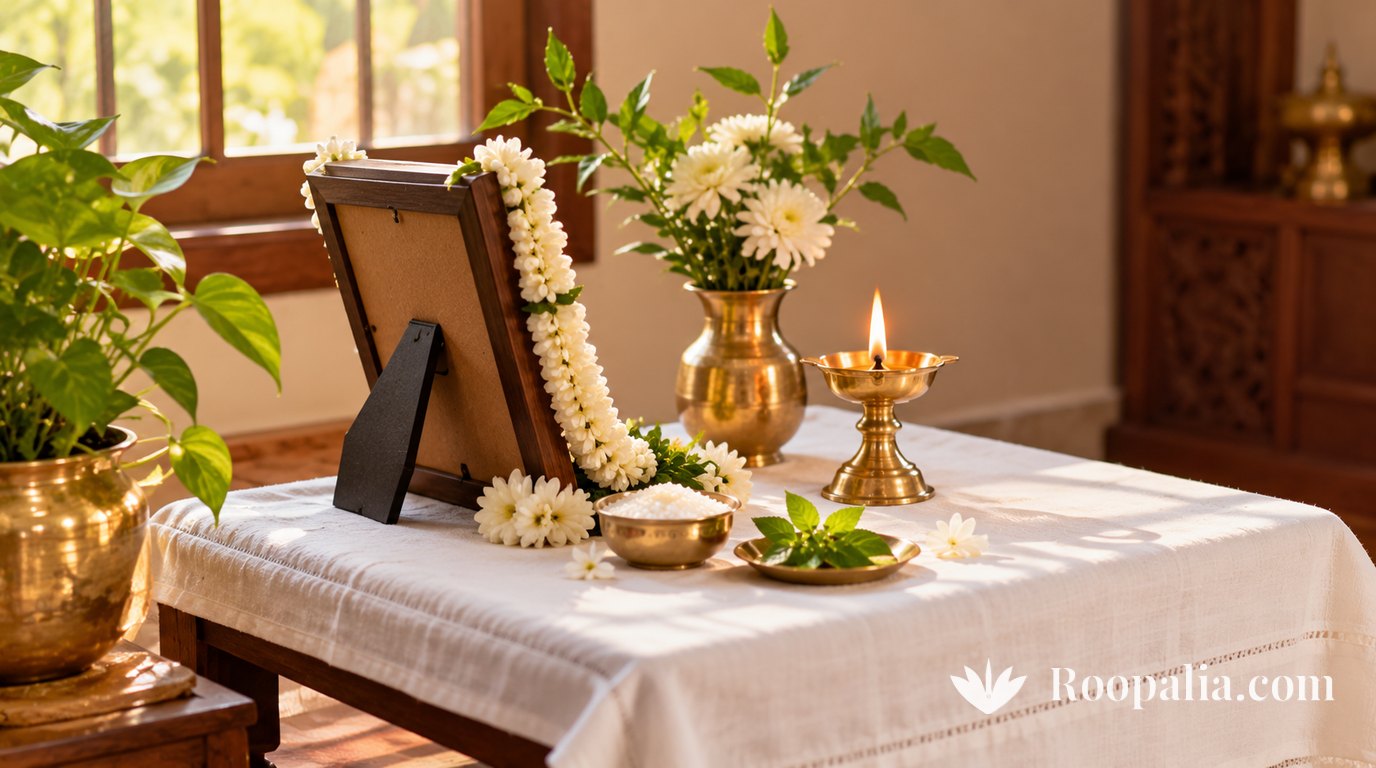
Hearing of a death in India while you live abroad
This exact situation is in the Manusmriti. For a relative who lives in a distant country:
- If the news arrives within ten days, you observe mourning only for the days that remain of the ten (5.75).
- If the news arrives after ten days, a bath taken with your clothes on is the purification (5.77).
- If a year has passed, a bath alone is enough (5.76).
In practice: set up a small corner at home with a photo, a diya and a glass of water; offer water with black sesame each morning; join the family’s condolence gathering on a video call; and on the thirteenth day, cook a simple meal and give something in the name of the person you lost. If you cannot fly home, you are not failing them — the text itself allows for the distance.
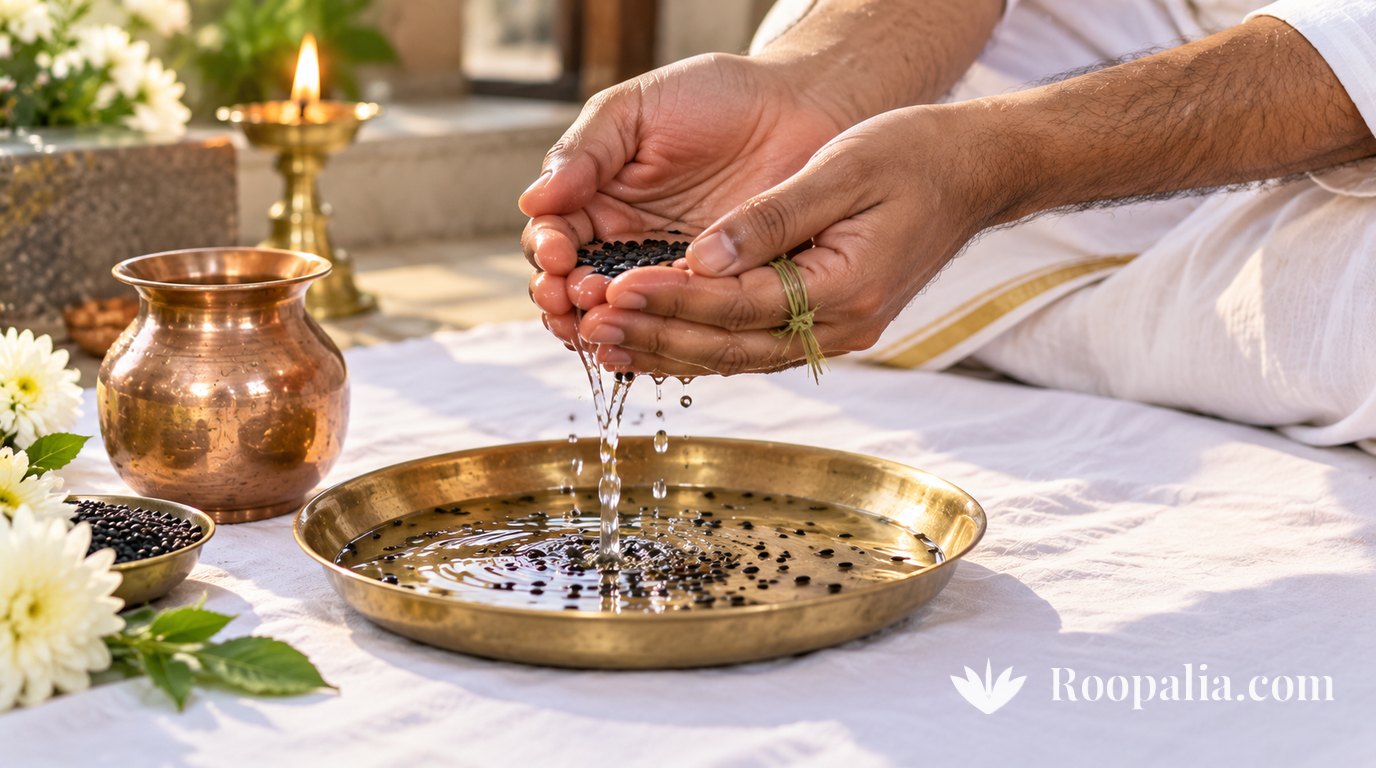
What happens at a Hindu funeral in the UK, USA or Canada?
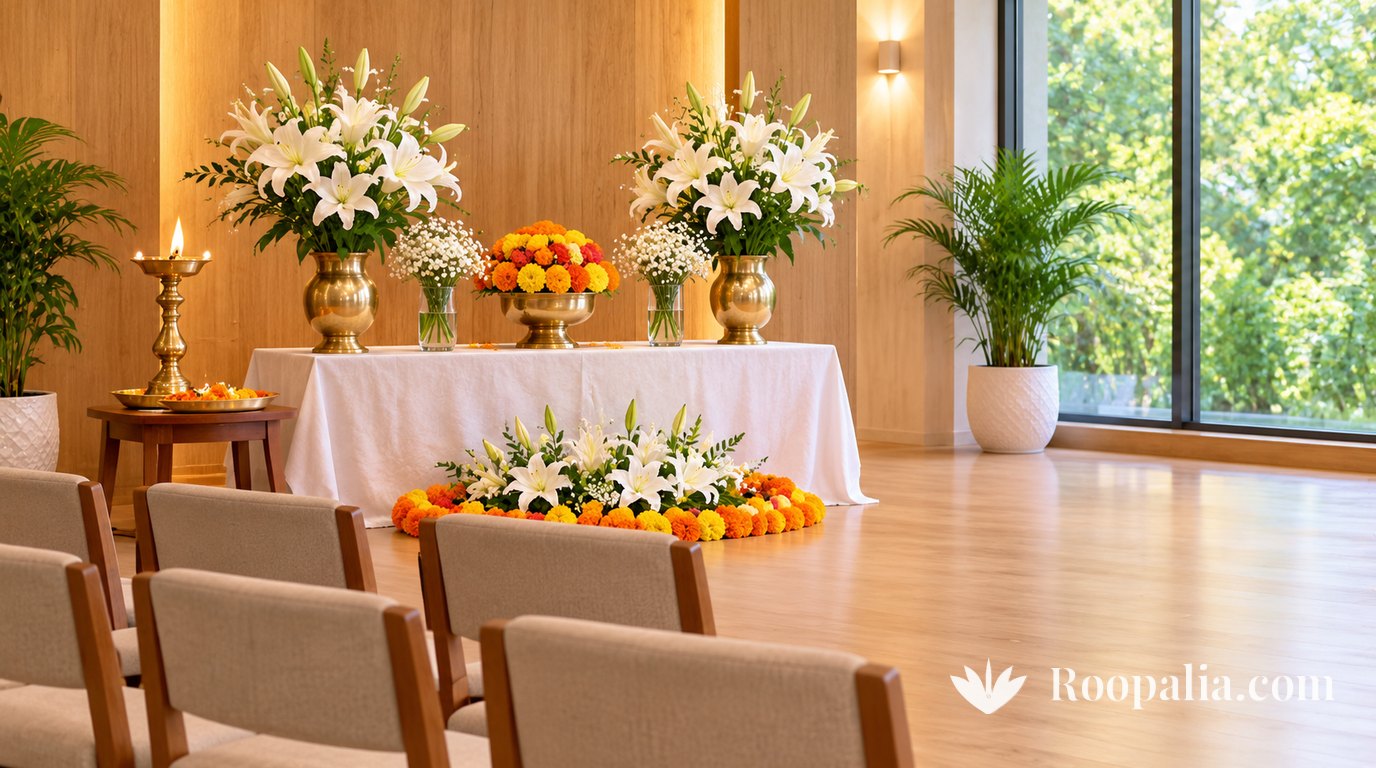
A Hindu funeral is called antyesti (“last sacrifice”) — the cremation rite. Outside India, the open pyre is replaced by a crematorium, but the family can still do most of the rites.
- Register the death first. In England and Wales, GOV.UK (After a death) says the death must be registered within 5 days of the medical examiner’s confirmation (8 days in Scotland). You then receive the “green form”, which goes to the funeral director or crematorium. Rules differ in the US and Canada by state and province; your funeral director will guide you.
- Prepare the body. Wikipedia (Antyesti) describes the body being washed and wrapped in white cloth for a man or a widow, and red for a married woman whose husband is living. Ask your funeral director whether the family can take part.
- The chant. As the body is carried, families say “Ram naam satya hai” — “the name of Rama is the truth”. Wikipedia (Ramanama) notes it is commonly chanted while carrying a body to cremation.
- Mukhagni. Ask the crematorium in advance how much time you will have for prayers and whether the family can start the cremation themselves.
- Open-air cremation in the UK? According to Wikipedia (Antyesti), a traditional outdoor pyre was long held to be illegal in Britain; a later Court of Appeal ruling allowed cremation inside a building open to the sky. Facilities for this are rare, so most families use a regular crematorium.
- What to wear. Mourners usually wear white or plain, muted clothes; it is a family custom, so follow what the family asks.
Taking ashes to India from the UK, USA or Canada
Many families still want the ashes immersed in the Ganga, at the ghat where their family’s ancestral priests (pandas) keep the family records. The Indian Embassy in Berlin lists the papers it asks for (transportation of human ashes to India), and they are a good checklist anywhere:
- A request letter from a family member.
- The death certificate, with an English translation if needed.
- The cremation certificate from the crematorium.
- A letter from the crematorium saying the box contains only ashes.
- The passport, PIO or OCI card of the person who died.
- Flight details.
Check the current rules with the Indian embassy or consulate where you live, and with your airline, before you book.

What are the 13 days of mourning in Hinduism? Day by day
| Day | What happens | Source |
|---|---|---|
| Day 1 | Cremation; mourners bathe and offer water with sesame; no food already cooked in the house | Garuda Purana 10 (vv. 60–62) |
| Days 1–12 | A lamp facing south where the person died | Garuda Purana 10 (v. 63) |
| Days 1–10 | A rice ball (pinda) and water each day; the son eats once and sleeps on the ground | Garuda Purana, chapter 11 |
| Day 3–4 | Collecting the bones (asthi sanchay); in many places the uthala or uthavna gathering | Garuda Purana 10 (v. 67); custom |
| Day 10 | Head-shaving for the son and other relatives | Garuda Purana 11 (vv. 37–38) |
| Day 11 | Ekadashah — rice ball, gifts, a Brahmin fed | Garuda Purana, chapter 12 |
| Day 12 | Sapindikaran — joining the departed to the ancestors; in many places the pagdi ceremony | Garuda Purana 13 (vv. 28–34); custom |
| Day 13 | Terahvi — prayers, a meal and the formal end of mourning | Custom (no feast rule found in these chapters) |
What is the pagdi ceremony?
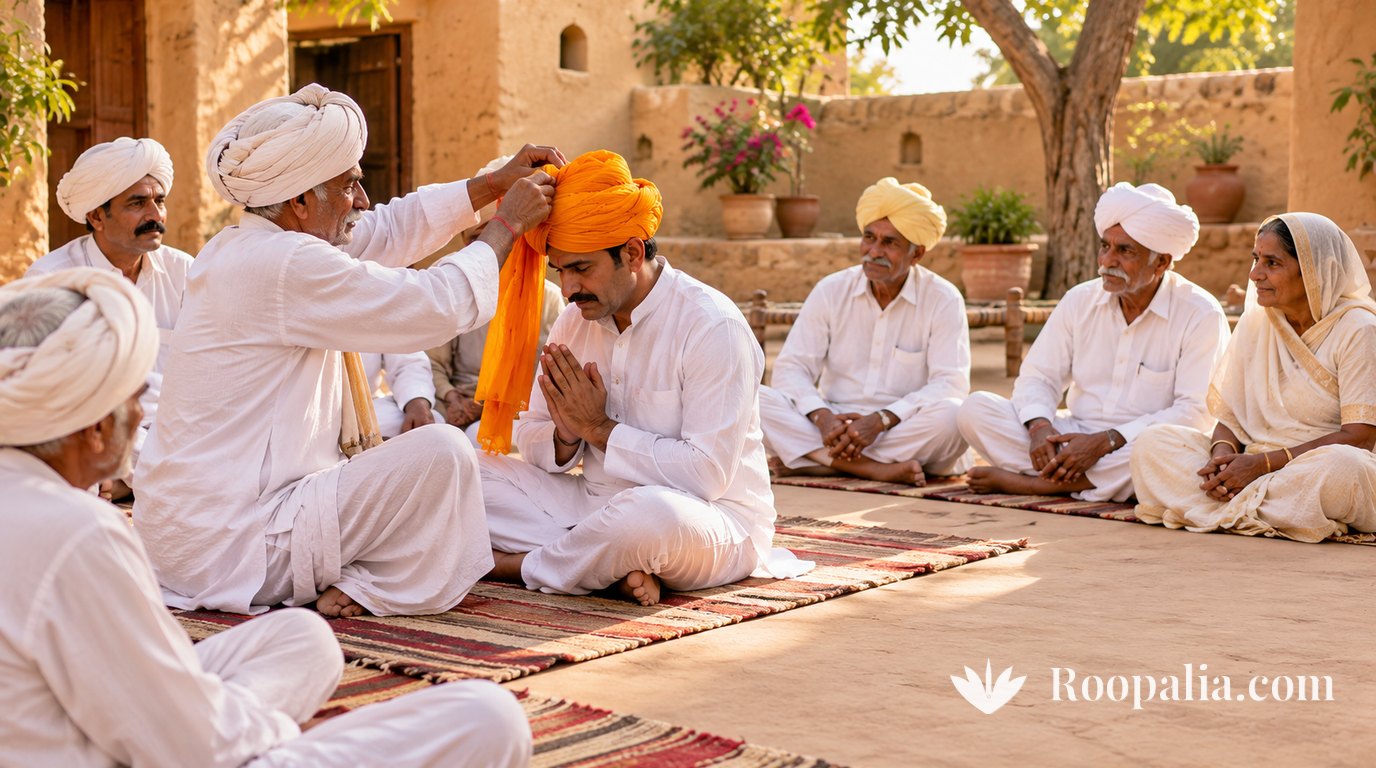
In the pagdi (turban) ceremony, the next eldest living man — usually the eldest son — is given a turban in front of the community after the death of the family’s eldest man. Wikipedia (Indian rituals after death) says Rasam Pagri appoints the heir and usually takes place on the fourth day after the funeral, a day also called uthala; the Hindi Wikipedia adds that it may be held on the thirteenth day and is practised by Hindu, Sikh and Muslim families alike. The turban stands for the family’s honour, which now rests on his head.
According to the experience of families in Rajasthan and Haryana, the pagdi is traditionally tied on the twelfth day; many families now hold it on the seventh, and some on the thirteenth. There is no single rule: each community keeps its own. In the same villages, many people take turns carrying the bier and chant “Ram naam satya hai” all the way; for someone who lived to around eighty, the procession may even include bhajans with a dholak.
Is the death feast (mrityu bhoj) banned?
Yes, in Rajasthan. The Rajasthan Prevention of Mrityu Bhoj Act, 1960 is listed on the Government of India’s India Code portal, with section 3 prohibiting death feasts and section 4 setting the punishment. According to a legal explainer on the iPleaders law blog, the penalty is up to one year in prison, a fine of up to one thousand rupees, or both, and local officials such as the sarpanch and patwari must report such feasts. Many families still hold them, but many communities and clans in Rajasthan and Haryana have stopped them by collective decision. A claim that Rajasthan was “the first state” to ban the practice could not be verified, so it is not repeated here.
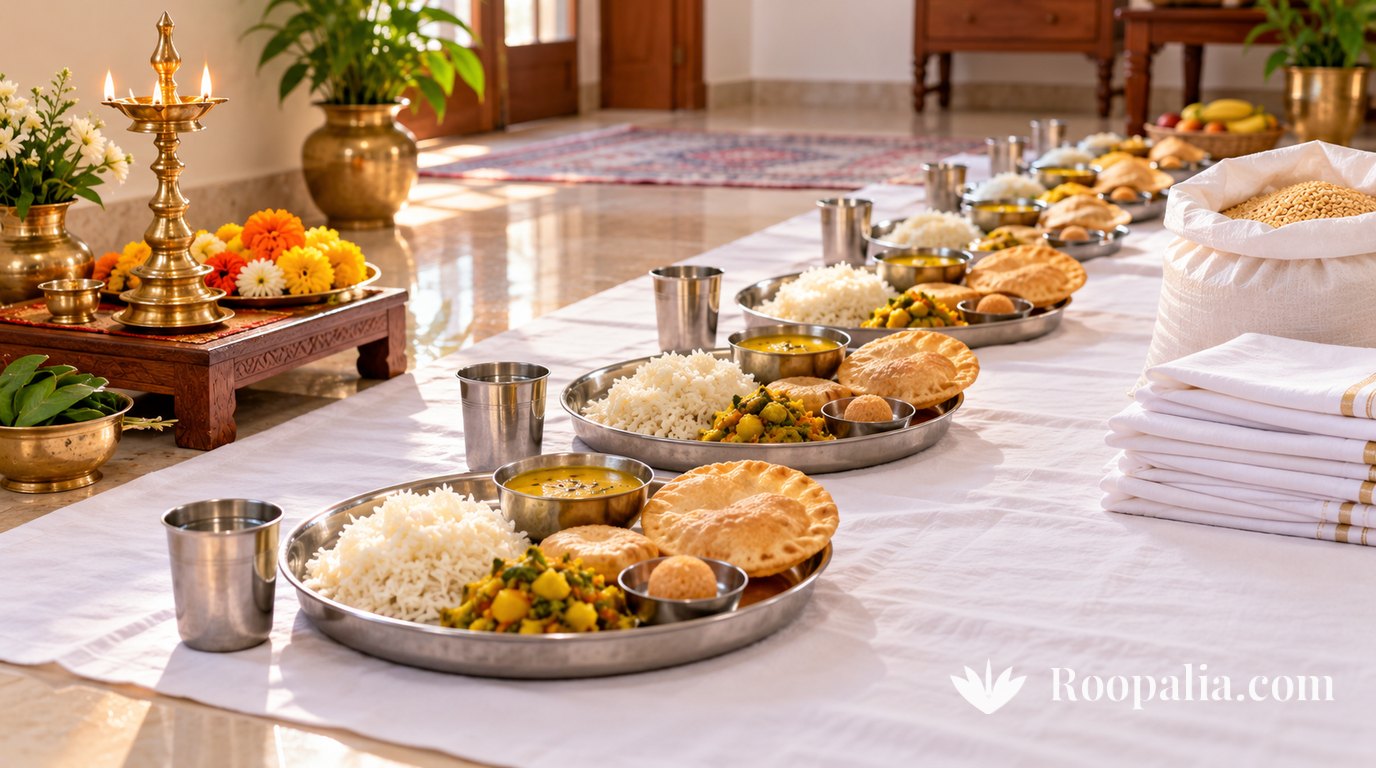
And then there is Lamba ki Dhani. In this village of about 105 households in the Taranagar tehsil of Churu district, Rajasthan, local news reports say the villagers decided together, decades ago, that ashes would not be immersed in any river: whatever bones remain after cremation are burned again to ash. The same village has not held a death feast in all that time.
It is not a verdict on anyone’s tradition. It is a reminder that mourning customs have always been shaped by communities — and can be reshaped by them.
A condolence message for a shok baithak
Announcing the gathering: “With deep sorrow we inform you that our beloved [name] passed away on [day]. A prayer and condolence meeting (shok baithak) will be held at [place] on [day] at [time]. — The [family name] family”
To the family: “I was deeply saddened to hear about [name]. May their soul rest in peace, and may you all find strength in this difficult time. 🙏”
What the Garuda Purana actually says about the 13 days
Search results often claim that “the soul stays at home for 13 days” and that “the rice balls build the soul’s body”. I checked these against the Garuda Purana, in the abridged translation by Ernest Wood and S. V. Subrahmanyam (chapter 1, courtesy: sacred-texts.com):
- The body from rice balls — found. The son offers rice balls for ten days; the head forms from the first day’s ball, the rest of the body follows, and by the tenth day the departed has a full body and strength (vv. 47–53).
- Days 11 and 12: the departed eats (v. 54).
- Day 13: “On the thirteenth day the departed, bound by the servants of Yama, walks alone along the road like a captured monkey” (v. 55). The thirteenth day is the start of the onward journey.
- “The soul stays at home for 13 days” — not found word for word. The closest is verse 42: the departed wants to return to the body but is held back by Yama’s messengers with a noose.
- Feeding 13 Brahmins — the number was not found. Chapter 12 asks for a Brahmin to be fed on the eleventh day, but gives no count.
Chapter 13 (vv. 28–34) is where the twelfth day becomes central: the sages list four possible times for sapindikaran — the twelfth day, the third fortnight, the sixth month or the end of the year — and the text prefers the twelfth day in the Kali age. The same chapter (vv. 122–126) praises hearing the Garuda Purana, but a rule that it must be read during these thirteen days was not in the chapters I checked. That is family custom, and a comforting one.
| Claim | Result |
|---|---|
| Rice balls form a new body over ten days | Found — Garuda Purana 1 (vv. 47–53) |
| On the thirteenth day the departed begins the journey to Yama | Found — Garuda Purana 1 (v. 55) |
| The soul stays at home for 13 days | Not found word for word |
| Twelfth day preferred for sapindikaran | Found — Garuda Purana 13 (vv. 28–34) |
| Thirteen Brahmins must be fed | Number not found |
| Ten days of impurity for close family | Found — Manusmriti 5.59 |
| A fixed meal time during sutak | Not found |
For related rites at home, see havan at home without a pandit and puja at home without a temple nearby. For the monthly day of remembering ancestors, read what not to do on Amavasya.
The short version: The thirteen days are for grieving slowly, not for getting every rule right. The texts I checked give ten days of impurity, the bones collected on the fourth day, and the twelfth-day rite as the key moment; the terahvi meal, the pagdi and the shok baithak are customs your community shaped. If you are far from home, the Manusmriti itself makes room for you: a bath, a diya, water with sesame, and remembering them well is enough.
Disclaimer: This article is for general information. References have been checked against published translations and reliable sources, and customs vary by family and region — follow your elders or family priest. All images in this article are AI-generated as examples for illustration only; they do not show real people, places or events. It is not medical, legal or astrological advice. Before lighting a diya or havan, check your lease and local fire-safety rules.
Frequently asked questions
How long is the Hindu mourning period?
What should you not do after a death in a Hindu family?
What happens on the 13th day after death in Hinduism?
What is the pagdi ceremony after a death?
Can Hindus have an open-air cremation in the UK?
How do I take ashes to India from abroad?
What if a family member dies in India while I live abroad?
Is the death feast (mrityu bhoj) banned in India?
Sources and cautions: sources consulted — Garuda Purana (Saroddhara), chapters 1, 10, 11, 12 and 13 (tr. Ernest Wood and S. V. Subrahmanyam, courtesy: sacred-texts.com); Manusmriti, chapter 5 (tr. G. Bühler, courtesy: sacred-texts.com); Wikipedia (Indian rituals after death; Ramanama; Antyesti; Hindi Wikipedia: Rasam Pagri); India Code (Rajasthan Prevention of Mrityu Bhoj Act); penalty details from the iPleaders law blog, cited in words only; GOV.UK (After a death); Embassy of India, Berlin. Lamba ki Dhani is described from local news reports, so no link is given. The procession, pyre and pagdi customs are from the experience of families in Rajasthan and Haryana. Three things should be said plainly. First, “the soul stays at home for 13 days”, a fixed number of Brahmins, a meal time during sutak and a “first state” to ban death feasts were not found; that is the result of a search, not a final verdict. Second, every family and community has its own customs; follow your elders and priest. Third, the legal and travel information is general, not legal advice; check current rules with the authorities. No brand or shop is recommended.