Shanivar Vrat Katha — the full story
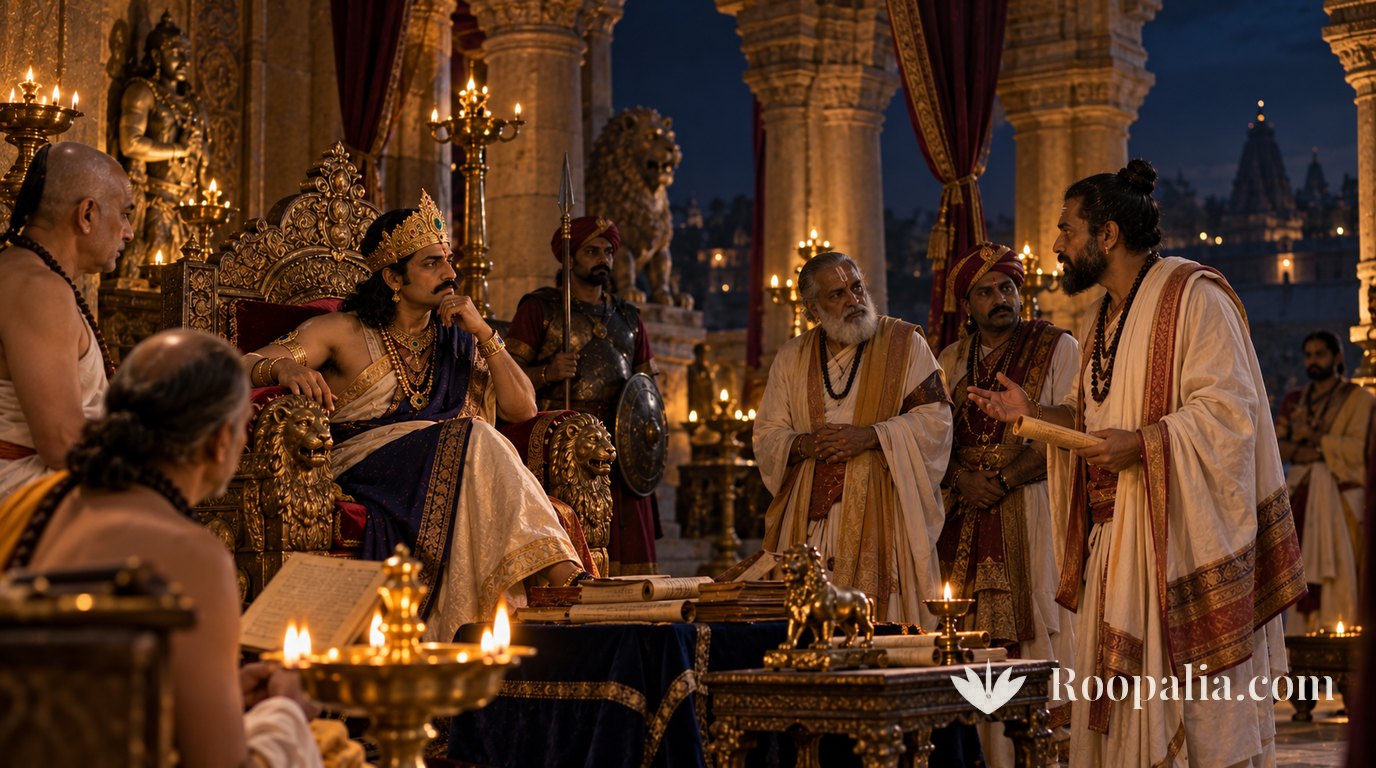
There was once a dispute in the heavens over which of the nine planets was the greatest. It grew until it was close to war. Unable to settle it among themselves, the devas went to Indra.
Indra declined. "I am not able to answer this. On earth, in the city of Ujjayini, there is King Vikramaditya, who is known for his justice. Only he can decide."
And so the nine planets, with Indra among them, arrived at the palace in Ujjayini.
The nine thrones of nine metals
The question troubled the king. Every one of them was great in his own power, and calling any of them lesser was an invitation to be ruined.
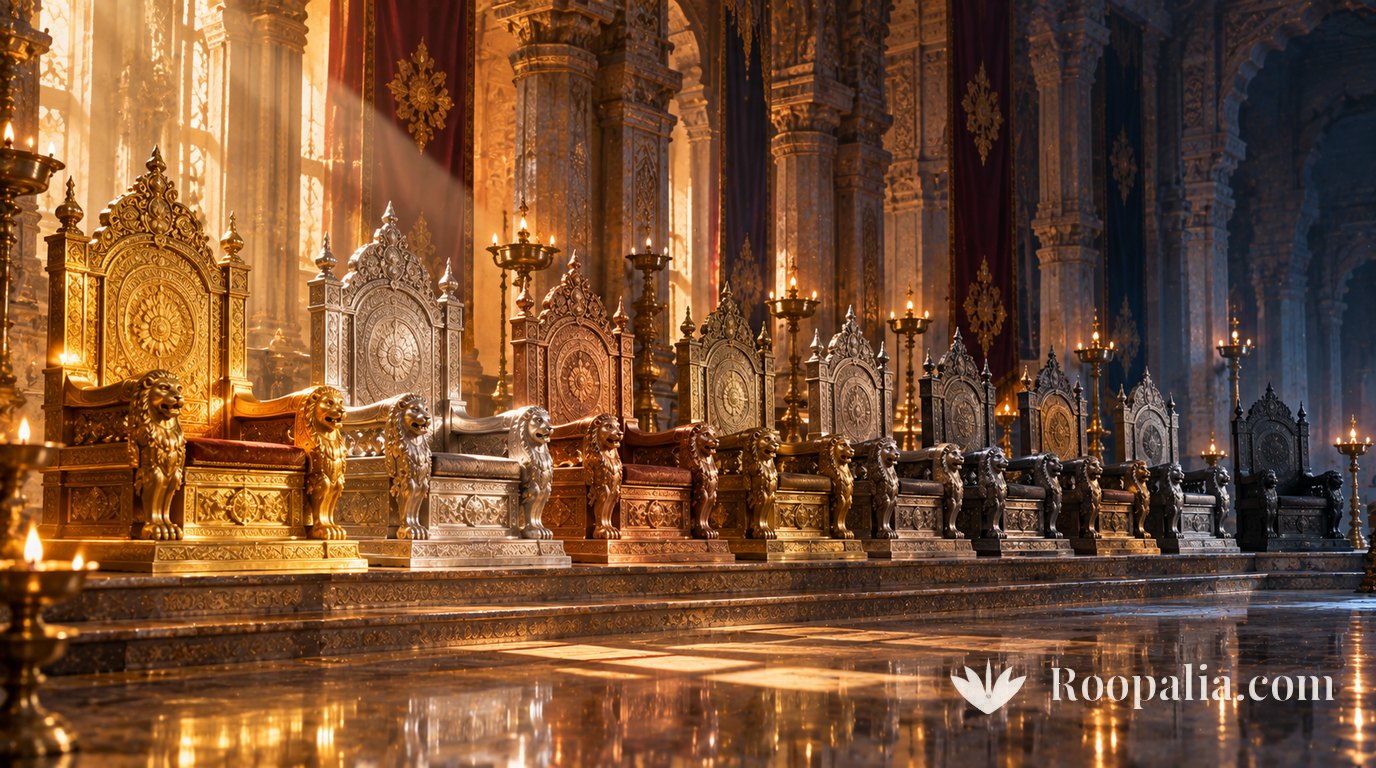
Then a solution came to him. He had nine seats made, each of a different metal — gold, silver, bronze, copper, lead, tin, zinc, mica and iron — and had them placed one behind the other in the order of the metals' worth, gold at the front and iron at the very back.
"Take your seats," the king said.
They sat. The king folded his hands. "You have decided it yourselves. Whoever sits at the front is the greatest."
Shani, who had been left with the iron seat at the back, rose in anger.
"King Vikramaditya. You have seated me last and dishonoured me. You do not know what I am. The Sun stays one month in a sign, the Moon two and a quarter days, Mars a month and a half, Mercury and Venus a month each, Jupiter thirteen months — but I stay seven and a half years in a single sign. I have afflicted gods far greater than you. Now you will not escape either."
The others left content. Shani left angry.
The turning point — the horse trader
Some days passed quietly. The king went on dispensing justice and his people went on prospering. Shani had not forgotten.
One day he took the form of a horse trader and arrived in Ujjayini with a string of fine horses. The king sent his master of horse; the animals were so good that he came himself and picked out a strong and beautiful one.
He mounted it to test its gait — and the horse bolted like lightning. It carried him far into a forest, threw him there, and vanished.
The king wandered, hungry and thirsty, until he came upon a cowherd. He asked for water, drank, and gave the man his ring in thanks. Then he asked the way and walked on to the nearest town.
There he sat a while resting at a merchant's shop and, in the course of talking, mentioned that he had come from Ujjayini. The merchant's takings that day were far above the usual. Thinking the stranger lucky, he took him home for a meal, pleased.
In one room of the merchant's house a gold necklace hung on a peg. The merchant left the king alone there for a few minutes.
And then the thing happened on which the whole story turns. In front of the king's eyes, the peg swallowed the necklace.
The merchant returned to find it gone, and only the king in the room. The suspicion fell where it had to.
The king said exactly what he had seen — that the peg had swallowed it. Who would believe such a thing? He was bound and taken before the ruler of that town, and there he said the same. For the theft he was sentenced: his hands and feet were cut off and he was left on the street.
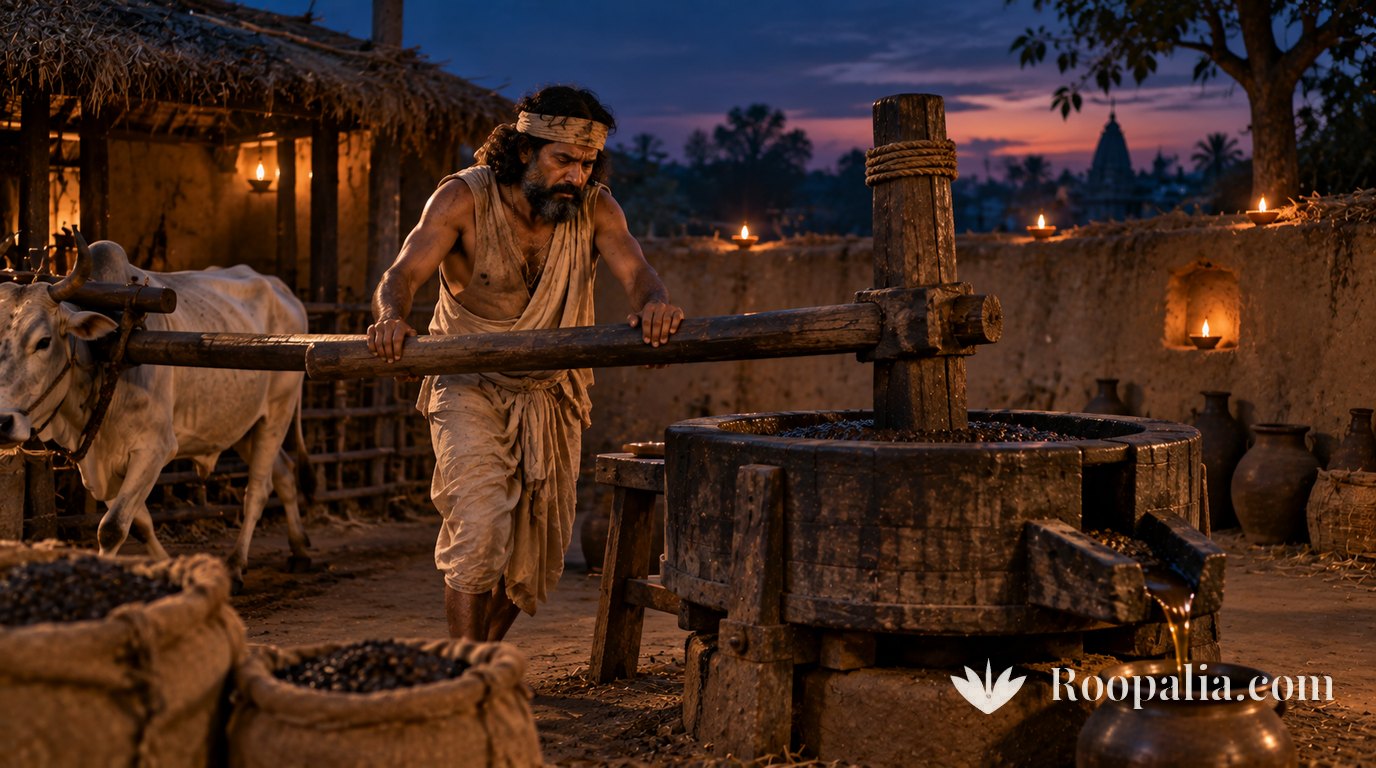
Some days later an oil-presser picked him up, took him home and set him at his kolhu. The king called to the oxen and kept them moving; the press turned, and he was fed.
In that condition the seven and a half years passed.
The Megh Malhar, and the night everything turned
As the sade sati drew to its close, the rains began.
One night the king, sitting at the press, sang Megh Malhar. At that hour the ruler's daughter, Princess Mohini, was passing the oil-presser's house in her chariot. She heard it and was held by it, and sent her maid to bring the singer.
The maid came back and said the singer was a man with no hands and no feet. Knowing this, the princess decided to marry him.
Her parents were appalled. "Daughter," the queen said, "your fate is to be a king's queen. Why bring the axe down on your own foot?"
The princess would not move. In the end her parents had to consent.
After the wedding the two of them went on living at the oil-presser's house. And that night Shani came to the king in a dream.
"King. You have seen what I can do. I have given you the punishment of my dishonour."
The king folded what he had. "Shani Dev, forgive me. And I ask one thing of you — the suffering you have given me, do not give it to anyone else."
Shani was silent a while. Then: "King, I accept your prayer. Whoever, man or woman, worships me, keeps the Saturday fast and listens to my vrat katha, will have my grace."
The king woke at dawn with his hands and feet as they had been. The princess, seeing it, was struck speechless — and then he told her who he was, and the whole story of Shani's anger.
When word reached the merchant, he came running and fell at the king's feet to beg forgiveness. The king forgave him. It had been Shani's doing; the merchant had not been at fault.
The merchant took him home and fed him. And there, while they ate, in front of everyone, the same peg brought the necklace back up. The merchant gave his own daughter to the king in marriage as well, and sent him away with gold and wealth.
King Vikramaditya returned to Ujjayini with Princess Mohini and the merchant's daughter, and the city received him with joy.
The next day he had a proclamation made through the kingdom: Shani Dev is the greatest of the deities. Let every man and woman keep his fast on Saturday, and hear his vrat katha without fail.
Shani was much pleased. And that is where the Saturday fast and this katha come from.
Say it — Jai Shani Dev. 🙏
May the grace that came to King Vikramaditya come to all.
The other version — the Shani Mahatmya and the city of Tamralinda
The story above is the one read in homes on Saturday. But a much longer telling exists in the booklet called the Shani Mahatmya, and several of its episodes are quite different. In Maharashtra and Gujarat that is the better-known form.
Its court scene is not the same. There the king has no thrones made. He asks the pandits who is greatest among the planets, and when one of them recounts Shani's birth — that his glance at the moment of his birth afflicted his own father, the Sun — the king laughs and says, "What use is a son whose birth brings his father suffering? Such a one is an enemy, not a son." The whole court laughs with him. Shani appears that instant.
From there the king rides the horse to a city called Tamralinda. He stays at a merchant's house, and a marriage with the merchant's daughter, Alolika, is proposed. Sleeping that night in the picture gallery, he watches a swan step alive out of one of the paintings and swallow her pearl necklace — that version's counterpart of the peg. The accusation, the severed limbs, the years at the oil-press, and at the end the singing of the Deep Raga, at which every lamp in the city lights by itself, follow in the same order. There it is Princess Padmasena who hears him sing.
In that telling Shani also tells the king whom else he has not spared — his own guru Brihaspati among them, and Rama, Sita, Ravana, Harishchandra, Nala and Damayanti, and the Pandavas.
So which is the right one? They are two forms of one story and both are accepted. For the Saturday puja it is the shorter one — the nine thrones — that is read, and that is the one given above. The long Shani Mahatmya is meant to be read in parts through a sade sati.
What the story actually means — three things
One — the suffering did not come from a mistake in the ritual. What happened to Vikramaditya did not follow an error in method, a mispronounced mantra or a missing offering. It followed an insult delivered in open court. The whole architecture of the katha rests on arrogance and mockery, not on ritual correctness. Which is why the largest rule of the Saturday fast is not about materials but about conduct — that on this day no one speaks harshly to a servant, a labourer or anyone weaker.
Two — the king asked for nothing for himself. This is the finest moment in the story and the one most often passed over. When Shani, pleased, offers him a boon, the king has everything to ask for: his hands and feet, his kingdom, his wealth. What he asks is that this suffering not be given to anyone else. And Shani's boon comes back at exactly the same scale — that whoever keeps the fast and hears the katha will have his grace. What is granted in this story matches the size of the wish, not the standing of the one who makes it.
Three — the length of a sade sati is written into the story itself. Shani says in his own words that he stays seven and a half years in one sign, and the king's hardship runs exactly that long. This is, in other words, a story about a sade sati — its beginning, its middle and its end. And the end does arrive. That is worth noticing for anyone who has been frightened on the subject: even inside the katha, that period is a span of time and not a permanent sentence.
And one small thing hidden in the ending. The king's hands and feet returned while he was in an oil-presser's house, not in a palace. The cowherd he gave his ring to, the oil-presser who picked him up off the street, the princess who married him knowing what he was — the story keeps all three. In Shani's katha, the people who showed mercy are never left out.
When and how to read the katha
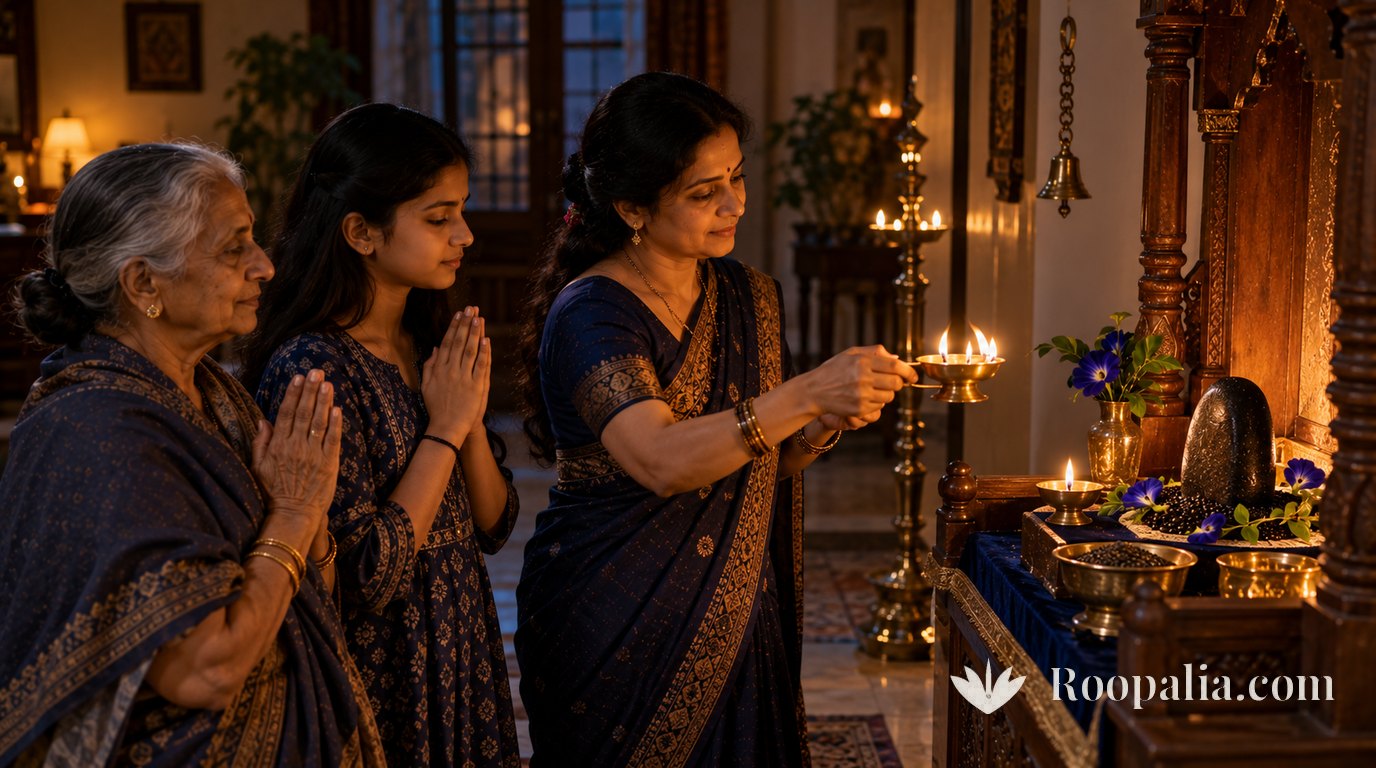
The katha is part of the puja, not something done separately. In the ten steps set out in our method article, it is the ninth.
When: in the evening puja — after the lamp and the chanting, before the aarti.
How to sit: on an asana, with the lamp burning in front of you. Once you begin, do not get up or break off to talk.
With whom: with the family if you can. One reads, the others listen — the tradition places as much weight on listening as on reading.
Language: whichever you think in. Feeling has always been ranked above pronunciation here.
How often: every Saturday of the number you resolved on, and again in full on udyapan day.
Afterwards: the aarti, then the prasad — and a portion of the meal set aside for someone in need, a labourer, or a dog.
You do not need to download a PDF. The complete katha and the aarti below are on this page in writing — the page opens straight on a phone during the puja, and once loaded it can be read with the connection off.
Shani Dev Aarti
Jai jai Shri Shanidev, bhaktan hitkaari,
Sooraj ke putra prabhu, chhaya mahtaari.
॥ Jai jai Shri Shanidev ॥
Shyam ang vakra-drishti, chaturbhuja dhaari,
Neelambar dhaar naath, gaj ki asavaari.
॥ Jai jai Shri Shanidev ॥
Kreet mukut sheesh raajit, dipat hai lilaari,
Muktan ki maala gale, shobhit balihaari.
॥ Jai jai Shri Shanidev ॥
Modak mishthaan paan, chadhat hain supaari,
Loha til tel urad, mahishi ati pyaari.
॥ Jai jai Shri Shanidev ॥
Dev danuj rishi muni, sumirat nar naari,
Vishwanath dharat dhyaan, sharan hain tumhaari.
॥ Jai jai Shri Shanidev ॥
After the aarti, sprinkle water and share the prasad — the household first, then whoever comes.
A story in which nobody defeats the deity
Indian vrat kathas usually run the same course — the devotee suffers, the deity is pleased, everything is restored. This one differs in a single place: Vikramaditya never wins against Shani. He performs no rite to turn the affliction aside, works no clever escape. He simply serves it out, and is not bitter with anyone while he does. What comes back to him at the end comes back through his patience, not his victory. That is probably why this story holds up best for people going through a long hard stretch of their own.
Frequently Asked Questions
What is the Shanivar Vrat Katha?
When and how should the Shanivar Vrat Katha be read?
Why did Shani punish King Vikramaditya?
What is the peg-and-necklace episode in the katha?
What is the Shani Dev aarti?
What does the Shanivar Vrat Katha really mean?
Is the Shanivar Vrat Katha found in any Purana?
How many versions of the Shanivar Vrat Katha are there?
Can women read the Shanivar Vrat Katha?
Where can I find the Shanivar Vrat Katha PDF?
What boon did Shani Dev give the king in the katha?
What does the katha say about sade sati?
📷 AI-generated images. For illustration only.
🙏 This article is general cultural and religious information. The shorter form of the katha given here follows the vrat booklets commonly read in homes, and the longer form follows the Shani Mahatmya tradition; this story does not come from a major Purana, and the article says so plainly. The wording of both the katha and the aarti varies somewhat by region and family.