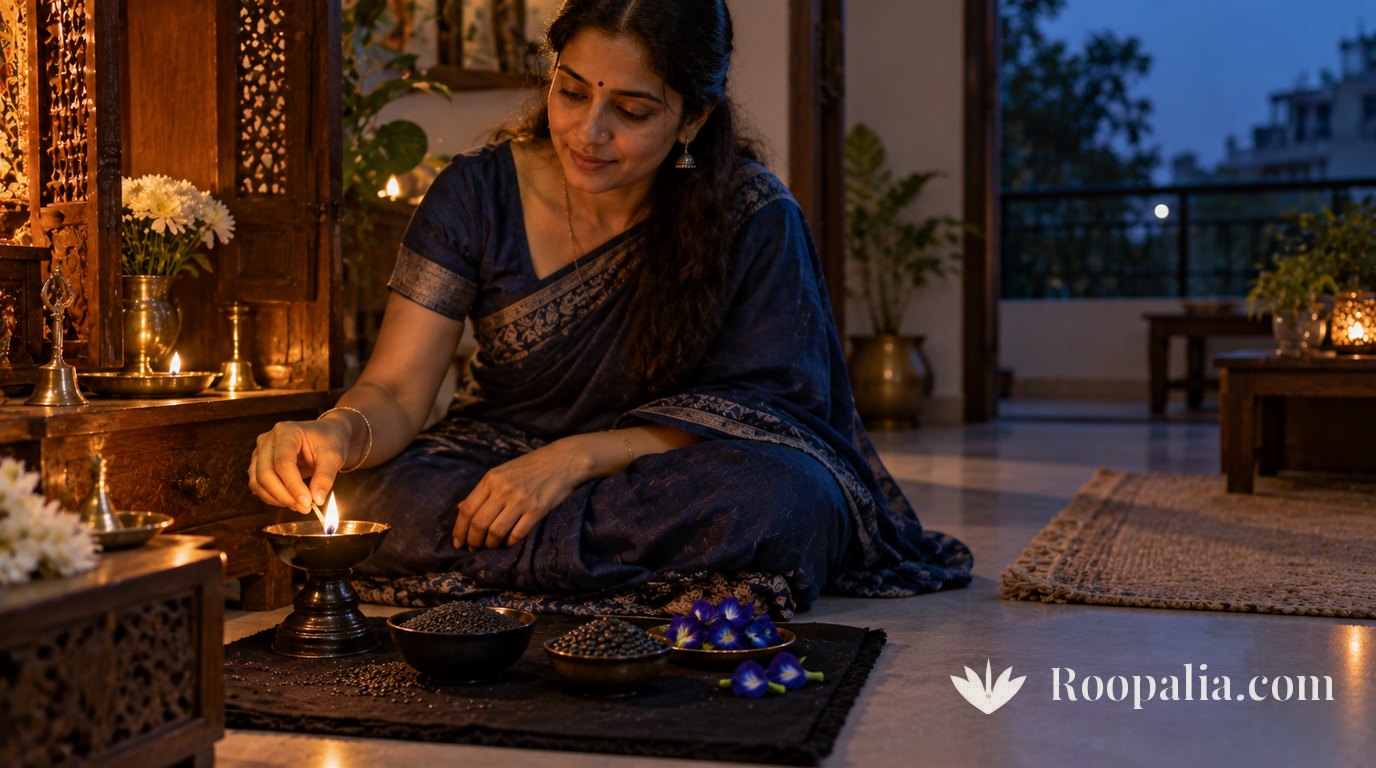
Saturday fasting is for which god? Three answers, all of them correct
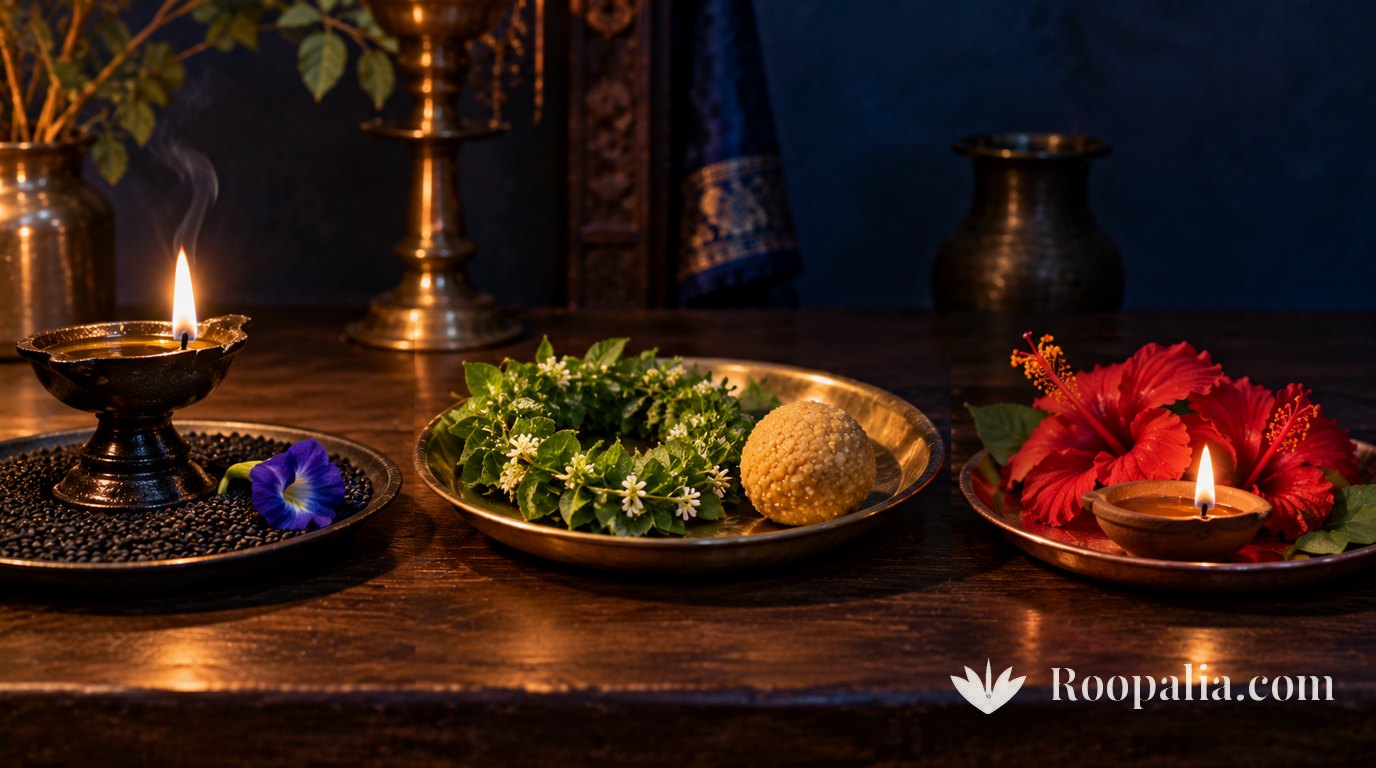
This is the first thing to settle, because every rule further down depends on it. There is no single Saturday fast in India. At least three distinct traditions run on the same day, and their offerings, their food and their rules do not match.
1. The Shani vrat — the most widespread, across north and central India
Offerings: mustard oil, black sesame, whole urad dal, blue flowers · Meal: urad dal khichdi, sesame laddoos · Clothing: dark blue or black · Charity: oil, sesame, urad, a blanket, iron
2. The Balaji (Venkateswara) Saturday — Tamil Nadu, Andhra Pradesh and Karnataka
This is the fast kept on the Saturdays of the Tamil month of Purattasi (mid-September to mid-October), known as Purattasi Sani or Tirumala Shanivaralu. Offerings: tulsi, ven pongal, chakkarai pongal, curd rice · Many families stay vegetarian for the whole month · Here Shani appears not as a threat but as the reason to take Vishnu's shelter
3. The Kali Saturday — Bengal and eastern India
Offerings: red hibiscus (jaba) flowers, a lamp, khichuri · In this region both Saturday and Tuesday are days for Kali
This is where the confusion starts. Most pages online mix the three together — tulsi in a Shani vrat, black sesame on a Purattasi Saturday. Which is why the same question returns three different answers.
So decide first which tradition your family follows. This article is mainly about the first — the Shani vrat — and wherever the other two differ, that is said separately.
And why is the fast kept at all? In most households the answer is one word: sade sati. Sade sati is not a punishment, it is arithmetic. Saturn transits the twelfth house from your moon sign, then the moon sign itself, then the second house. Three signs, and since Saturn spends roughly two and a half years in each, the journey takes about seven and a half years. It comes to everyone, and more than once in a life. The Saturday fast is the simplest and least expensive of the traditional responses to it.
A note on scope: calculating sade sati, when it falls for each moon sign, and remedies involving gemstones are not covered here. This article is about the fast itself, which is the same whatever your sign.
Now the next question, and here the answer is less tidy than it looks — how old is this tradition?
Where this tradition is actually documented
Let us be honest at the start. The full method of the Saturday fast — how many Saturdays, which offerings, how to conclude it — is not set down in any one Purana in one place. The printed vrat booklets sold in Indian markets carry tradition, not citation. This matters, because when a page tells you "the scriptures say", you should be able to ask which scripture.
Shani himself, though, is old, and four references can be given by name.
One — the Shiva Mahapurana. The Shatarudra Samhita carries the episode of the sage Pippalada and Shani, which ends with Pippalada forgiving Shani on the condition that he will not trouble children below a certain age. The closing verse of that episode reads:
pippalādasya caritaṁ padmācarita-saṁyutam।
yaḥ paṭhec-chṛṇuyād vāpi subhaktyā bhuvi mānavaḥ॥
śani-pīḍā-vināśārtham-etac-caritam-uttamam।
— Shiva Mahapurana, Shatarudra Samhita 25.21–22
The sense is plain: for anyone who reads or listens to the story of Pippalada and his wife Padma with devotion, this story is the best means of ending the affliction of Shani. The phrase shani-pida is the text's own — not later coinage. The worship of the peepal tree comes out of this same episode, and has its own section further down.
Two — the Padma Purana and the Skanda Purana. King Dasharatha's encounter with Shani, when Shani was about to cross Rohini nakshatra and Dasharatha went up to stop him, appears in the Uttara Khanda of the Padma Purana and the Prabhasa Khanda of the Skanda Purana. The hymn Dasharatha offered there is the Dasharatha-krita Shani Stotra, still the most widely recited Saturday text:
namaḥ kṛṣṇāya nīlāya śitikaṇṭha-nibhāya ca।
namaḥ kālāgni-rūpāya kṛtāntāya ca vai namaḥ॥
— Dasharatha-krita Shani Stotra, verse 1
Three — the Brahmavaivarta Purana. The Ganapati Khanda has the episode in which Shani, come to bless the infant Ganesha, refuses to look at him; when Parvati insists, his glance severs the child's head — and that is how Ganesha becomes Gajanana. The moral detail is the one usually skipped: Shani did not want to cause harm and said so first. His nature in these texts is not malice, it is a law that does not bend.
Four — the Veda. In navagraha worship the Vedic mantra assigned to Shani is taken from Yajurveda 36.12 — oṁ śaṁ no devīr-abhiṣṭaya āpo bhavantu pītaye। śaṁ yor-abhi sravantu naḥ॥ Here full honesty is owed: the original verse does not name Shani at all; it is an invocation of the waters (the same verse appears in the Samaveda). The tradition of navagraha viniyoga assigned it to Shani later. The mantra is authentic; its Vedic context is something else.
And the story read in homes every Saturday — King Vikramaditya and the nine thrones — does not come from a major Purana either. It comes from a booklet called the Shani Mahatmya, written first in Gujarati and later translated into Marathi and other languages. The story is powerful; its standing is folk tradition rather than scripture. Both versions are given in full in our katha article.
So where does one begin? With the sankalp — and with one decision inside it that most people skip.
The sankalp — the first step
A sankalp means settling two things: what for, and how many Saturdays. The second is the one people leave open, and then get tangled in the question of when the fast is complete.
On the first Saturday, after bathing and just before the puja, sit with water, a few grains of rice and one flower in your right hand. Say it aloud or in your mind, in whatever language you think in — Sanskrit is not required:
"Shani Dev, I, (name), resolve to keep your fast for (number) Saturdays from today. Forgive whatever I get wrong, and let me complete it."
Then pour the water at the root of a plant.
The most useful advice here: if this is your first time, resolve on a small number. Five Saturdays completed is better than fifty-one begun and abandoned. The number can always be increased later; nothing forbids that.
Shani vrat puja vidhi — step by step
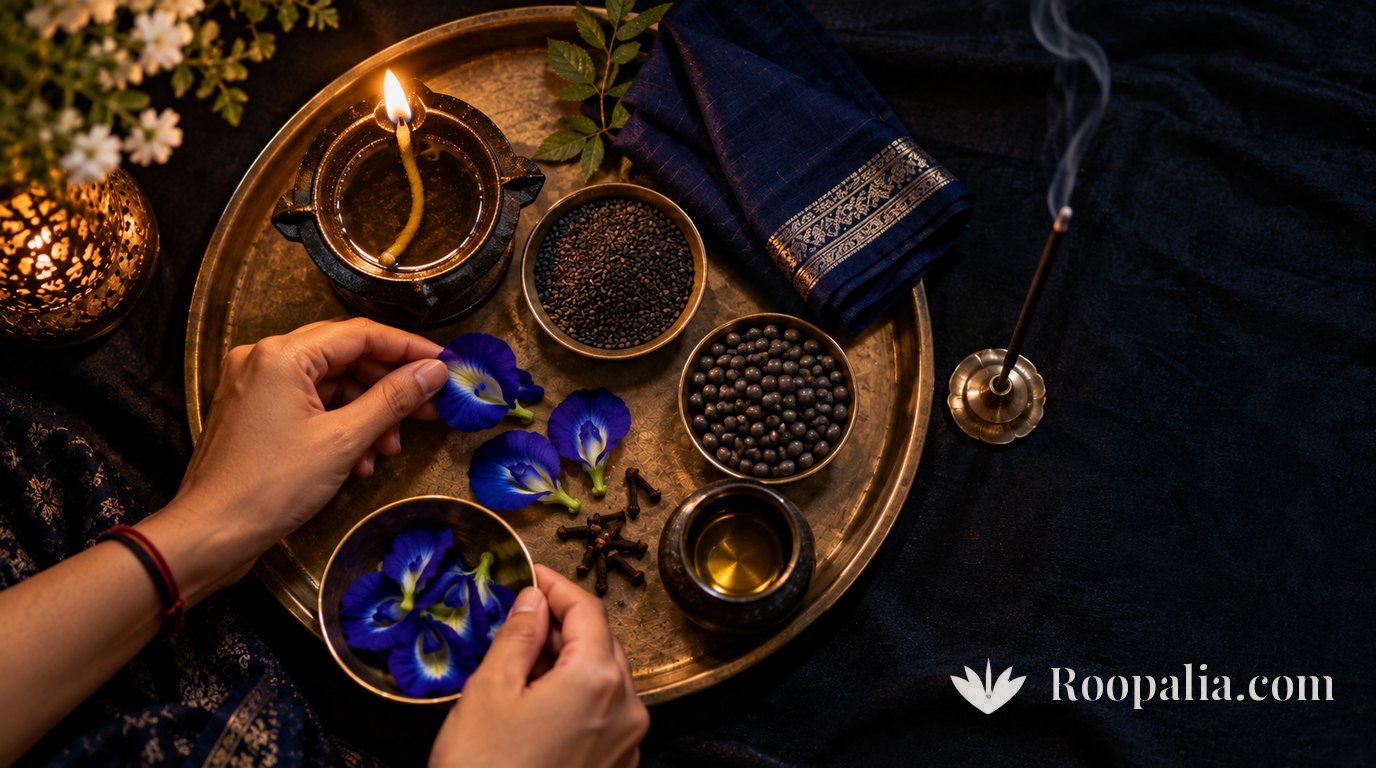
Ten steps. The order holds whether you do this at home or at a temple.
1. Bathe before sunrise. A few black sesame seeds in the water if you have them.
2. Wear dark blue, black, or simply anything clean. New clothes are not required.
3. Clean the house and the place of worship. In Shani's worship, cleanliness ranks above materials.
4. Take the sankalp, as above.
5. On a black or dark blue cloth place a Shani yantra, a picture, or simply a smooth black stone. An idol is not necessary.
6. Light a lamp of mustard or sesame oil, in an iron lamp if you have one. A ghee lamp does not belong to this tradition.
7. Offer black sesame, whole urad dal, blue flowers and a little oil. Light incense.
8. Chant — at least one mala. Which mantra is covered further down.
9. Read or listen to the vrat katha. This is not an optional extra; without it the fast is held to be incomplete.
10. Do the aarti, share the prasad, and set aside a portion of the meal for someone who needs it, for a labourer, or for a dog. This last step is not a formality in this vrat. It is the centre of it.
One line is worth adding to step ten. Shani is the deity of karma, and in this tradition what is said to please him is not the thali but the conduct. More on that in the rules section.
What you need — and why each item is there
The list looks long and costs almost nothing. That is a feature of this vrat: every item on it was something the poorest household could find.
| Item | How much | Why, in the tradition |
|---|---|---|
| Mustard or sesame oil | A small bowl | The oldest offering to Shani; the katha ties him to the oil-presser |
| Black sesame | A handful | Held to be Shani's grain; also added to the lamp |
| Whole urad dal | A handful | The pulse associated with Shani, for both the meal and the giving |
| An iron lamp | One | Iron is Shani's metal; a clay lamp does just as well |
| Blue flowers (aparajita) | Five or seven | Shani's colour is described as blue-black |
| Dark blue or black cloth | One piece | To spread at the place of worship |
| Incense | — | Standard to any puja |
| Cloves and black pepper | A few | Offered with the oil in some regions |
| Shani yantra, picture or a black stone | One | The focus of the puja; any of the three is accepted |
No aparajita — any blue or dark flower, and failing that plain rice grains. No iron lamp — clay. A shortage of materials does not break the fast, and nearly every vrat booklet says so explicitly.
What to eat during the Saturday fast — and what to avoid
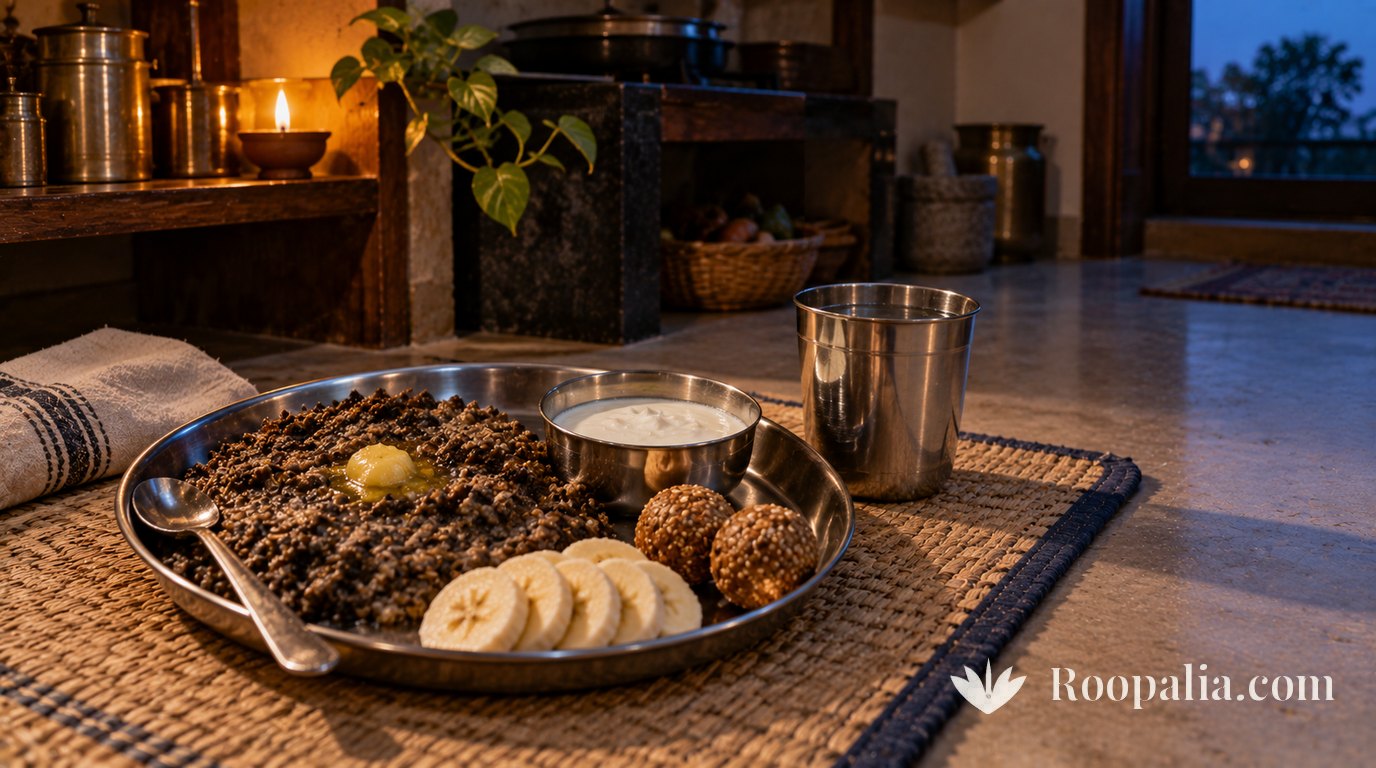
First, the misconception: the Saturday fast does not have to be waterless or grain-free. In most families it is ekabhukta — one plain meal, after sunset. Some keep to fruit through the day, some to water alone. All three are accepted, and the right one is whatever your body can carry.
✓ You can have
- Urad dal khichdi
- Black sesame halwa or laddoos
- Roti or puri made in mustard oil
- Curd and buttermilk
- Banana, ripe papaya, apple, sweet fruit
- Milk and milk preparations
- Rock salt (sendha namak)
✗ Leave out
- Meat and alcohol, in any form
- Onion and garlic
- Heavily fried or spiced food
- Stale or reheated leftovers
- Ordinary table salt, in some families
Two items draw contradictory advice, so they are worth settling.
Gram flour and chickpeas. Some pages list these as forbidden on Saturday. That rule actually belongs to the Thursday fast, where chana and besan are tied to Brihaspati and are avoided on the day in some traditions. No older basis for it on Saturday turns up. If it is your family's practice, keep it; there is no need to treat it as a universal rule.
Curd. Perfectly fine, and eaten with the evening khichdi as a matter of course. The ban on sour food belongs to the Friday Santoshi Mata vrat, not to Saturday. Different fasts; their rules do not travel.
Can you have salt during the Saturday fast?
Yes — rock salt is fine. On ordinary table salt, practice varies by family and region: some leave it out, many do not.
Where the confusion comes from explains the whole question. The clear, old prohibition on salt belongs to the Sunday fast, where a saltless meal is widely observed for Surya. Once the weekday fasts began to be printed as one list, the rule drifted onto neighbouring days. No separately recorded older basis for it on Saturday turns up.
The practical answer: if your family leaves salt out, use rock salt, which is accepted in every fast. If there is no such custom in your house, ordinary salt is fine. Anyone on blood-pressure medication should decide this with their doctor — no fast asks you to harm your body.
When to break the Saturday fast
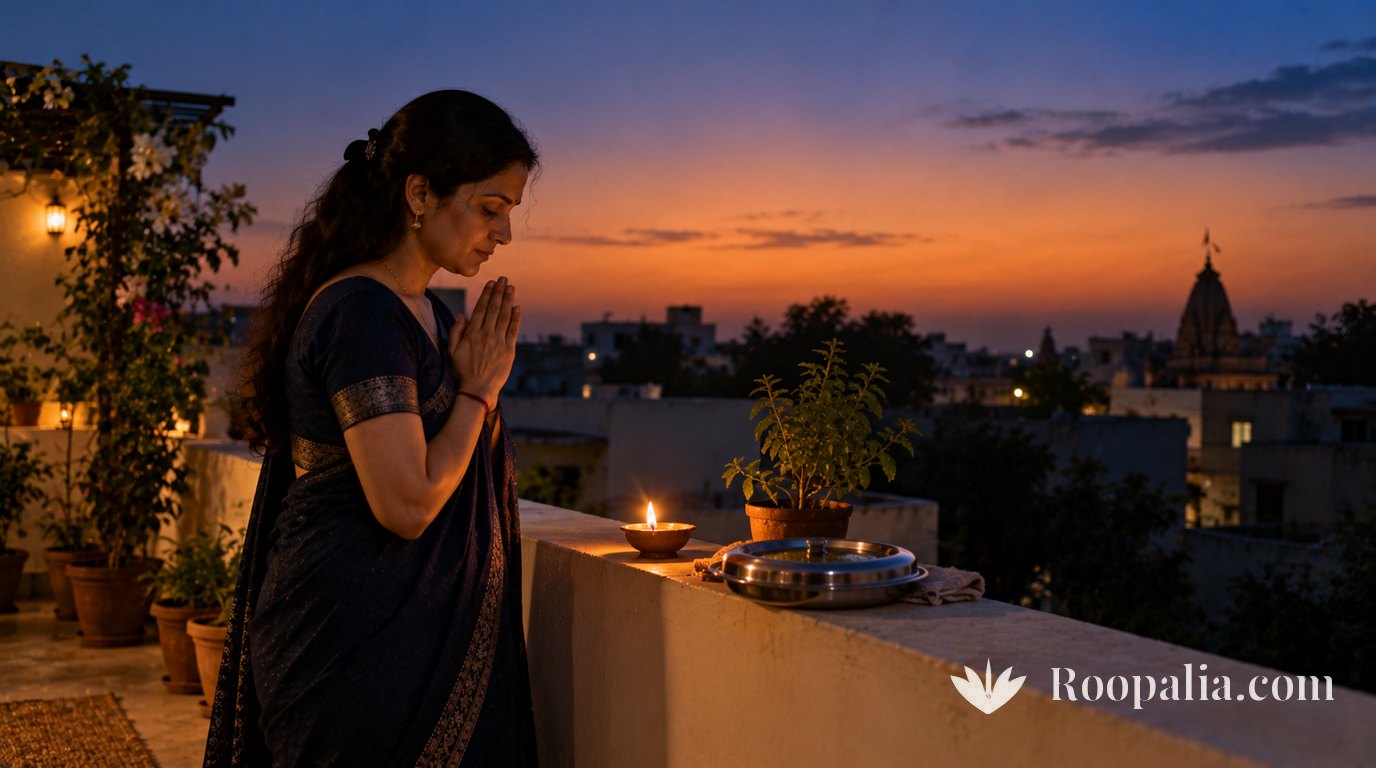
There is no clock time in the tradition. The rule is that the fast is broken after sunset, once the lamp is lit and the katha and aarti are done. Three practices are found, and all three are accepted:
| Practice | When | Where it is common |
|---|---|---|
| Straight after sunset | Once the lamp, katha and aarti are done | The most widespread |
| After the stars appear | Roughly 30–45 minutes after sunset | Many north Indian homes |
| Two hours after sunset | With the night meal | Several printed vrat booklets |
The evening meal is most commonly urad dal khichdi, with curd, a sesame laddoo or halwa, and a banana. Many homes also make roti or puri in mustard oil.
And the part that is not a formality: before you eat, set aside a portion — for a labourer, for someone who needs it, or for a dog. Nearly every vrat booklet carries this line, and it is the whole spirit of Shani's worship.
Take the timing from sunset in your own city, not from an Indian panchang. Where summer sunset falls after nine at night, the tradition allows breaking the fast in the afternoon instead.
On health: a long fast is not advisable with diabetes, pregnancy, blood pressure, thyroid conditions or any regular medication. Eat fruit in the afternoon and keep the evening meal plain. The point of the fast is restraint, not damage.
How many Saturdays — 7, 11, 16 or 51?
This confusion is real, not invented. Checked in September 2026, a search for shanivar vrat returns a Google AI Overview saying "7, 11 or 16 Saturdays", while a search for saturday fast returns a Google AI Overview from the same engine saying "11, 16 or 51 Saturdays". Two answers, one search engine.
The printed booklets say something else again — the number that recurs most often in them is 51 or 31. Households most often keep 11, 21 or 51. And in the southern Balaji tradition the question is not asked at all: you keep however many Saturdays fall in the month of Purattasi.
| Source | Number given |
|---|---|
| Google AI Overview (Hindi query) | 7, 11 or 16 |
| Google AI Overview (English query) | 11, 16 or 51 |
| Common printed vrat booklets | 51 or 31 |
| Ordinary household practice | 11, 21 or 51 |
| Purattasi (Balaji) tradition | All the Saturdays of that month |
So which is right? The honest answer is that there is no single canonical number. That follows directly from what was said earlier — the method of this fast is not compiled in any one Purana. Where there is no single source text, there can be no single authorised number.
What is actually settled is this: the number comes from your sankalp, not from scripture. Whatever number you resolve on is the length of your fast. The rule is not about the number. It is about finishing.
When to begin? Here the tradition does speak with one voice, which itself tells you something. The first Saturday of the shukla paksha of any month is held to be the most auspicious start, and the month of Shravan especially so. New fasts are not begun, and udyapan is not performed, during malmas or kharmas. If sade sati is already running, the fast can be started inside it; you do not wait for it to end.
Can women fast and pray to Shani?
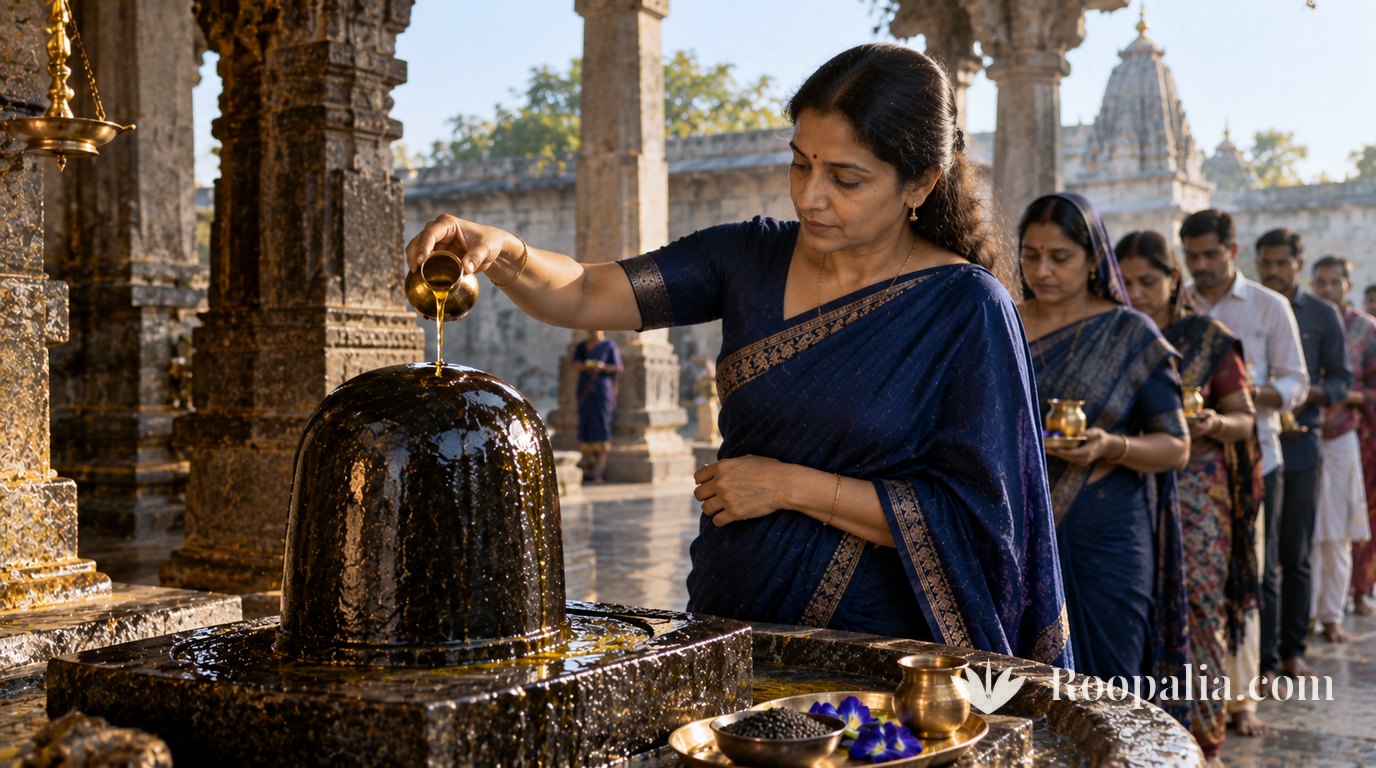
Yes. There is no recorded bar on a woman keeping this fast, offering oil, chanting, or reading the katha. It is worth saying flatly, because households say the opposite. The confusion has three sources.
One — the platform at Shani Shingnapur. At this well-known Maharashtra temple, custom for decades held that women could not climb the platform around the black stone. That single place made national news, and from it spread the belief that Shani's worship is not for women.
That changed in 2016. On 1 April 2016 the Bombay High Court held that entry into a place of worship is a woman's fundamental right and that protecting it is the state government's duty — where men are allowed, women must be too. Within days the Shani Shingnapur trust itself lifted the restriction and opened every part of the temple to everyone. The one example the belief rested on no longer exists.
Two — the idea of "Shani's gaze". Women are told not to look into the eyes of a Shani idol. The belief appears to descend from the Brahmavaivarta Purana episode with Ganesha. But in that story the effect of the glance turns on its intensity, not on the sex of the person — and the one whose insistence made Shani look was Parvati herself.
Three — family custom. Some households tell unmarried girls not to keep this fast. That is a family's own practice, not a recorded injunction.
So what can a woman do? All of it — the fast, the sankalp, the lamp, the oil, the chanting, the katha, the aarti, the peepal worship and the udyapan. Chanting in particular carries no restriction, which is worth repeating because it is a common worry.
During menstruation? Practice differs by region and family here, and no single rule can be imposed. What is widely followed: the fast is kept, but the puja is performed by another member of the household, or the day is kept with quiet remembrance and by listening to the katha — and the Saturday counts. If your family's custom differs, follow that.
Shani mantras — which one, how many times, on which mala
Four are in use. Pick one; they are not meant to be stacked.
1. The simplest name mantra — the right place to start:
oṁ śaṁ śanaiścarāya namaḥ
2. The beeja mantra — for those comfortable with the pronunciation:
oṁ prāṁ prīṁ prauṁ saḥ śanaiścarāya namaḥ
3. The Pauranic verse — Shani's verse from the Navagraha Stotra, the one most often sung:
nīlāñjana-samābhāsaṁ ravi-putraṁ yamāgrajam।
chāyā-mārtaṇḍa-sambhūtaṁ taṁ namāmi śanaiścaram॥
— Navagraha Stotra
Meaning: he whose lustre is like blue collyrium, son of the Sun, elder brother of Yama, born of Chhaya and Martanda — to that Shanaishchara I bow.
4. The Vedic mantra — Yajurveda 36.12, assigned to Shani in navagraha worship (as noted above, the original verse invokes the waters):
oṁ śaṁ no devīr-abhiṣṭaya āpo bhavantu pītaye।
śaṁ yor-abhi sravantu naḥ॥
— Yajurveda 36.12
How many, on what, and when? The usual count is 108 — one mala. Some booklets prescribe 19 or 3 malas of the beeja mantra. The mala is traditionally black agate or rudraksha; counting on the fingers is equally accepted. The best time for Shani's japa is said to be sandhya kaal, around sunset, though it can be done in the morning puja too.
Do not worry about the pronunciation. Stumbling over Sanskrit is ordinary, and the tradition has always ranked feeling above articulation. If it will not come, chant oṁ śaṁ śanaiścarāya namaḥ alone. That is complete and sufficient.
Rules of the Saturday fast — do's and don'ts
✓ Do
- Bathe before sunrise
- Clean the house and the shrine
- Light a mustard-oil lamp
- Read or listen to the katha
- Set aside food for someone who needs it
- Offer water at a peepal tree
- Speak gently to workers and elders
✗ Don't
- Quarrel or speak harshly to anyone
- Lose your temper with a worker or helper
- Eat meat or drink alcohol
- Humiliate or mock anyone
- Cut hair or nails (traditional)
- Buy new iron (in some regions)
- Borrow oil from others
One rule on that list stands above the rest, and it has nothing to do with the puja tray.
Shani is the deity of karma — he punishes, but never without cause. This is why every vrat booklet repeats that on this day no one should be harsh with a servant, a labourer, an elder or anyone weaker. The story you will read that evening rests on exactly the same point: King Vikramaditya's suffering did not begin with an error in a ritual. It began with a joke at someone else's expense.
How the fast is concluded — the udyapan
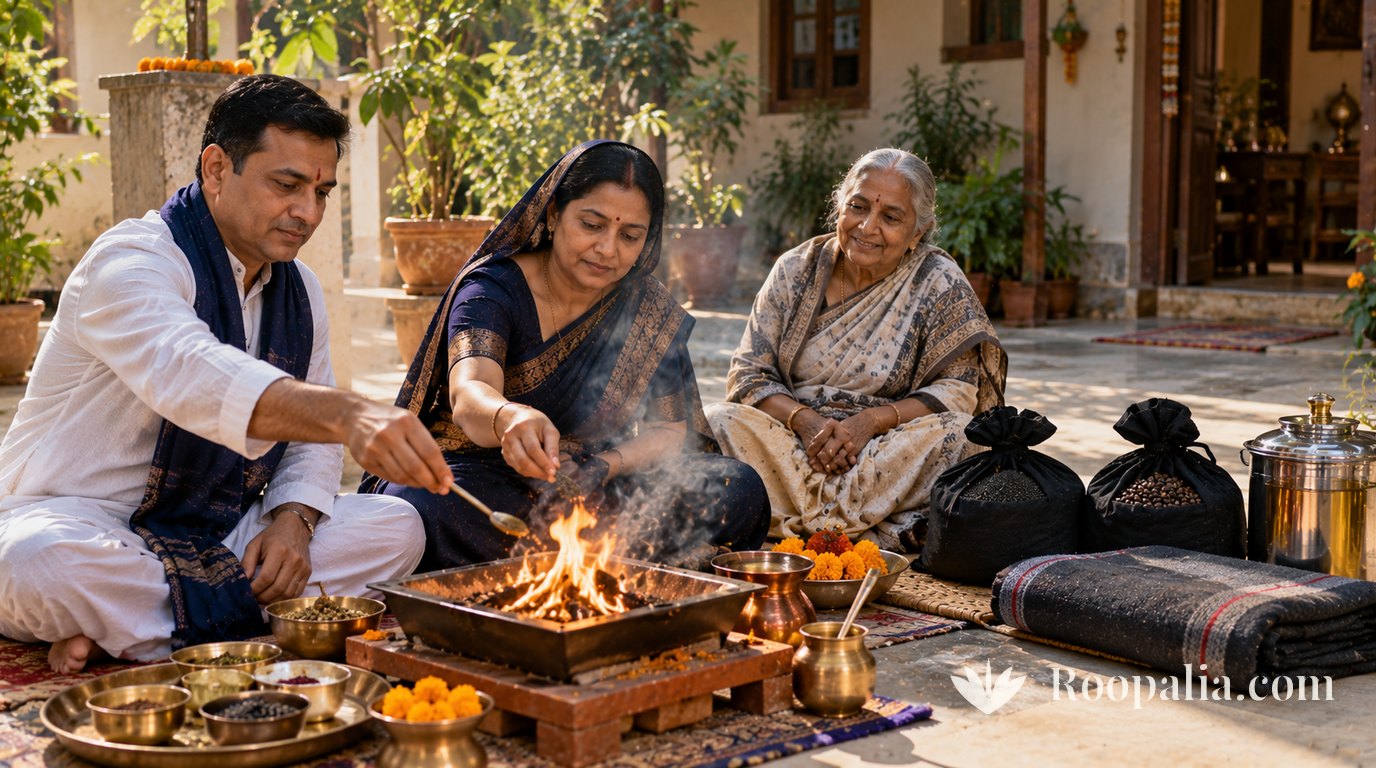
The udyapan is done on the last Saturday — that is, when the number you resolved on is complete. In the tradition the fast is held to be unfinished without it.
What you need: havan materials and mango wood, black sesame, whole urad dal, mustard oil, jaggery, a black or dark blue cloth, a blanket, something made of iron, a coconut, fruit, a lamp, incense and a dakshina according to your means.
1. Bathe and do the usual puja, this time in full.
2. Perform a small havan — at least 11 or 21 offerings of black sesame, urad and havan samagri.
3. Read the katha in full and do the aarti.
4. Give. This is the heart of the udyapan — black sesame, urad, mustard oil, a black cloth, a blanket and an iron object, to someone who genuinely needs them.
5. Feed a brahmin or anyone in need, and offer a dakshina.
6. Take the prasad with the family and declare the fast complete.
If a havan is not possible — you live in a flat, or nobody is available to conduct one — it is not a problem. A proper puja with a lamp, the full katha, the aarti and the giving is held to complete the udyapan. The giving is the part that is never dropped; the havan is the part that can be scaled to your circumstances. And since fear is sold on this subject, it should be said plainly: no penalty for a delayed or imperfect udyapan is recorded anywhere.
The peepal tree, mustard oil and black sesame
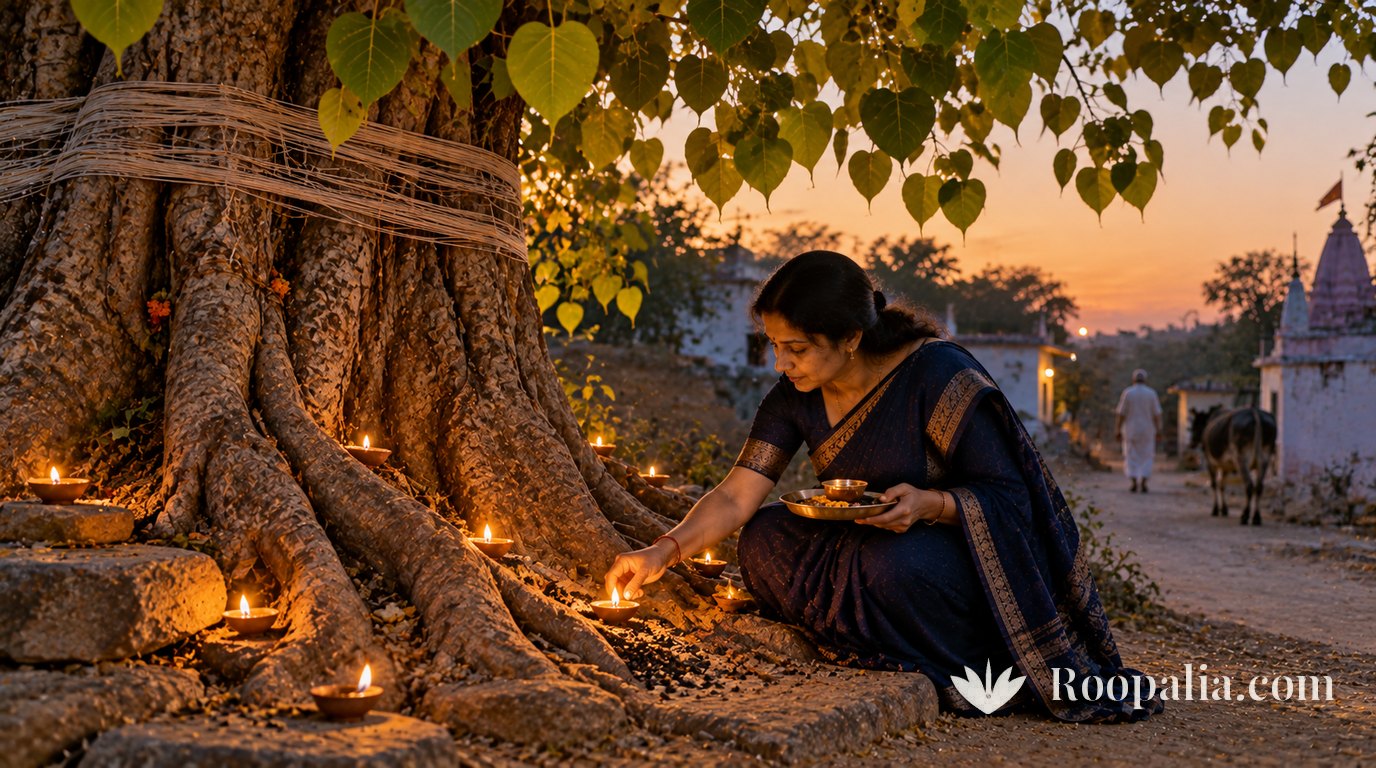
The peepal. Offering water at a peepal tree on Saturday, and lighting a mustard-oil lamp at its roots, is the most widespread of all these customs in north India — kept by those who fast and by those who do not.
Its root is the Shiva Mahapurana episode cited earlier. The sage Pippalada's name is itself derived from the tree — pippala is the peepal — and tradition holds that he was born beneath one. The practice of worshipping Shani under a peepal, and of invoking Pippalada to ease Shani's affliction, comes from there.
The method is simple: pour water at the roots, set a mustard-oil lamp beside them, wind raw cotton thread seven times around the trunk and walk seven circuits. In some places black sesame is added to the water.
Clear the dry leaves before setting a lamp at the roots in the evening, and place it where the wind cannot tip it. Dry peepal leaves catch very quickly. No booklet mentions this, but it should be mentioned.
Mustard oil. The oldest and most widespread offering. The tradition ties it back to the story itself — Shani is associated with the tailika, the oil-presser, and in the Vikramaditya katha the king's years of hardship are spent at an oil-presser's kolhu.
Black sesame. Held to be Shani's grain, and used three ways — added to the lamp, offered, and given away. Sesame laddoos also appear in the evening offering.
Keeping this fast outside India

The fast is no less complete there. Four things simply need deciding.
One — timing. Sunrise, sunset and the breaking of the fast all go by your own city. Where the summer day runs very long, eating fruit in the afternoon is fully accepted.
Two — materials. Mustard oil is stocked by Indian grocers in almost every country; note that in several countries it is sold labelled "for external use", which is fine for the lamp — keep a separate oil for cooking. Black sesame is in any Asian store, whole urad in any Indian one. If aparajita is unavailable, dried butterfly pea flowers sold as tea work — and failing those, any blue flower, or plain rice grains.
Three — the lamp. Many apartment buildings have strict rules about open flames and smoke. Keep the lamp in a glass holder, use a thin wick, and never light it under a smoke detector. Where flames are barred outright, an LED lamp carries no fault — the same principle of feeling over form applies.
Four — the peepal and the giving. There will be no peepal tree in most countries. Two substitutes are accepted: offer the water to a plant at home, or give away what you would have spent. A local food bank, or a meal to someone who needs one, completes the same intention — and the same route works on udyapan day.
And the question that comes up most: if you have to work on Saturday, the fast is not broken. Light the lamp in the morning, take the sankalp, chant, keep to fruit through the day, and read the katha when you get home. The fast is not about staying indoors. It is about restraint through the day.
Explaining the day to children
What reaches children first about Shani is usually fear — he will be angry, his gaze will fall on you. It is neither accurate nor useful.
The plain version is that Shani is the deity of karma — described in the tradition as a judge, one who keeps the account rather than one who hands out punishment. What you do comes back. Children already understand that. And it is the lesson of the story too: Vikramaditya's trouble did not start with a ritual error, it started when he mocked someone in open court. The whole architecture of the katha rests on arrogance, not on ritual.
Three things work in practice — let them light the lamp (supervised), give them the job of arranging the tray and counting out the sesame and urad, and tell them the story rather than making them read it. And do the giving with them. Setting aside a portion of the meal for someone else is the simplest and deepest thing in this vrat, and it is the part children take up fastest.
In closing
This fast is about accounting, not fear
There is far more fear sold around the Saturday fast than the tradition itself supports. The three things that genuinely recur in every source are these — a mustard-oil lamp, the reading of the katha, and a portion of the meal given to someone who needs it. The numbers, the salt, the gram flour and the rest come after, and opinion on them shifts. If everything except those three is missed, the fast still stands.
And if something is still unclear, ask the oldest woman in your family. Her version is more authoritative than any page on the internet, this one included.
Frequently Asked Questions
What can you eat during the Saturday fast?
Which god is the Saturday fast for?
How many Saturdays should the fast be kept?
How to do Saturday fasting for Shani?
What time should the Saturday fast be broken?
Can girls and women fast on Saturday and pray to Shani?
Can you have salt during the Saturday fast?
How is the Saturday fast concluded — the udyapan?
Which Shani mantra should be chanted, and how many times?
Why is a lamp lit under the peepal tree on Saturday?
When should the Saturday fast be started?
Can children and elderly people keep the Saturday fast?
What if a Saturday is missed, or menstruation falls on that day?
When and how should the Shanivar vrat katha be read?
📷 AI-generated images. For illustration only.
🙏 This article is general cultural and religious information. Scriptural references are drawn from widely available editions of the Shiva Mahapurana (Shatarudra Samhita), the Padma Purana and Skanda Purana (the Dasharatha Shani Stotra episode), the Brahmavaivarta Purana (Ganapati Khanda) and Yajurveda 36.12; practices vary by region and family. If you have diabetes, are pregnant, have high blood pressure or take regular medication, please consult your doctor before fasting.