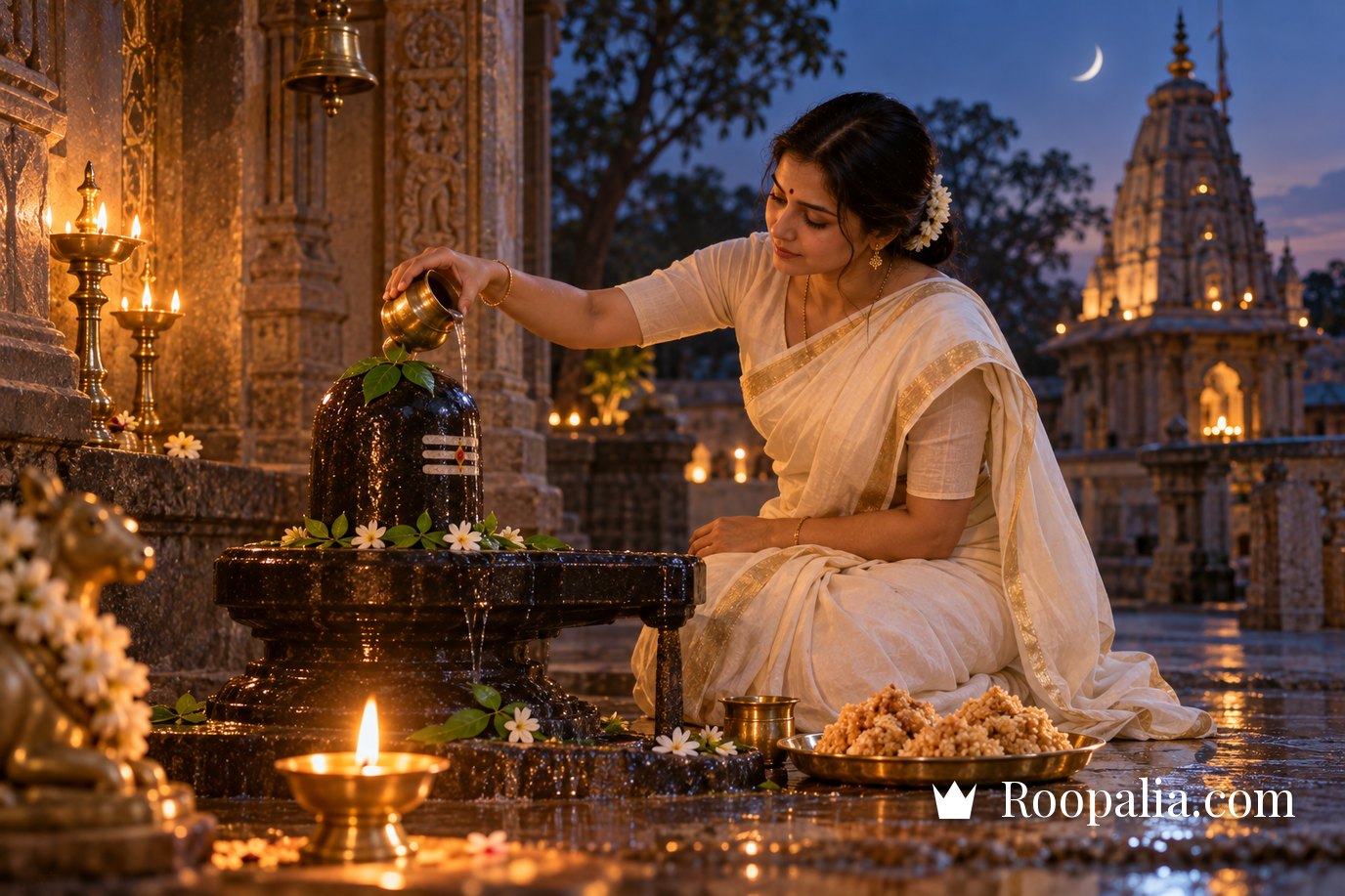
What is Solah Somvar Vrat, and how is it different from an ordinary Monday fast?
Solah Somvar Vrat is a committed fast kept on sixteen consecutive Mondays. That commitment is what separates it from the ordinary Somvar Vrat.
| Difference | Ordinary Somvar Vrat | Solah Somvar Vrat |
|---|---|---|
| Count | No fixed number | Exactly 16, consecutive |
| Sankalp | Optional | Essential |
| Duration | One day to a lifetime | About four months |
| Prasad | Any sattvic offering | Panjiri, in three portions |
| Udyapan | Not required | Required, on the 17th Monday |
| Timing of puja | Morning and evening | Especially Pradosh kaal |
The puja itself is nearly identical in both; the differences lie in the sankalp, the count, the panjiri and the udyapan. The full vidhi of the ordinary fast is in our Monday Fast guide.
One point belongs here because it is rarely mentioned. The Somvar Vrat described in the Skanda Purana (Prabhasa Khanda) runs for eight Mondays, not sixteen — a different datun twig, flower and fruit each Monday, with udyapan on the ninth. The sixteen-Monday form is later and separate, coming from the printed vrat-katha literature rather than from a Purana. Neither contradicts the other, but it is worth knowing where what you keep comes from.
Solah Somvar Vrat Katha — the complete story
The version read in households comes from printed vrat-katha compilations such as Barah Mahinon ki Vrat Kathayein. Here it is in full, retold in plain language.
The game of chausar
Once, Shiva and Parvati were wandering through the mortal world and came to the city of Amravati in the land of Vidarbha. The king there had built a magnificent Shiva temple — so beautiful and so calming that the two of them stayed on.
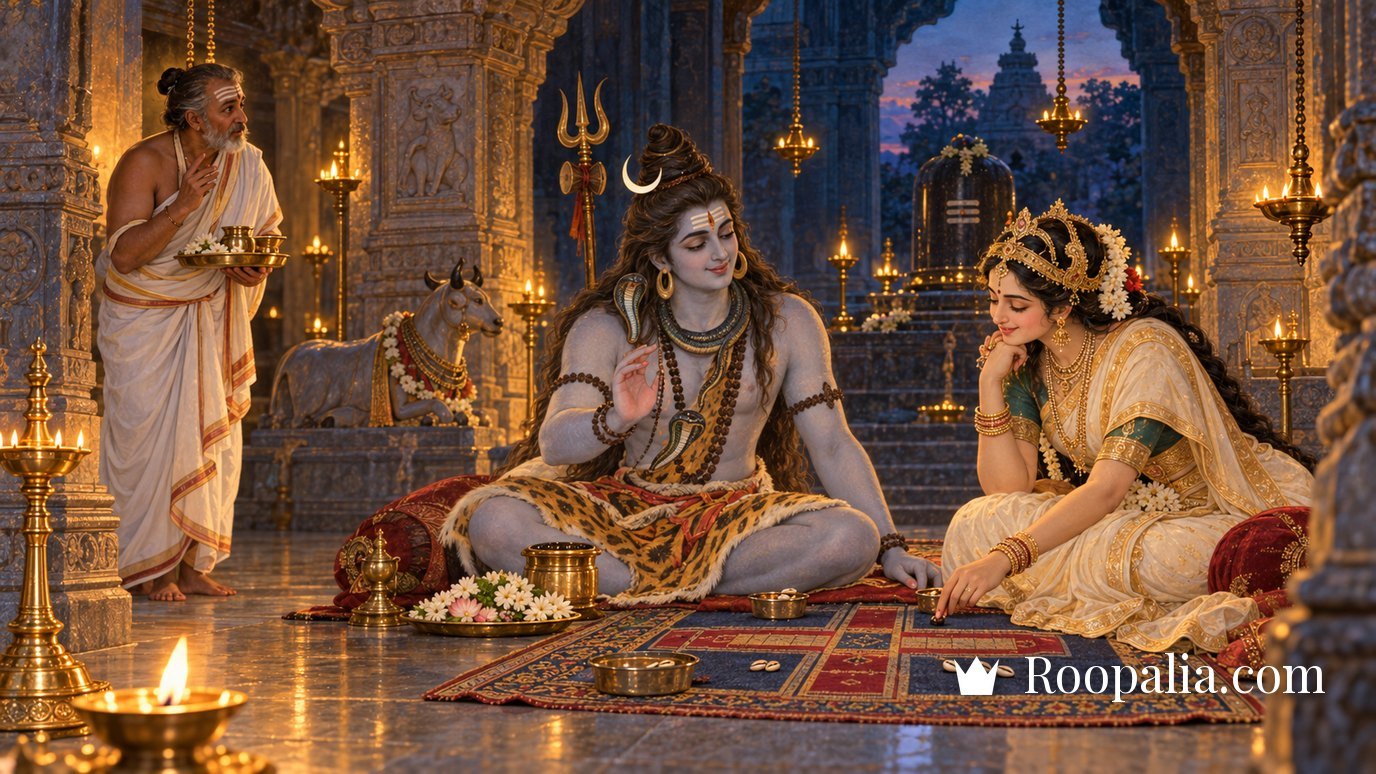
One day Parvati said, "My lord, come, let us play chausar." The game began. Just then the temple priest arrived for the evening aarti.
Parvati asked him, "Tell us — who will win?"
The priest was a devotee of Shiva. The words came out before he thought: "In this game none can match Mahadev. He will win."
But the opposite happened. Parvati won. And for speaking an untruth, she cursed the priest with leprosy.
One line deserves attention. Shiva tried to stop her, saying this was only the turn of fortune and the priest was not at fault. But the curse had been spoken.
First link — the apsaras to the priest
The priest suffered for a long time. One day apsaras came to the temple to worship, saw his condition and asked what had happened. He told them everything.
"Keep the Solah Somvar Vrat," they said. "Shiva will be pleased and your affliction will lift."
He asked how, and what they described is still the backbone of this vrat: bathe and wear clean clothes; roast wheat flour in ghee and mix in jaggery; divide it into three portions; worship Shiva in Pradosh kaal; offer one portion and distribute two. Do this for sixteen Mondays, and on the seventeenth make churma and complete the udyapan.
The priest kept the vrat with faith, completed the udyapan — and was cured.
Second link — the priest to Parvati
Some time later Shiva and Parvati returned to that temple. Seeing the priest entirely well, Parvati asked what remedy he had found, and he told her: the Solah Somvar Vrat, taught by the apsaras. Here the story takes the turn that is discussed least of all.
Third link — Parvati to Kartikeya
Parvati kept the vrat herself. For what? The katha says it plainly — for her estranged son Kartikeya. Through the vrat, Kartikeya was reconciled with his mother and became devoted to her again.
Kartikeya asked her, "Mother, why is it that my mind rests always at your feet?" And Parvati taught him the vrat.
Fourth and fifth links — Kartikeya, his friend, and the princess
Kartikeya kept the vrat so that he might meet a friend he had been separated from. The friend, a brahmin, returned.
The friend asked how, Kartikeya explained, and so the brahmin kept the vrat himself, wishing to be married.
He travelled abroad, where a king's daughter was to choose a husband and the king had vowed that whoever the royal elephant garlanded would marry her. The brahmin was only there to watch, sitting off to one side — and the elephant placed the garland around his neck.
Later the princess asked what merit had earned him that garland. He told her about the vrat, and she kept it herself, wishing for a child.
Sixth link — and the turn that sits uneasily
The son grew up, heard the story from his mother, and kept the vrat wishing for a kingdom. In time he inherited the throne — and continued the vrat even as king.
One Monday he asked his wife to bring the puja materials to the Shiva temple. Instead of coming herself, she sent them with her maids. When the puja ended, a voice from the sky said: abandon this wife, or you will lose your kingdom.
The king turned her out of the palace.
The queen wandered. A storm took away the bundle of thread an old woman gave her to carry; an oil-presser's pots cracked; the pond she drank from filled with insects; the tree she slept under lost its leaves. Everywhere she was called ill-fated and driven off.
Seventh link — the queen keeps her own vrat
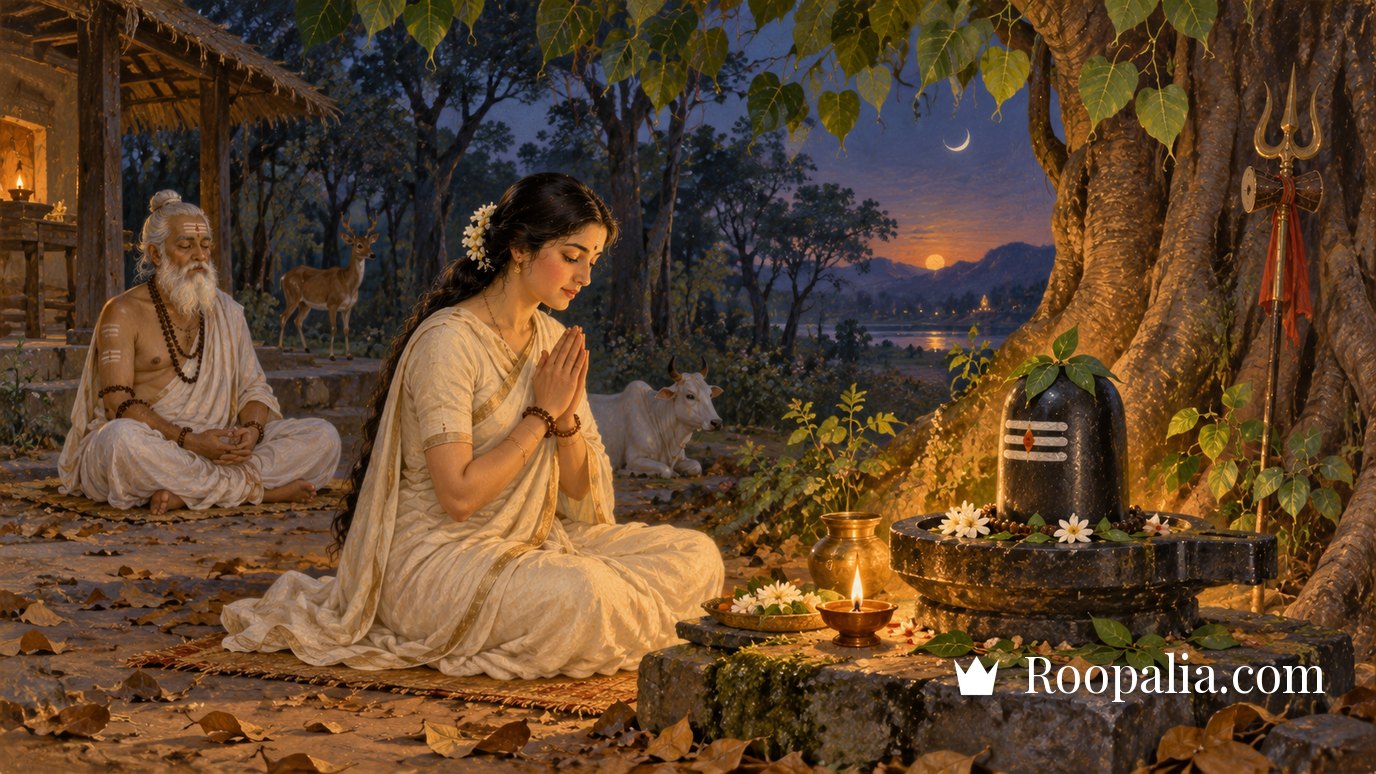
At last she reached an ashram. The old priest took one look and understood that this was a woman of high birth brought low. "Daughter," he said, "stay in my ashram. Do not worry about anything."
Even there, whatever she touched spoiled. Asked which deity she had offended, she said she had disobeyed her husband and had not gone to the Shiva temple herself.
He told her to keep the Solah Somvar Vrat. She kept it, completely and correctly.
Through the vrat the king remembered her and sent men to search. They found her at the ashram and asked to take her back. The old priest refused — "Tell your king to come and fetch her himself."
The king came in person and took her back to the palace with honour. The two of them kept the Solah Somvar Vrat every year thereafter and lived in contentment.
॥ Om Namah Shivaya ॥
The one thing about Parvati that almost every website gets wrong
You will have read it many times: "Goddess Parvati kept the Solah Somvar Vrat to obtain Lord Shiva as her husband." The sentence appears on some very large websites.
But it is not in the katha. You have just read the story in full. Parvati keeps this vrat for Kartikeya, her estranged son. Shiva is already hers — they are travelling together in the opening lines and playing chausar side by side.
So how did Parvati win Shiva? The answer is in the Rudra Samhita, Parvati Khanda of the Shiva Purana, and it is not a vrat but tapasya. She performed austerities in the forest while chanting the Panchakshara mantra — surrounded by fire in summer, on bare drenched rock through the monsoon, in water through winter. She gave up cooked food, then ate only leaves, then gave up even leaves, which is why she is called Aparna. The Saptarishis tested her, and at the last Shiva came disguised as a brahmin.
So what is accurate?
Parvati obtained Shiva through tapasya, and kept the Solah Somvar Vrat for her son.
This is not a trivial correction. The two stories teach different things — one says that what you truly want will cost you something of yourself, the other says that broken relationships can be mended. Both are worth having. Substituting one for the other loses both.
What the katha is really saying
First: it is a chain. The apsaras told the priest, the priest told Parvati, Parvati told Kartikeya, Kartikeya told his friend, the friend told his wife, the wife told her son, and at the end an old priest told the queen. Nobody arrives at it alone. Each one is taught, and each one teaches. This is a story about transmission more than about fasting — which makes it exactly the right story for anyone trying to hand something on to their own children.
Second: only one of the seven kept it for marriage. The other six wanted relief from illness, a reconciled son, a lost friend, a child, a kingdom, and a home restored. The katha settles the question of who this vrat is "for" without arguing about it.
Third, and most important: the queen. That passage is uncomfortable to read now — a husband turns his wife out on the strength of a voice from the sky. The story comes from a world where that was not considered remarkable, and nothing is gained by hiding it.
But read to the end, because that is where the story shows its hand. The queen is not rescued by her husband's mercy. She keeps the vrat herself, and only afterwards does he remember her. And when his men arrive to collect her, the old priest refuses outright: "Tell your king to come and fetch her himself."
By the last page, the power in this story sits with the queen's own resolve, and with an old man who took in a stranger everyone else had called cursed. If you are telling this story to your daughters, tell that part loudest.
When should you start the Solah Somvar Vrat?
The Solah Somvar Vrat can be started on any Monday of the bright fortnight; waiting for Sawan is not a requirement, though Sawan and Kartik are held most auspicious. In practice people begin in Shravana, Kartik, Vaishakh or Margashirsha; in South and West India, Kartik is more common.
Because the vrat runs sixteen weeks, check the udyapan date before you take the sankalp. Four months out you may find yourself travelling, or in the middle of a wedding at home.
📅 Upcoming start and udyapan dates
| Start | 16th Monday | Udyapan (17th) |
|---|---|---|
| 16 November 2026 — first Kartik Monday | 1 March 2027 | 8 March 2027 |
| 23 November 2026 | 8 March 2027 | 15 March 2027 |
| 19 July 2027 — Sawan (North India) | 1 November 2027 | 8 November 2027 |
| 9 August 2027 — Sawan (amanta regions) | 22 November 2027 | 29 November 2027 |
Dates follow the Indian panchang. Sawan falls on different dates in North India (purnimanta) and in the south and west (amanta), so both are given.
How to take the sankalp
The sankalp is the foundation here: it is what makes sixteen Mondays a single observance rather than sixteen separate ones.
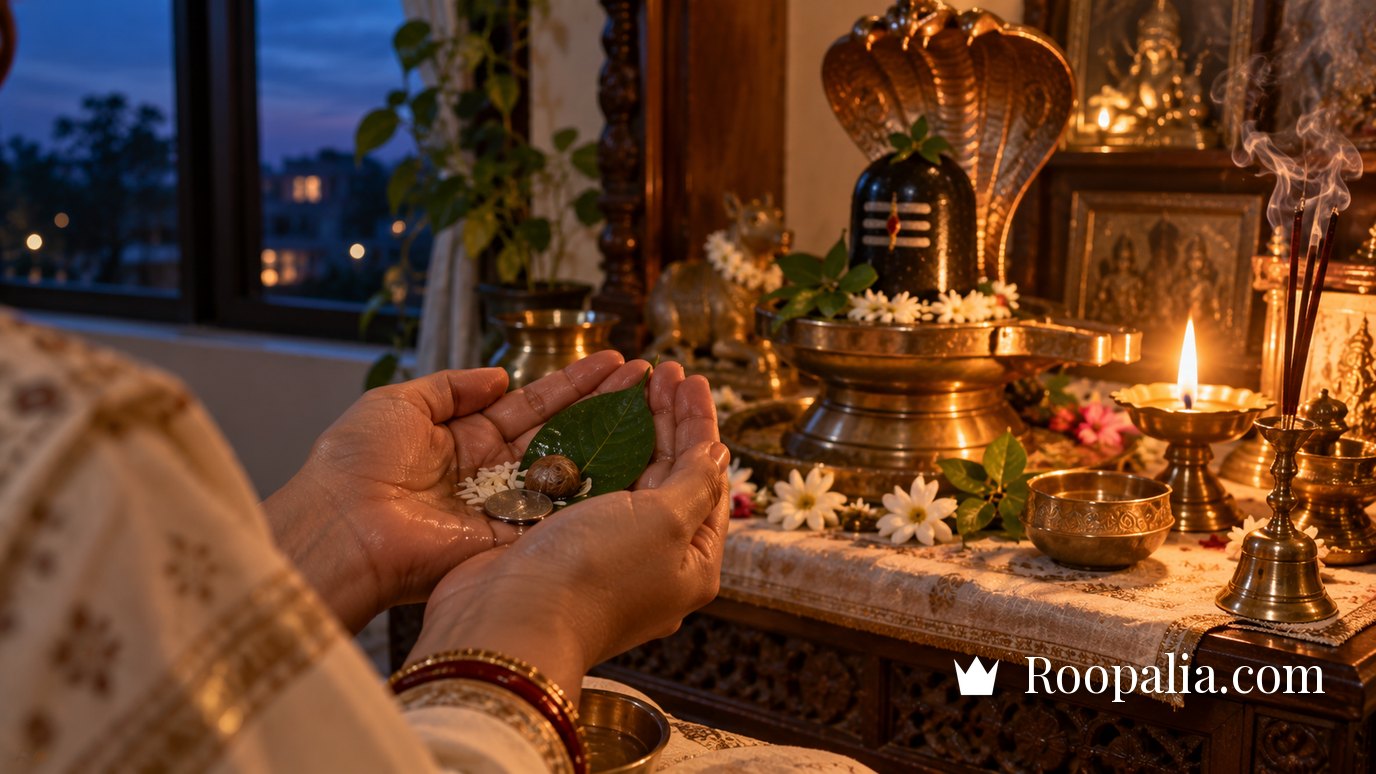
On the first Monday, bathe, wear clean clothes and sit facing east or north. Take in your hand water, whole rice, a betel leaf, a supari and a small offering of money, then say the sankalp aloud — your own language is fine. Three things must be in it:
- What you are doing — "From today I begin the Solah Somvar Vrat."
- For how long — "I will complete sixteen Mondays and perform udyapan on the seventeenth."
- Why — your wish, or simply "for the grace of Lord Shiva."
Then release everything into a copper vessel. And one practical instruction: write all sixteen Mondays into your calendar before you take the sankalp. That is the discipline this vrat is actually asking for.
Solah Somvar Vrat puja vidhi
The same sequence repeats every Monday. The main puja falls in Pradosh kaal — the window around sunset, roughly forty-five minutes either side. That is part of the method the apsaras describe, and it should not be skipped.
- Bathe and purify. Bathe early, wear clean clothes (white is preferred), and sprinkle the puja space with Gangajal.
- Sankalp. The full sankalp on the first Monday; on later Mondays simply note which Monday this is.
- Avahan. Holding rice and a flower, invoke Shiva together with Uma.
- Jalabhishek. Pour water over the Shivling from a copper or brass lota in a thin unbroken stream, chanting Om Namah Shivaya.
- Panchamrit abhishek. Milk, curd, ghee, honey and sugar in order, rinsing with clean water after each and at the end.
- Sandalwood, bhasma, offerings. White sandalwood paste, the tripundra in bhasma, then bilva leaves (smooth side down), white flowers, datura, rice and a sacred thread.
- The panjiri naivedya. Offer the panjiri divided into three portions — the method is explained below.
- Lamp, incense, japa. Light a ghee lamp and incense; chant Om Namah Shivaya 108 times on a rudraksha mala.
- Katha and aarti. Read or hear the Solah Somvar Vrat Katha, then perform the Shiva aarti.
- Prasad and parana. Distribute the panjiri, then break the fast.
Panjiri and the three portions — the instruction everyone leaves out
This is the most distinctive element of the vrat, and it goes missing from most online guides. It sits at the centre of what the apsaras actually prescribe.
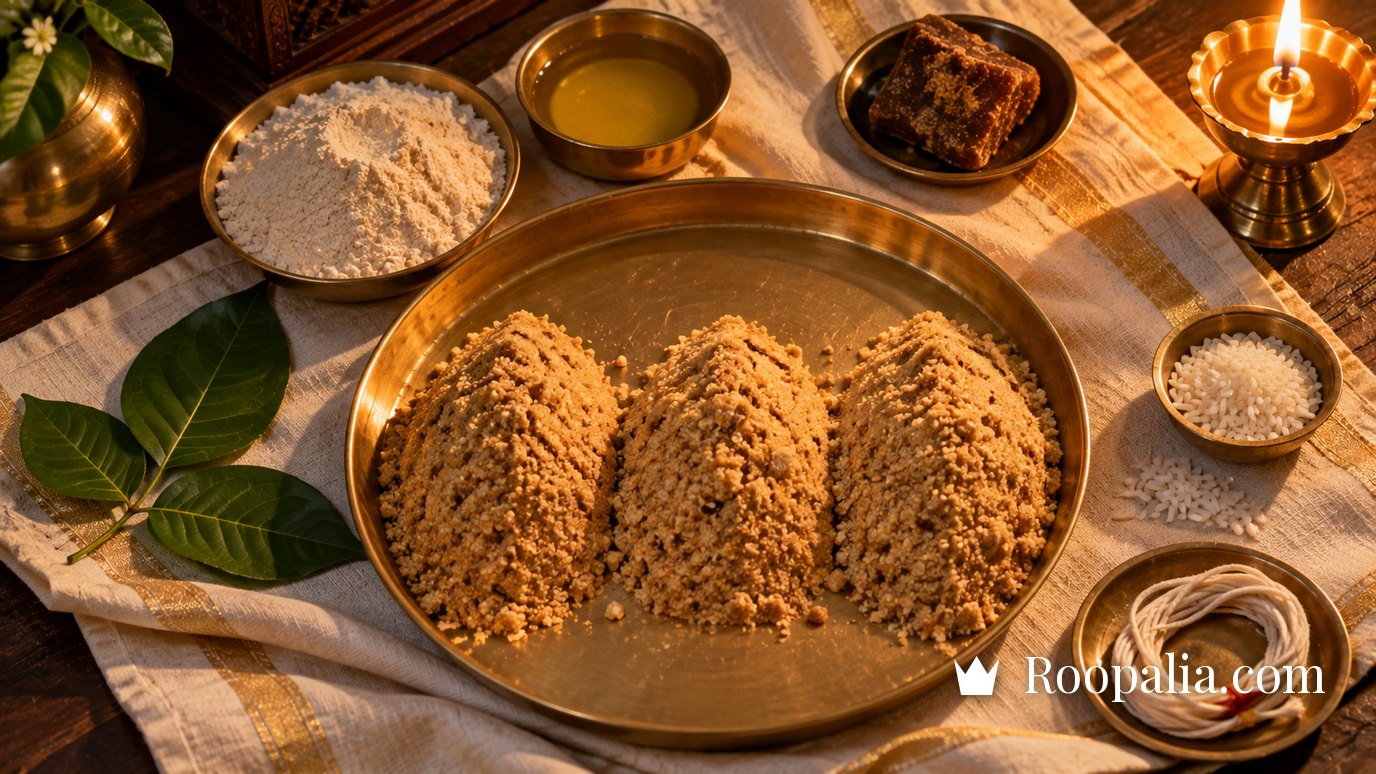
How to make it: the older text specifies "half a seer" of wheat flour, roughly half a kilo. Roast it in ghee over a low flame until golden, then mix in jaggery or sugar. Some households call the same preparation churma.
The three portions: divide it into three equal parts. Two traditions are current, and both are accepted:
| Tradition | First portion | Second portion | Third portion |
|---|---|---|---|
| As given in the katha | Offered to Shiva | Distributed to those present | Yourself and family |
| Widely followed variant | Offered to Shiva | Given to a cow | Yourself |
Follow your family's practice. If there is none, use the katha's version — it comes from the source text.
On the seventeenth Monday the quantity changes: about a quarter seer, roughly 225 grams of flour, made into churma, offered to Shiva and shared with everyone present.
🌾 What the three portions mean
Notice that two of the three portions are for others — one for the deity, one for people or for a cow — and only one is yours. The whole philosophy of the vrat is laid out on a single thali.
This is why skipping the panjiri and offering only fruit leaves this particular vrat incomplete. The panjiri is not merely prasad; it is a weekly exercise in giving most of it away.
Rules and food during the Solah Somvar Vrat
Because this vrat runs four months, its most important rule is practical: choose a form you can sustain sixteen times. Three forms are common:
- Phalahar — fruit, milk and buttermilk through the day, one sattvic meal after the evening puja. The most widespread.
- Ek bhukt — a single meal in the day, water or milk otherwise.
- Strict fast — water only. The katha mentions it, but over four months it is unsuitable for most people.
Allowed: seasonal fruit, milk, curd, buttermilk, paneer, sabudana, samak rice, kuttu and singhada flour, potato, sweet potato, bottle gourd, makhana, nuts, coconut, jaggery and mishri; rock salt, black pepper and cumin for seasoning.
Avoided: grains, ordinary salt, onion and garlic, meat, fish, eggs, alcohol and tamasic food. Water is not restricted — drink through the day.
Other rules: avoid anger, harsh words and untruth in particular — the whole katha begins with one false sentence. Send no one away empty-handed, and never skip the sharing of the panjiri.
⚠️ Health — this is a four-month fast, please read this
- Pregnant and breastfeeding women should not attempt a full fast; phalahar is enough
- With diabetes, sixteen weeks of fasting can destabilise blood sugar — never alter medication or meal timing without asking your doctor
- With blood pressure, thyroid, kidney or heart conditions, decide only after speaking to your physician
- For elderly people, children, students in exams and anyone doing heavy physical work, phalahar is the appropriate form
- Dizziness, palpitations, weakness or a cold sweat mean you break the fast immediately — protecting the body comes first
There is no fault in choosing a gentler form. The sankalp is to the vrat, not to hunger.
What if you miss a Monday?
Something always intervenes over sixteen weeks — travel, illness, a death in the family.
The most widely followed answer is not to count the missed Monday and to extend the vrat until sixteen are complete. If the seventh was missed, the next Monday becomes the seventh, and the udyapan shifts a week later.
Some stricter traditions require starting again if the sequence breaks. That view is not universal. The sensible course is to settle it once with your family priest or the senior woman of the house and then hold to it — changing the rule midway weakens a sankalp far more than one missed Monday does.
And if you are ill or travelling on a Monday, doing only the puja and the katha without the fast counts in many households as having kept that Monday.
What to do about periods during the Solah Somvar Vrat
This cannot be avoided in a vrat of this length — over sixteen weeks menstruation comes three or four times, and some of those land on a Monday. Most guides do not touch the subject at all.
The prevailing tradition is that the sankalp is not broken. Puja, abhishek and touching the Shivling are avoided on those days while the fast continues. Three routes are current:
- Have someone else do the puja — another woman of the house, a husband, a mother or sister performs that Monday's puja and offers the panjiri; the observer continues the fast and silent japa.
- Mental puja — sitting at a distance, chanting Om Namah Shivaya and hearing the katha, touching nothing.
- Not counting that Monday — and adding one at the end to complete sixteen.
All three are accepted. And one thing should be said plainly, because many young women worry about it unnecessarily: nowhere does the tradition say menstruation destroys the vrat or incurs sin. The rules that exist concern touch and the puja room — not your sankalp.
How to perform the udyapan on the seventeenth Monday
Once sixteen Mondays are complete, udyapan is performed on the seventeenth Monday. Without it the vrat is considered unfinished.
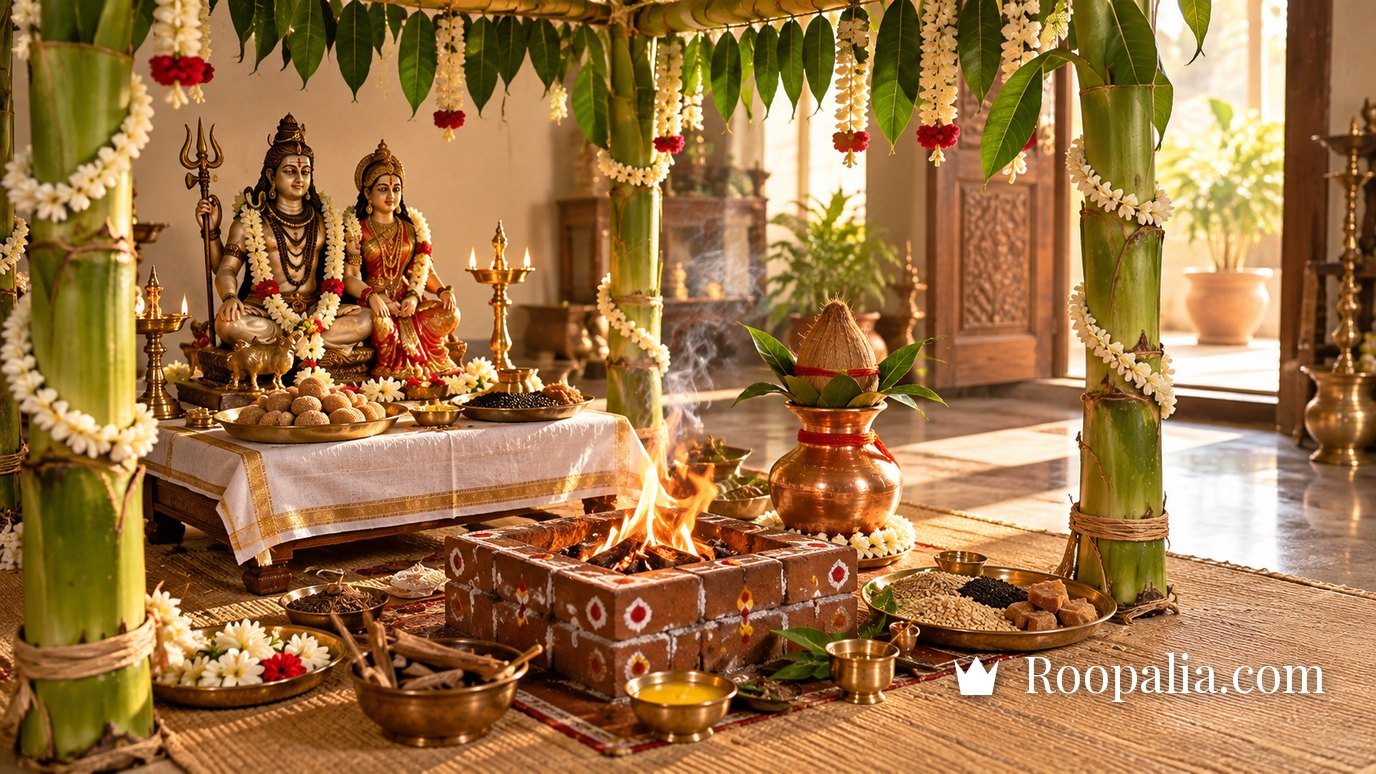
- Bathe in the morning, wear clean clothes and purify the puja space.
- Build the mandap — four banana stems forming four gateways, with mango-leaf toran and white flower garlands.
- Install the kalash — water, a supari, a coin, rice and mango leaves inside, a coconut on top.
- Install Shiva and Parvati on a chowki spread with new white cloth, invoking them with the Panchakshara mantra.
- Panchamrit abhishek followed by the full shodashopachara puja.
- Havan — offerings of ghee, sesame, barley and jaggery with Shiva mantras.
- The churma offering — about 225 grams of wheat flour made into churma, offered and shared with everyone present.
- Dana and bhojan — dakshina and cloth to the acharya, a meal for those in need, then prasad for the family.
- Kshama-prarthana to close.
Nothing requires this to be large. If a mandap is impossible, four banana leaves, a kalash and a havan at home are enough. Tradition has never asked for more than your means allow.
Keeping a four-month vrat abroad
First, dispose of the question that troubles everyone: do you follow the Indian date or your own? Your own. This vrat runs on the weekday, not the tithi. When it is Monday where you live, that is your Monday, and your own sunset is your Pradosh kaal.
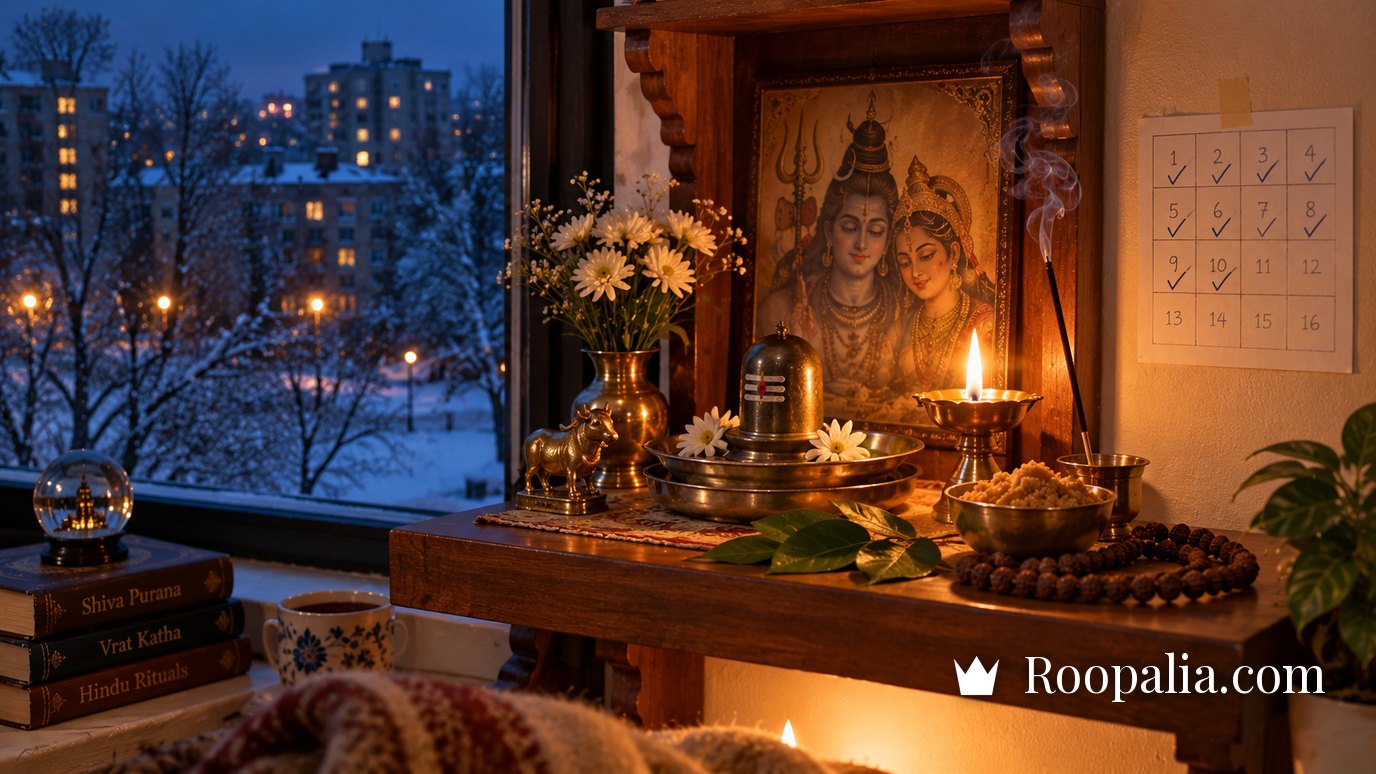
The real difficulty is the length:
- Make a tracker. Draw sixteen squares on paper, stick it on the wall, tick one off each Monday. On the fourteenth Monday that is what keeps you going.
- Plan for winter. Starting in Kartik puts the vrat through the darkest months in Europe and North America, where sunset can be at four o'clock and Pradosh kaal lands in your working day.
- Panjiri is the easiest part. Wheat flour, ghee and jaggery are in every Indian grocery; twenty minutes' work.
- No Shivling or bilva leaves? An image of Shiva and dried bilva leaves both serve; failing that, a single lota of water offered with faith is enough.
- Smoke alarms? Keep the lamp small or use an electric diya. If a havan indoors is impossible, replace it at udyapan with an extended puja and charity.
- Who gets the panjiri? Colleagues, neighbours, your children's friends, or a food bank. Giving it away is the point of the three portions.
And this: children who watch sixteen weeks of it do not forget. That is exactly what happens in the katha — someone saw, then asked, then learned.
Handing the chain to your children
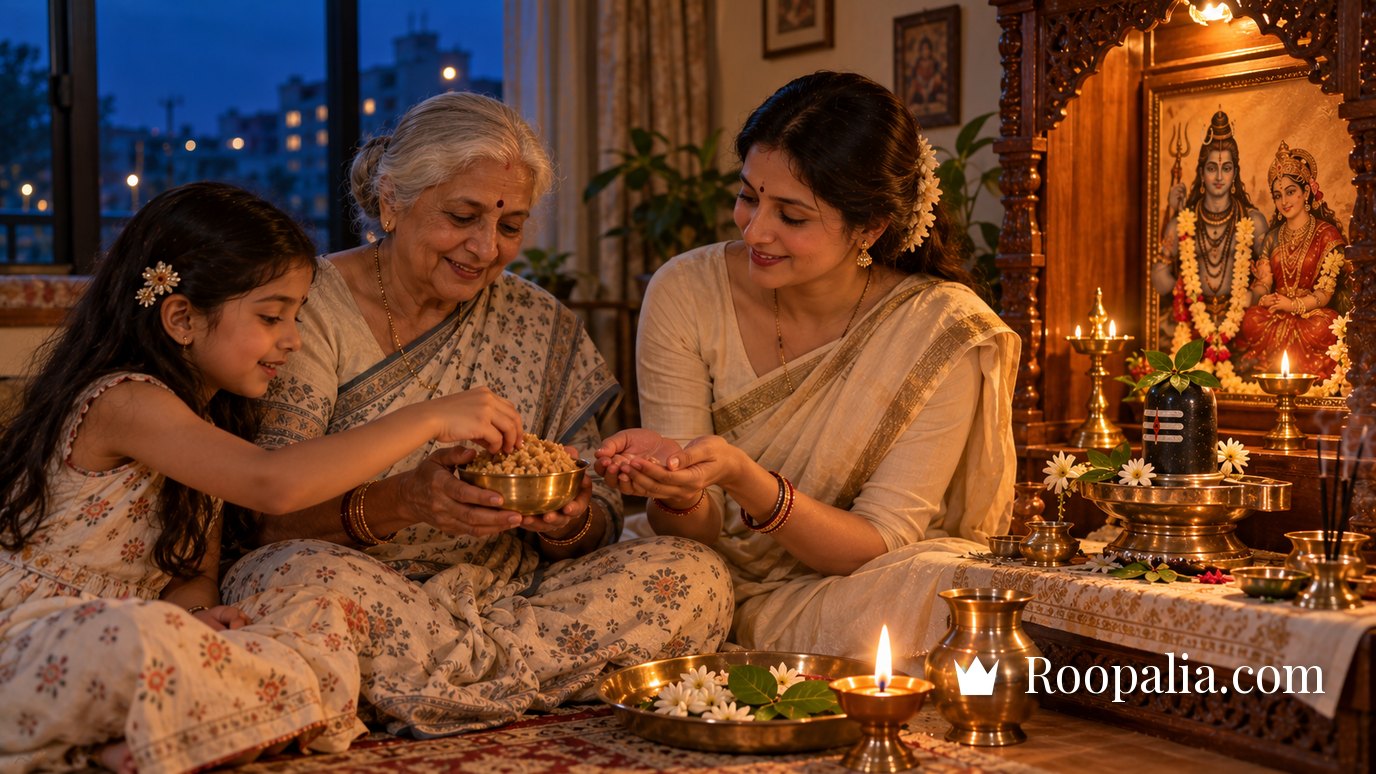
For younger children (5–9). Bring them into making the panjiri; the smell of flour roasting in ghee stays with a person for life. Then, as you divide it, ask whose the three heaps are. When they say "one is ours," explain that only one of three is ours. That is the first lesson, and it needs no sermon.
For older children (10–14). Tell the katha as a puzzle. "Who taught the priest? Who taught Parvati? And Kartikeya?" Let them assemble the chain. When all seven are linked, ask where the chain has reached now. They will answer it themselves.
For teenagers. Talk to them directly about the queen. That passage will bother them, and it should. Ask who actually rescued her — and let them see that she kept her own vrat, and that an old priest told a king to come and fetch her himself. A tradition survives when it can be questioned.
And the most effective method is the simplest: do not make a child fast. Let them hand out the panjiri on a few Mondays. What the hands do is what stays.
In closing
The real difficulty here is not hunger; it is continuity. Over sixteen weeks the enthusiasm drains, festivals arrive, and some Monday comes when you would rather let it go. That is precisely the practice.
The katha says as much. Nobody in it was saved by a miracle — all seven simply did what somebody had told them, sixteen times, without breaking off. And each of them, having finished, told someone else.
🪔 If you remember one line from this guide
Divide the panjiri into three, and remember that only one of the three is yours. This is not a fast about going hungry sixteen times; it is a practice of giving away sixteen times.
And the seventeenth Monday is not only for the udyapan. In the katha, everyone who finished told somebody else. That is where your link closes.
Disclaimer: This article presents religious tradition, vrat-katha literature and popular belief for informational purposes. The katha is based on printed compilations and retold in our own words; versions, procedures and dates differ by region and family — give priority to your own household's practice and local panchang. Nothing here is medical advice. Please consult your doctor before extended fasting, particularly in pregnancy or with diabetes, blood pressure, thyroid or any chronic condition.
Frequently Asked Questions
The vrat runs sixteen Mondays, so here are sixteen questions.