Shukravar Vrat Katha — the full story
There was once an old woman with seven sons. Six of them earned; the seventh did not.
She fed the six well, and whatever remained on their plates she gave to the youngest. He was a simple man. He ate it quietly and never said a word.
One day his wife noticed. She said to him, "Do you even know? Your mother feeds you what the others leave behind."
He did not believe it at first. When he watched, he saw that it was true. Shame settled on him. He told his mother, "I am going away. I will come back only when I have earned something."
As he left he asked her for a parting mark. She pressed a hand smeared with cow dung onto his back and sent him off.
He walked a long way and reached a distant town, where he asked a merchant for work. The merchant took him on. He worked without stopping, and his diligence made the business grow. Within a few years he was a partner in the shop. Money came, and comfort came — and the memory of home slowly faded.
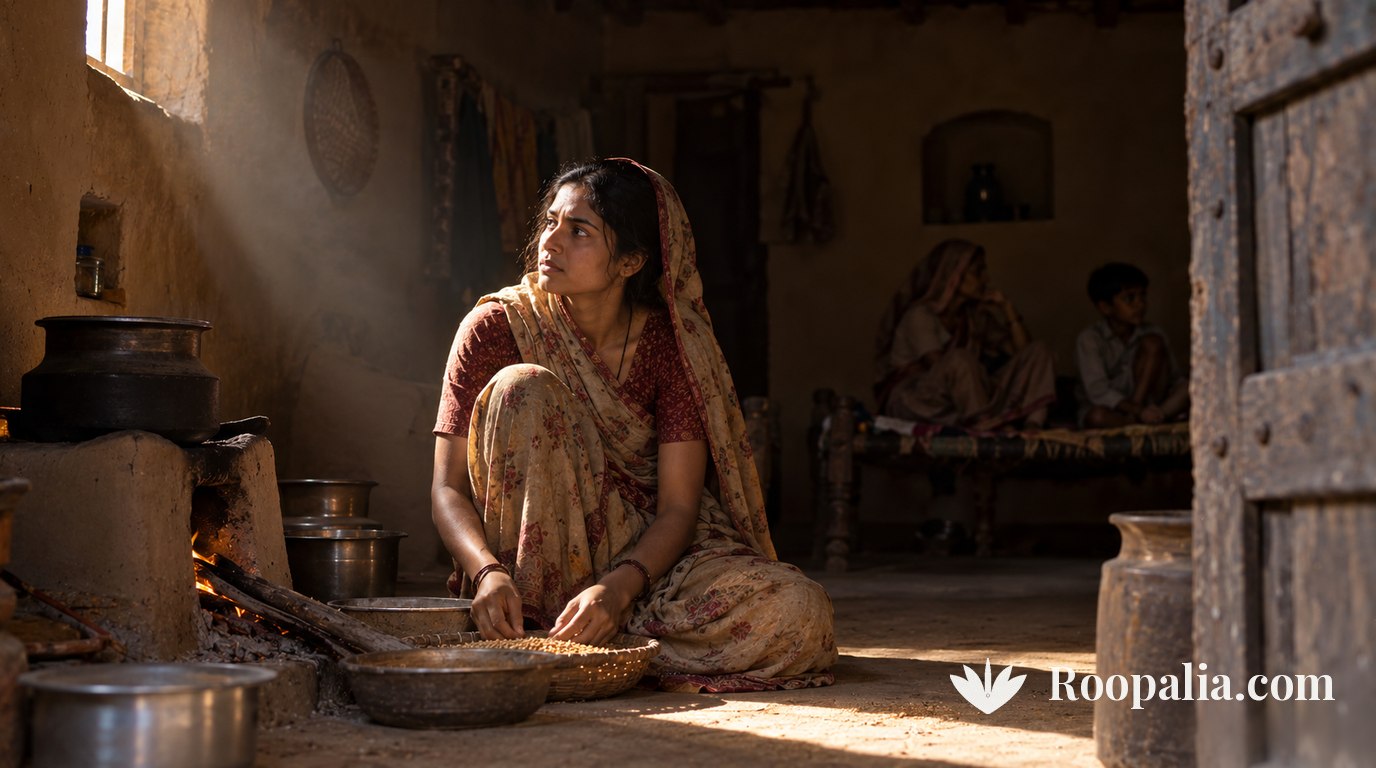
At home, the weight fell on his wife. Her mother-in-law and the older daughters-in-law made her do the work of the whole house: fetching firewood from the forest, grinding grain, scouring vessels. She ate whatever was left after everyone else and slept in the room where the chaff was kept.
One day, walking towards the forest for firewood, she passed a group of women returning from worship. They had been keeping the Santoshi Mata vrat. She stopped and asked, "What fast is this? How is it kept?"
They told her: "It is kept on Fridays. Offer the Mother a little jaggery and roasted chickpeas, listen to the katha, and eat nothing sour all day — and give nothing sour to anyone. Whoever keeps sixteen Fridays with faith, the Mother looks after."
She had no money, no jewellery, no one to turn to. The fast she was given was cheap too — a little jaggery and a handful of chickpeas. Perhaps that is exactly why she could keep it. In this story, the Goddess is pleased by the one offering the poorest woman in the village can still afford.
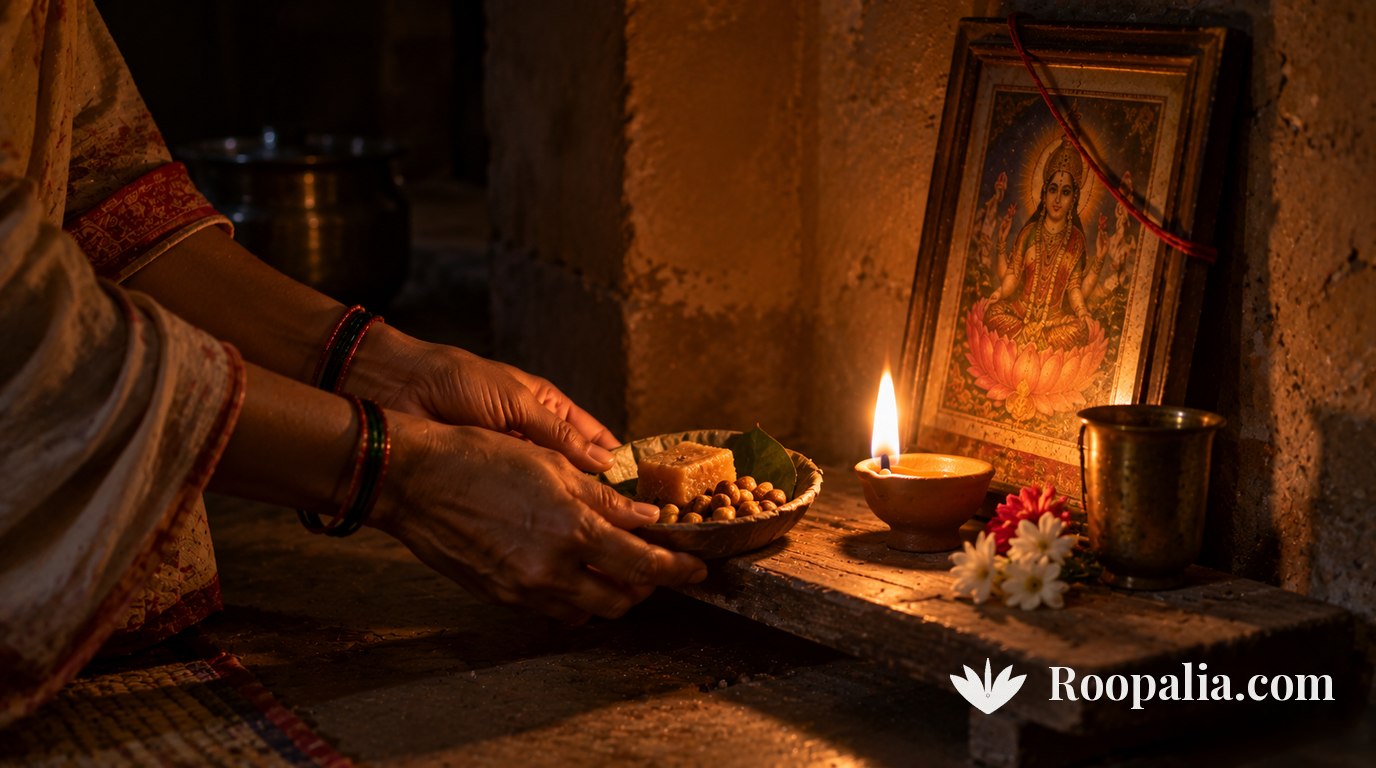
From the following Friday she began. She lit a lamp, offered jaggery and chickpeas, listened to the katha, and kept away from anything sour all day.
Only a few Fridays had passed when her husband, asleep in that distant town, had a dream. In it the Mother said, "Your wife is suffering in your name. Go home."
He woke with a start. The dream would not leave him. He settled his accounts with the merchant and prepared to return.
He came back a wealthy man. Seeing the state his wife was in, his eyes filled. He set up a separate household, and the two of them lived in peace.
The turning point — sour food at the udyapan
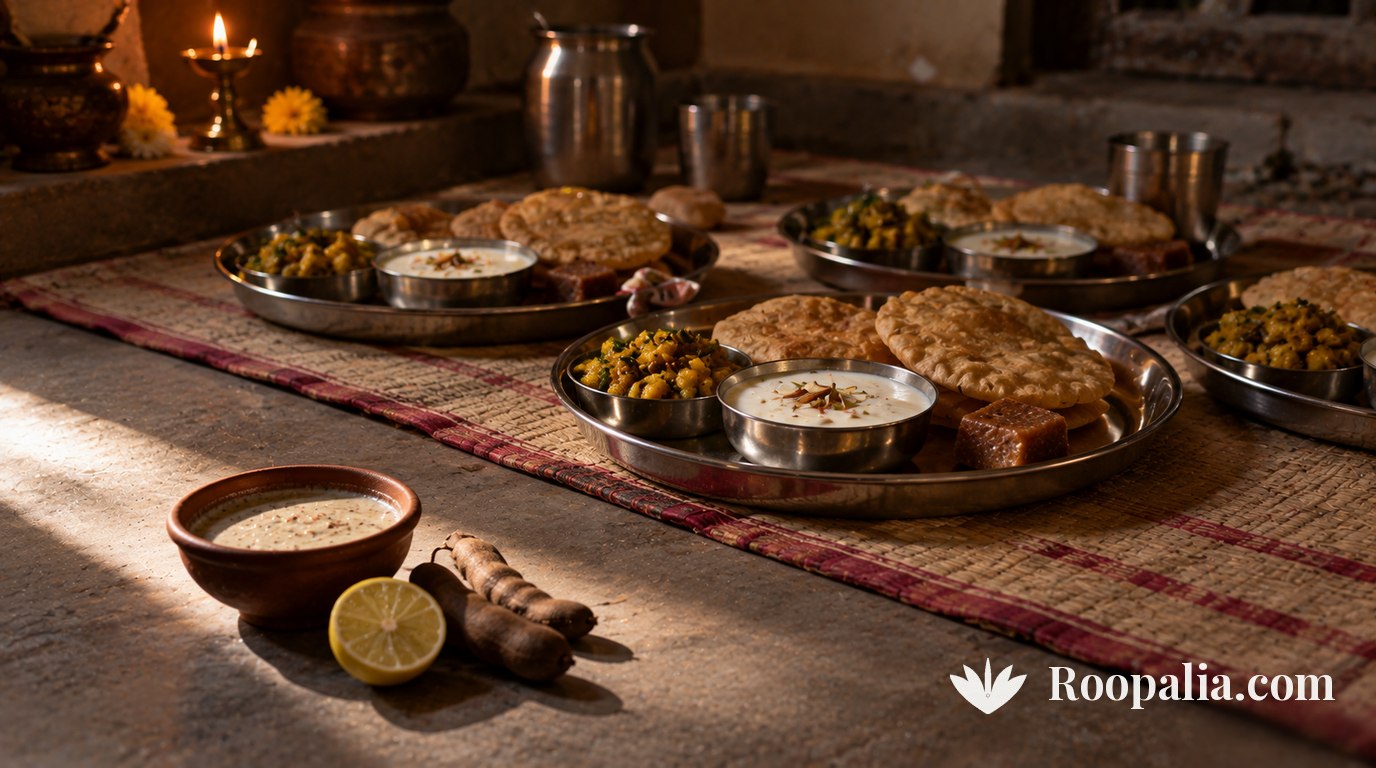
The sixteen Fridays were completed. She prepared for the udyapan — kheer, puri, plain vegetables, and eight boys invited to eat.
But the older daughters-in-law were bitter. They coached their children: "When the food is served, insist that you want something sour."
Halfway through the meal the boys began demanding it. She tried hard to refuse, but the argument grew and in the end something sour was given.
In that moment the udyapan was broken.
That same day the king's men came and took her husband away on some charge. The darkness returned to the house.
Weeping, she sat before the Mother and said, "I made a mistake. Forgive me."
In a dream the Mother told her, "Sour food entered your udyapan. Keep the fast again, properly."
She kept the sixteen Fridays a second time. At this udyapan she checked every single thing herself — no curd in the kitchen, no lemon, no tamarind, no pickle. She fed eight boys, gave them a small offering and took their blessing.
Within days her husband was cleared and came home.
In time a son was born to her.
One day the Mother herself came to the house in a fierce form. The mother-in-law and the sisters-in-law fled in fear, but the wife recognised her and laid her head at her feet. Then the Mother showed her gentle form. The others too asked forgiveness, and the whole family was blessed.
॥ Jai Santoshi Mata ॥
The other story — Satyavati and Birju
Now the version you may have heard, which does not appear above.
This one opens in the world of the gods. On Raksha Bandhan, Ganesha's sister ties a rakhi on his wrist. Watching this, his two sons — Shubh and Labh — insist that they want a sister too. Urged by Narada and by Riddhi and Siddhi, Ganesha brings forth a daughter, and Narada names her Santoshi, the one who gives contentment.
The story then moves to earth. A devotee named Satyavati, through her worship of Santoshi Mata, is married to Birju. Narada's mischief provokes the jealousy of three goddesses, who set out to test her. Birju goes away to earn; a rumour spreads that he is dead; Satyavati is tormented in the household. She keeps the sixteen-Friday fast, Birju is reminded of her in a dream and returns wealthy. At the udyapan her sisters-in-law mix in something sour, disaster follows, and in the end the Goddess restores everything.
Why the two versions differ — worth knowing
The shorter, unnamed story above is the one printed in the old vrat pamphlets, and it is the one still read on the day of the fast. It names no character and makes no mention of Ganesha.
The longer Satyavati-and-Birju version came from the 1975 film Jai Santoshi Maa, which carried this fast across the whole country. The episode describing Santoshi Mata as Ganesha's daughter and linking her to Raksha Bandhan comes from that film rather than from the printed katha — a point documented in Philip Lutgendorf's study in Manushi and in the writing of Veena Das and John Stratton Hawley.
None of this diminishes anyone's devotion. It is worth stating only so that finding two different stories doesn't unsettle you — each has its place, and the first is the one the tradition reads on the day itself.
What the story actually means — three things
One — the offering is deliberately cheap. In the whole tradition there is hardly a humbler offering than jaggery and roasted chickpeas. The woman in the story owned nothing, and she could still keep this fast. A goddess satisfied by a handful of chickpeas is making a plain point: devotion has no price tag.
Two — the sourness is not really the subject. The crisis did not come from lemon or curd. It came from envy. The sisters-in-law coached the children to demand it. The lapse was not in the ingredients but in the intention. That is why, the second time, she did not merely inspect the kitchen — she took charge of the whole occasion herself.
Three — and this is the least remarked on. At the end, the mother-in-law and the sisters-in-law are not punished or turned out. They ask forgiveness and remain in the family. The story of a goddess whose name means contentment ends not in revenge but in reconciliation. In an age when family quarrels run for decades, that ending is not a small thing.
When and how to read the katha
- When: on Friday, after the puja and before the aarti. The katha is a required part of the ritual, not an optional one.
- How: sit holding a few rice grains or a flower, and offer them at the Mother's feet when the reading ends.
- With whom: reading alone is fine, but reading it aloud with the family is held to be better — and it is how children absorb it.
- During: once you begin, don't get up or break off to talk.
- Language: whichever you understand. The tradition places feeling above pronunciation.
Santoshi Mata Aarti
Jai Santoshi Mata, maiya jai Santoshi Mata,
apne sevak jan ko, sukh sampatti daata. ॥ Jai Santoshi Mata ॥
Sundar cheer sunahri, maa dhaaran keenho,
heera panna damke, tan shringaar leenho. ॥ Jai Santoshi Mata ॥
Geru laal chhata chhavi, badan kamal sohe,
mand hansat karunamayi, tribhuvan jan mohe. ॥ Jai Santoshi Mata ॥
Gud aru chana param priya, taa mein santosh kiyo,
Santoshi kahlaayin, bhaktan vaibhav diyo. ॥ Jai Santoshi Mata ॥
Shukravaar priya maanat, aaj divas sohi,
bhakt mandali chhaayi, katha sunat mohi. ॥ Jai Santoshi Mata ॥
Mandir jagmag jyoti, mangal dhwani chhaayi,
vinay karein hum sevak, charanan sir naayi. ॥ Jai Santoshi Mata ॥
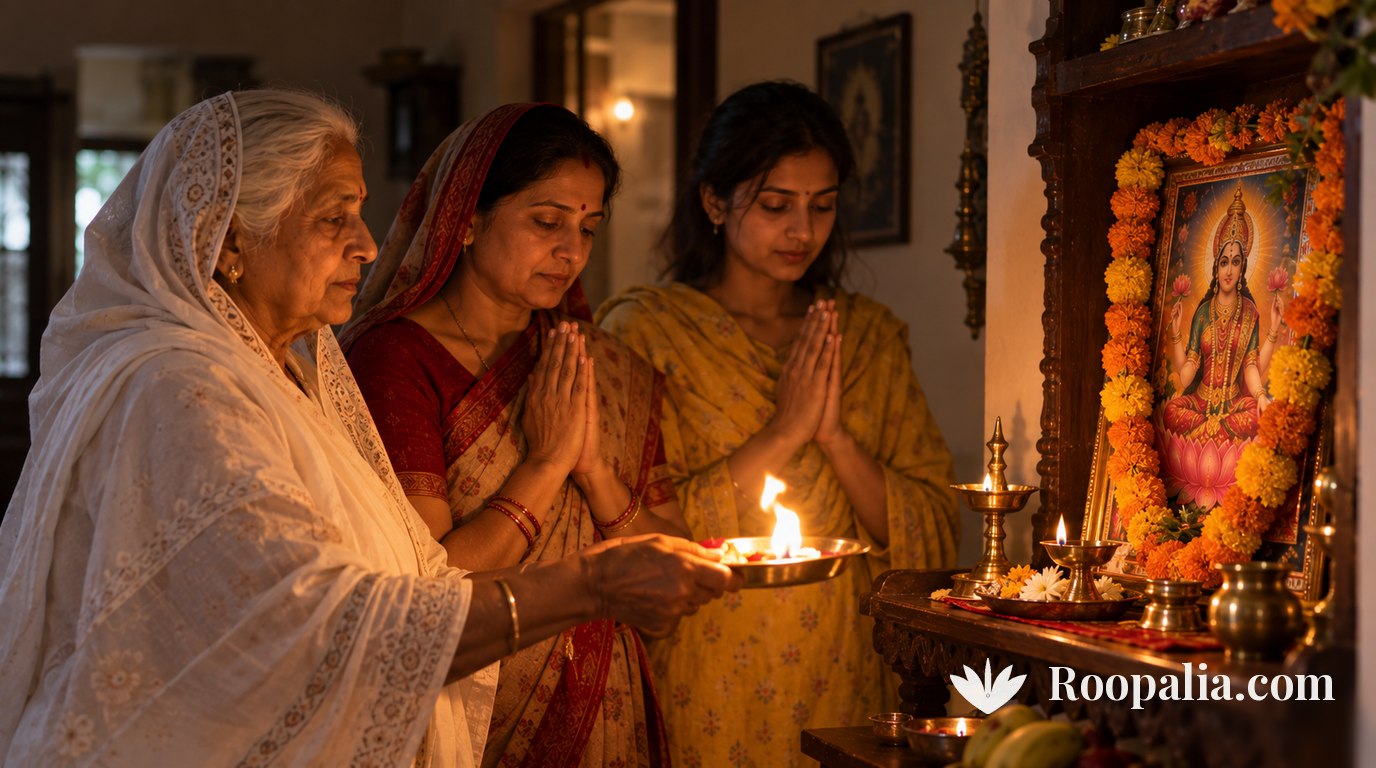
After the aarti, sprinkle water and distribute the prasad — the jaggery and chickpeas to the household first, then to whoever comes.
A story with no kings and no queens in it
Indian vrat kathas usually come stocked with kings, queens, sages and curses. This one is different because it has no famous character at all — an old woman, seven sons, and a daughter-in-law whose name the story never gives. The folklorist A. K. Ramanujan described such nameless tales as the most interior kind of folktale, the sort told by women inside domestic spaces. That is probably why it travelled so far: in the place where the story leaves a blank, every woman listening could put herself.
Frequently Asked Questions
What is the Shukravar vrat katha?
What is the story of the 16 Friday fast?
Why are there two different Santoshi Mata stories?
Why is sour food forbidden in the Santoshi Mata vrat?
When and how should the katha be read?
What is the result of keeping the Santoshi Mata vrat?
📷 AI-generated images. For illustration only.
🙏 This retelling follows the tradition of the widely circulated vrat pamphlets; the historical note draws on Philip Lutgendorf's study in Manushi and on the writing of Veena Das and John Stratton Hawley. Details of the katha vary by region and family.