
Everything rests on the petticoat
This sounds like an odd place to begin, but it is where most problems start. If your saree keeps slipping, or bunches awkwardly at the waist, the fault is usually not in the saree at all.
Three things matter. Tie the cord tightly — tight enough that a finger only just slides under it. The entire weight of the saree hangs from that cord, and a loose one guarantees a drape that sinks through the evening.
Get the length right — about half an inch off the floor, measured while wearing the shoes you intend to wear. Too long and you will trip on it; too short and it peeps out beneath the hem.
And match the colour to the saree. Under a pale or sheer saree a white petticoat shows through and undoes everything else you have done well.
If your saree slips repeatedly, switch to a drawstring petticoat rather than an elasticated one. Elastic relaxes gradually through the day and the whole drape descends with it. A cotton drawstring stays exactly where you tied it.
The drape itself, in five steps
This is the Nivi drape — the one now worn across most of India. It looks complicated the first time and takes about ten minutes once it clicks.
Draping a saree in five steps
The Nivi drape, in order, for someone doing it for the first time
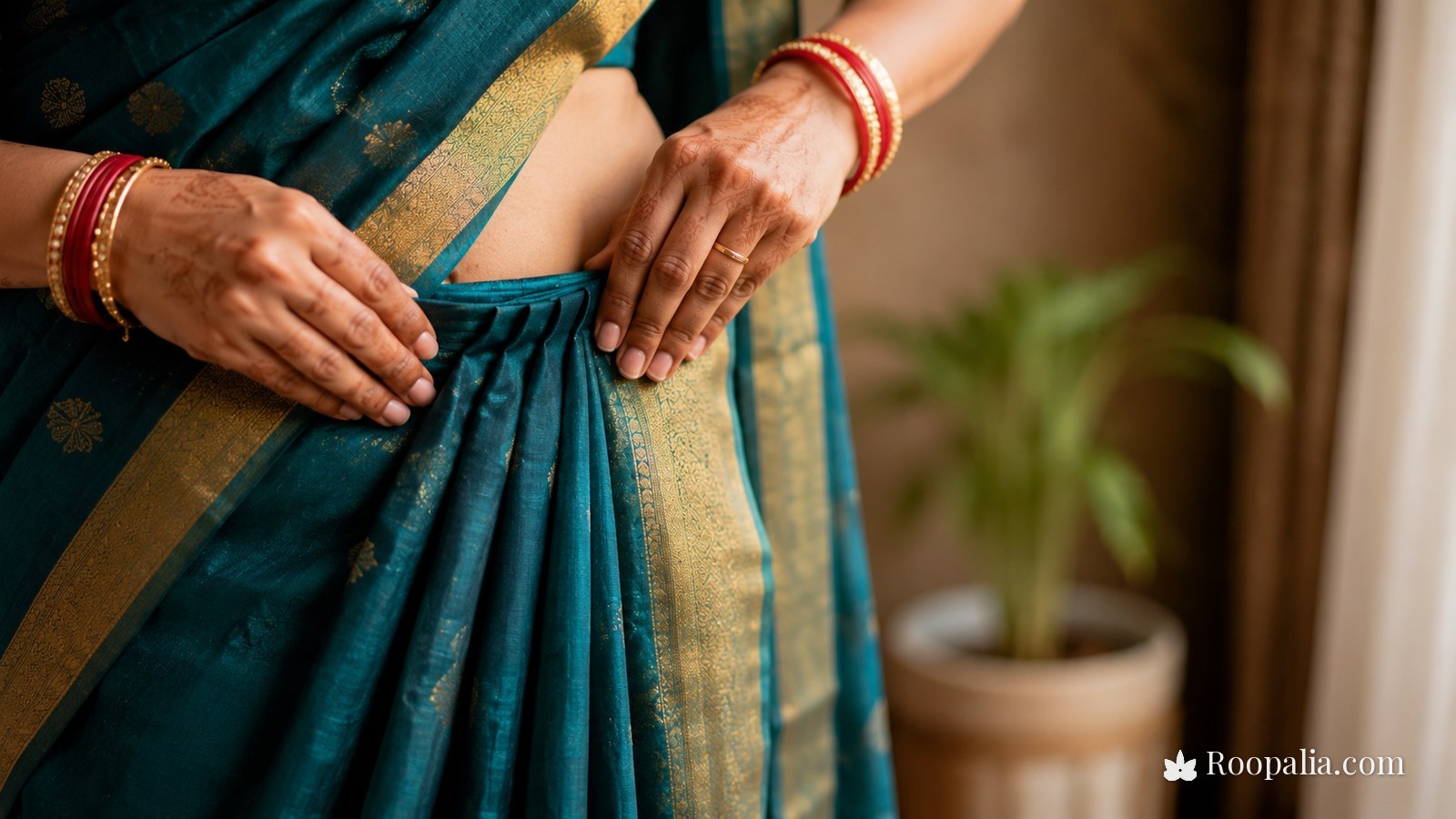
The trick to good pleats
Pleating sounds straightforward and almost never works the first time. Two things help.
First, form the pleats over your fingers rather than in mid-air. Hold the fabric between thumb and index finger and fold it back and forth, keeping each fold to roughly four or five inches.
Second, press that section of the saree first. Pleats made in pressed fabric hold their own shape and stay put all day; pleats made in creased fabric drift apart within an hour.
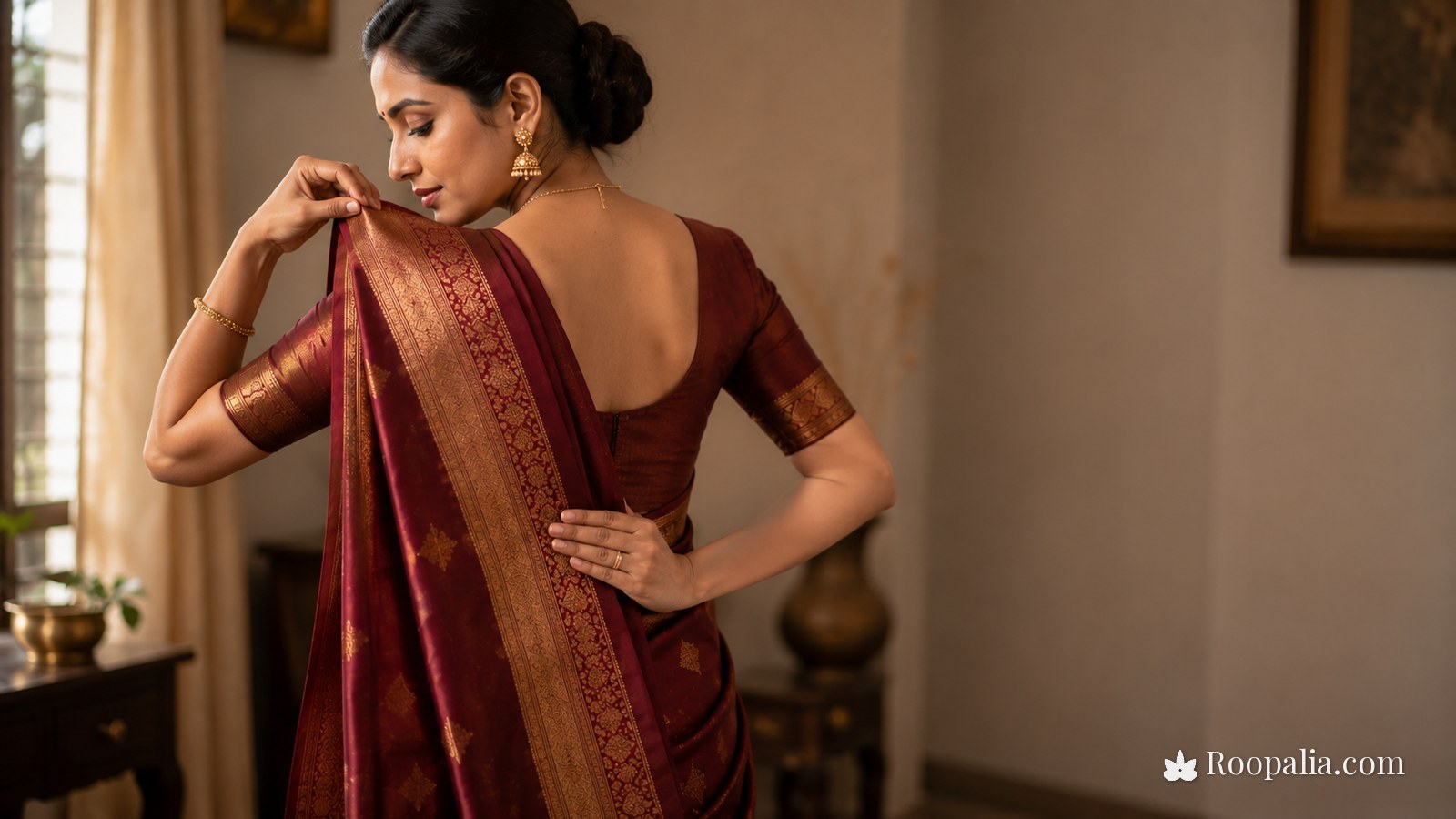
Draping for a leaner line — and what adds bulk
This is the section most people arrive for, so let me be clear about one thing first. What follows is about how cloth behaves, not about your body. A saree suits every shape; the drape simply changes the line, in exactly the way the cut of any garment does.
The underlying principle is straightforward: what adds visual width in a saree is not weight but gathered fabric. Wherever cloth bunches, the eye reads breadth. So every technique below does the same thing — less fabric collected at the waist, more long uninterrupted vertical lines.
What adds bulk, and what does not
The same saree, draped two ways — the difference is visible immediately
Two more that did not fit the grid but matter just as much.
Border width counts. A very wide border draws the eye horizontally and adds breadth. A narrow or medium border keeps the eye travelling up and down.
And the blouse fit affects the silhouette more than the saree does. A loose blouse makes the entire upper body look heavier. Three-quarter sleeves and a slightly lower back both lengthen the line.
💡 Said plainly: these are options, not rules. On the day you want to wear the heavily embroidered silk, wear it — at a wedding, nothing else looks right. These techniques are for the days when you happen to want a longer line.
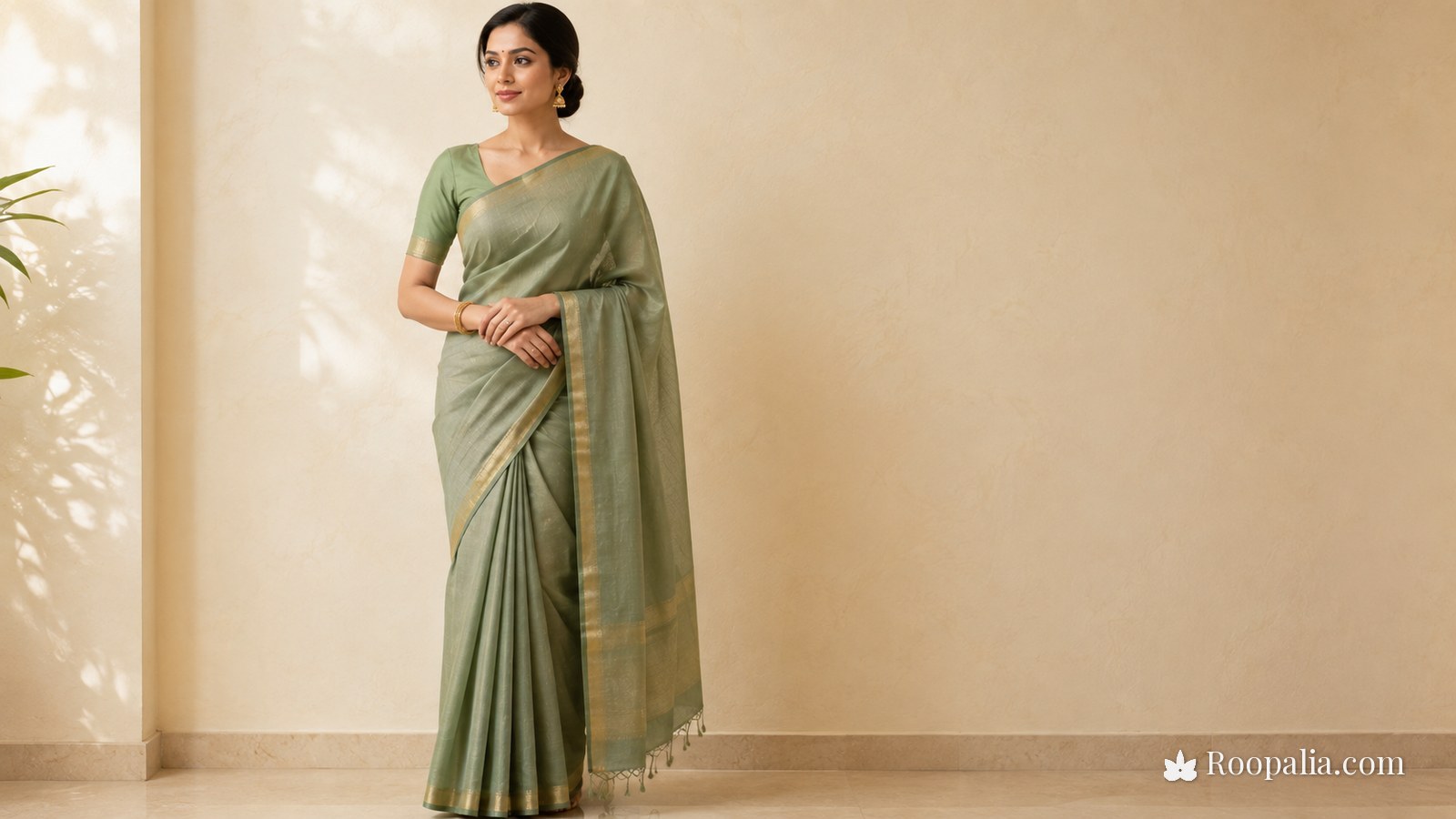
The part that surprises most people
The Nivi drape — blouse, petticoat, pallu over the left shoulder — is what almost everyone means by "traditional". It is also not very old.
It was assembled in the 1860s, and largely by one person: Jnanadanandini Devi, wife of Satyendranath Tagore and sister-in-law of the poet Rabindranath Tagore.
The story is well documented. In 1864 she moved to Bombay, where she observed Parsi women wearing the saree with a blouse and petticoat, the pallu over the right shoulder. She found it practical and adopted it — with one change. She moved the pallu to the left shoulder so that her right hand stayed free.
So the detail we treat as immemorial tradition has no scriptural basis whatsoever. It comes from one woman deciding that her working hand should not be tangled in cloth.
She also lengthened the saree from roughly five yards to six, which is where today's standard length comes from. The result was known as the Brahmika sari, because it combined Bengali, Gujarati and Parsi elements.
The most charming detail is what came next: she placed advertisements offering to teach other women the new drape. Maharani Suniti Devi of Cooch Behar later added the front pleats, and only then did the drape reach the form now worn in every household in India.
None of which makes the saree itself new. The garment is ancient — like bangles, it traces back to the Indus Valley. What is recent is only this particular way of wrapping it. Before that, sarees were worn in many different ways, frequently without either blouse or petticoat.
🪔 A thread worth pulling: a saree has no stitching, and in Hindu tradition unstitched cloth is considered ritually pure. That is precisely why the saree and the dhoti remain the required dress at pujas, at temples and at wedding ceremonies. The rule still holds at many temples today.
Six regional drapes — Nivi is only one of them
Search for saree styles and you mostly get minor variations on the Nivi. In fact over a hundred distinct drapes are documented across India, and each developed around the climate and the work of its region.
Six regional drapes and how to recognise them
Each one solved a practical problem before it became a tradition
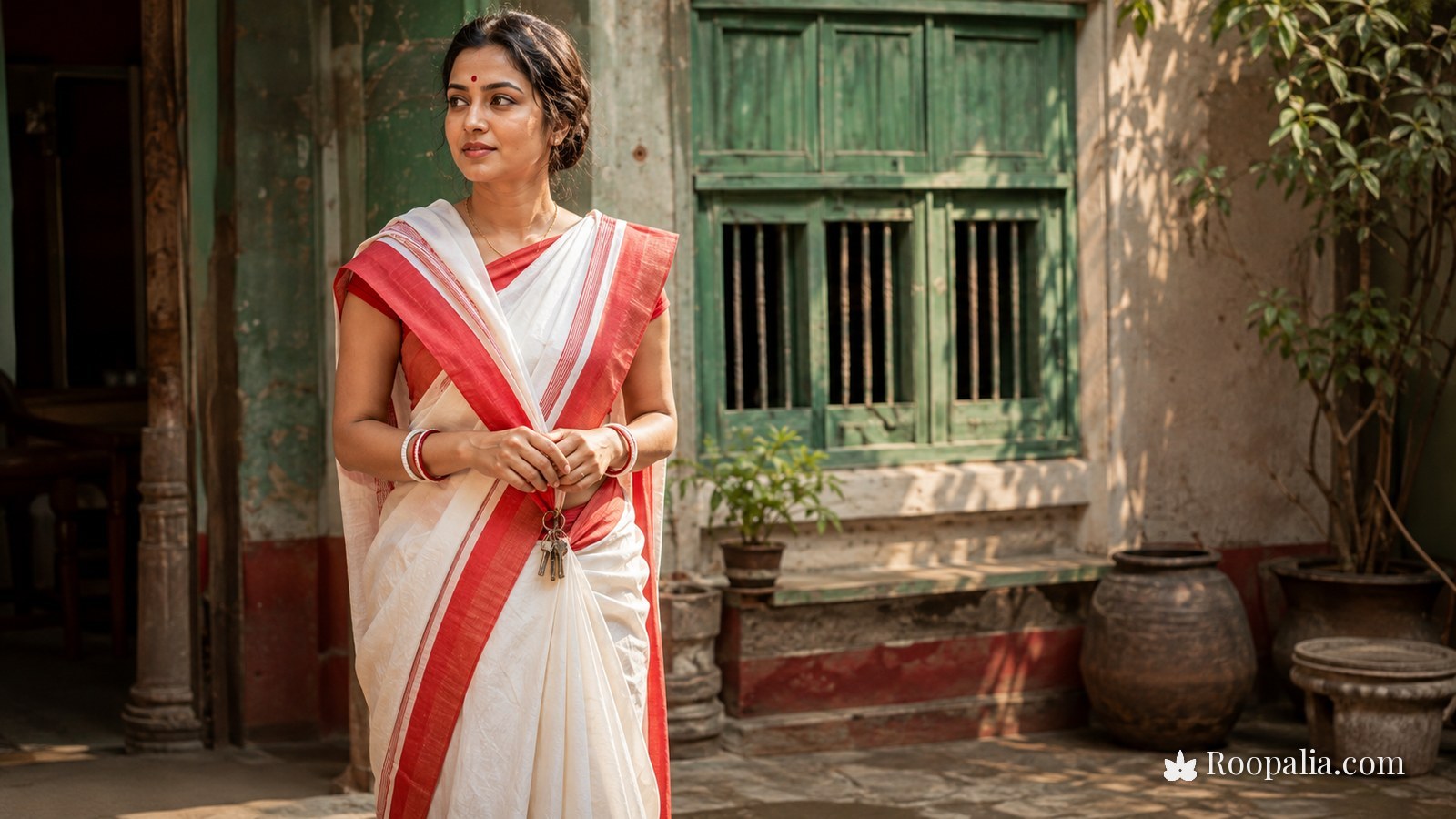
Those keys are not decorative. They signalled who held the household stores and the strongbox. The woman with the keys knotted into her pallu was the woman who ran the house — a piece of information communicated entirely through clothing.
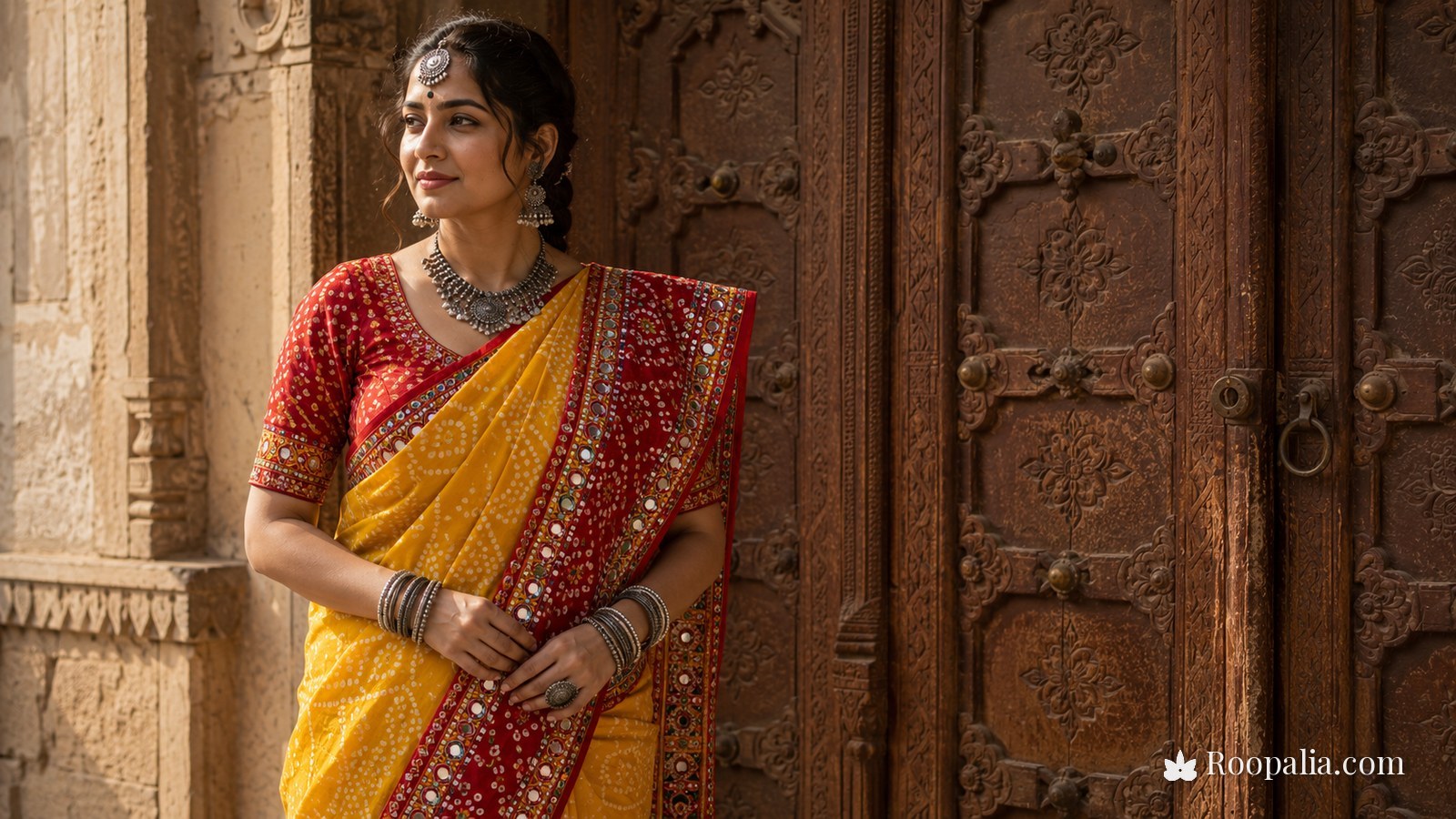
The front-facing pallu also has a practical origin. Where the ghoonghat was customary, the pallu needed to be at the front so it could be drawn over the head in one motion. And since the finest work on any saree is on the pallu, keeping it at the front means it is actually seen.
Wearing a saree for the first time
If this is your first or second saree, the following will make the day considerably easier.
- Start with cotton or georgette, not silk. Silk slides and will not stay put in inexperienced hands; cotton grips.
- Practise twice at home first. Do not let the event be your first attempt — twenty minutes of practice saves a great deal of anxiety.
- Set the length wearing your actual shoes, or you will either sweep the floor or expose your ankles all evening.
- Carry three or four spare pins. Anything that comes loose can be fixed in two minutes.
- Lift the pleats slightly on stairs — only slightly, just enough to clear your feet.
Gather the fabric behind you with one hand as you sit, or the pleats pull taut and come free. When you stand, run a hand once down the front pleats. That is genuinely all there is to it.
The almirah in every Indian house
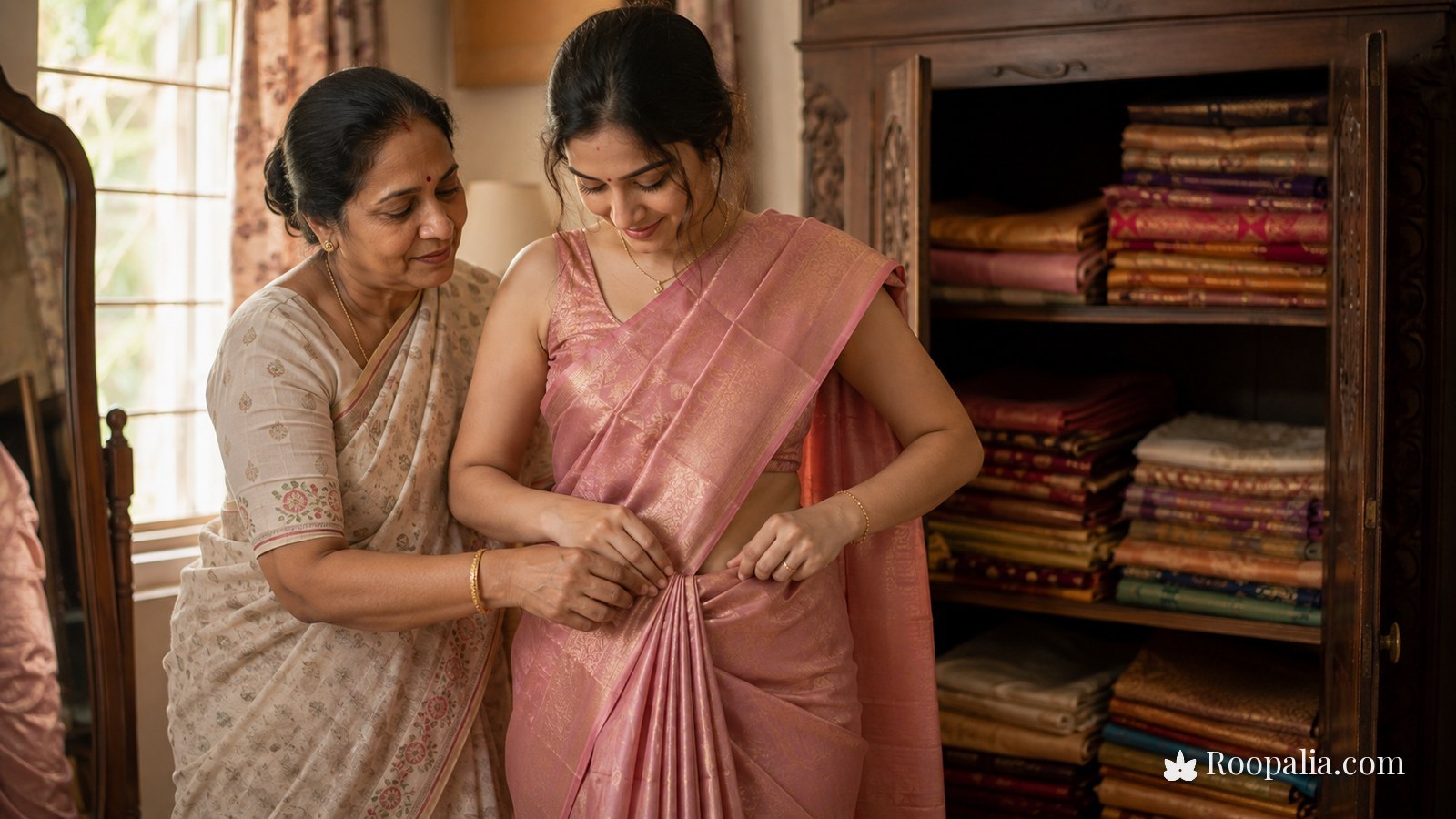
This article is about technique, but it would be incomplete without one observation.
Almost nobody learns to drape a saree from a tutorial. They learn it from a mother, an aunt, or the one relative who takes charge of this on every wedding morning. And while teaching, that person does not only demonstrate pleats — she tells you whose saree this was, when it was bought, what it was worn to.
Every Indian house has an almirah with folded silk sarees stacked inside it. Some belonged to a grandmother, some were worn at a wedding, some have never been worn at all. That cupboard is not really storage — it is a family record, and each saree in it carries a date.
Which may be why the garment has lasted thousands of years. The saree is the rare piece of clothing with no size — the same one fits a mother, a daughter, and eventually a granddaughter. Cloth cut for no particular body ends up belonging to no particular generation.
In closing
Three things, and the rest follows
Tie the petticoat cord tightly, keep the pleats narrow and even, and fold the pallu before pinning it. Everything beyond those three is practice, and practice shows by the second attempt. And once it is on, it is worth remembering what you are actually wearing: an unstitched length of cloth that every generation has had to work out for itself — Jnanadanandini Devi included. 🌸