
A 30-second self-check
Every dark mark forms the same way: pigment cells go into overdrive and deposit extra melanin. What differs is the trigger — and the trigger decides the treatment. Stand at a window in daylight, never under a bathroom light, and run through these four.
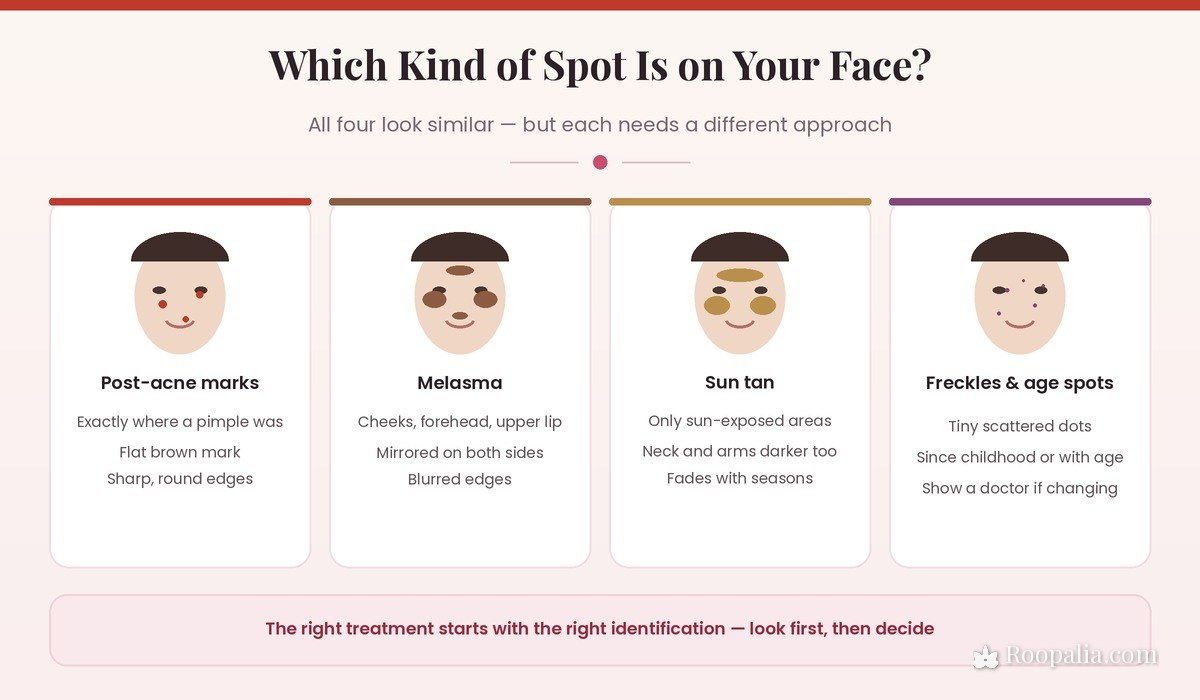
Post-acne marks sit precisely where a spot once was — round, flat, sharply defined. The technical name is post-inflammatory hyperpigmentation, and most clear by themselves, though it can take three months to a year. Picking at spots or stepping outside unprotected resets that clock. And if the mark is indented rather than discoloured, it is a scar, not pigment — no cream fills a scar.
Melasma is different: larger patches with soft, feathered edges across the cheekbones, forehead or upper lip — and, crucially, near-symmetrical on both sides. That symmetry is the most reliable clue you will get. It darkens in summer and eases in winter, which is why so many people think a product "stopped working" in June.
Tan has a simple test: compare the strip of wrist your watch covers against the back of your hand. It appears only where sunlight lands, and clears faster than anything else here. Freckles and moles are usually harmless — with one exception that matters: any mole changing in size, colour, shape or border, or that itches or bleeds, needs a dermatologist promptly.
What drives melasma
Melasma gets its own section because it frustrates people most. It is never a single cause — almost always sunlight plus something else, and without the sunlight the something else rarely does much alone.
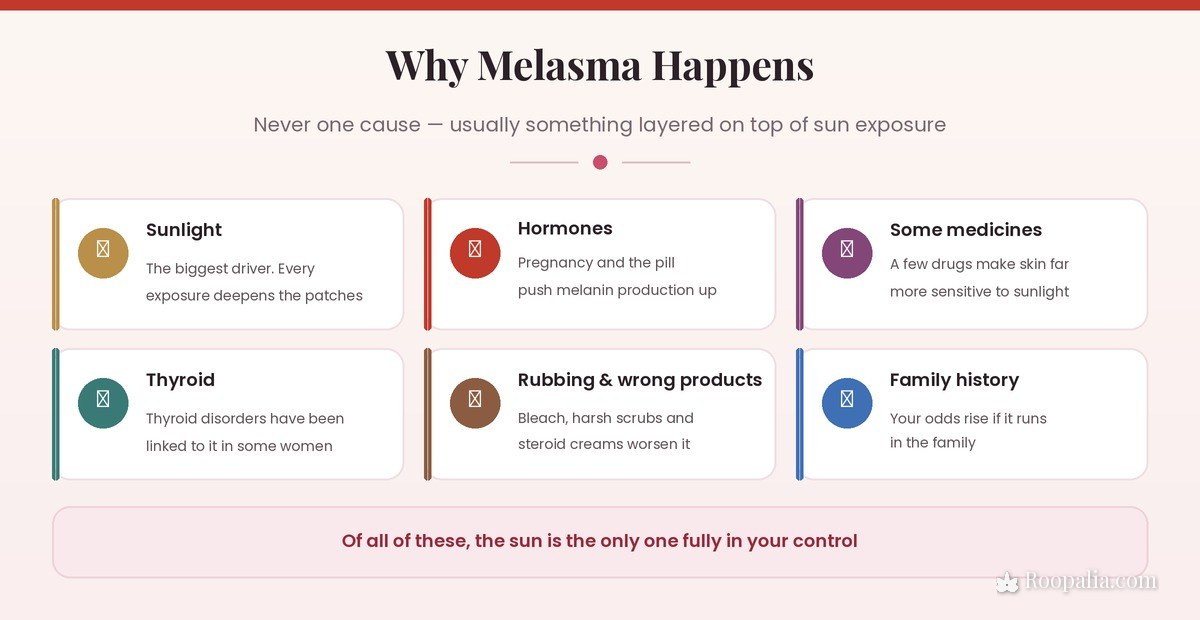
Hormones are the usual co-conspirator, which is why melasma so often begins in pregnancy — the old name is the mask of pregnancy. Combined oral contraceptives can do the same. If patches appeared within months of starting the pill, raise it with your doctor, though never stop taking it on your own.
Beyond that: some medications increase photosensitivity, thyroid dysfunction has been linked to melasma, and there is a hereditary thread. Then the factor people cause themselves — harsh scrubs, at-home bleaching, threading followed straight by sun. Inflammation and pigment are close cousins; irritate skin and it makes more melanin.

Why this hits skin of colour harder
If you have brown or deeper skin, you are not imagining that pigmentation behaves differently for you. Melanin-rich skin produces pigment more readily after any insult — a spot, a scratch, a bad product — and holds onto it far longer. A mark that fades in six weeks on pale skin can linger a year on deeper skin.
This cuts two ways. Prevention beats correction, because stopping the inflammation is far easier than erasing the result. And gentleness is not optional — the instinct to scrub harder is exactly backwards. Deeper skin also rebounds more readily from harsh peels and poorly chosen lasers, which is why a practitioner's experience with your skin tone matters more than the machine they own.
💡 On the word "brightening": your baseline skin tone is set by genetics and no product changes it — anything promising otherwise is either lying or contains something it shouldn't. What genuinely can change is tan, post-acne marks, the depth of melasma and general dullness. Clear those and skin looks even, luminous and healthy. That is what "brightening" honestly means.
The cream to walk away from
This may be the most useful section on the page. Across South Asia, the Middle East, parts of Africa and diaspora communities everywhere, skin-lightening creams circulate freely — sold over the counter, recommended by beauticians, passed between relatives. A substantial share contain undeclared potent steroids. Dermatologists have warned about this for years, and they keep selling, because for a fortnight they appear to work brilliantly.
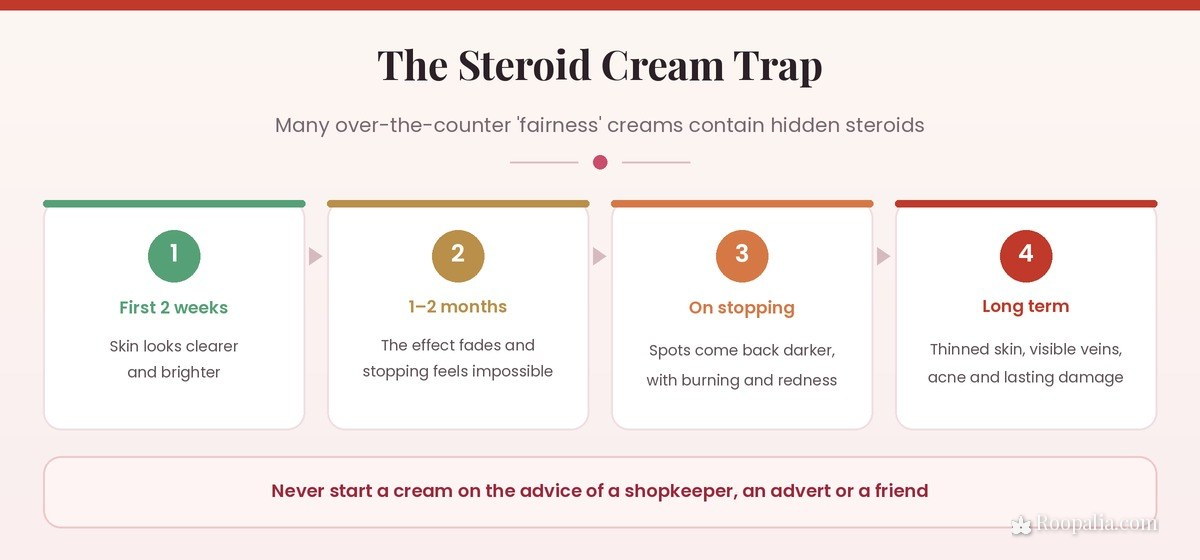
The arc is always the same. Skin looks clearer early on, because the steroid suppresses inflammation. Then the effect plateaus, and when the cream stops the face flares back angrier than before. Prolonged use thins skin, brings broken capillaries to the cheeks, and can trigger acne and unwanted facial hair.
⚠️ How to spot one: read the ingredient list. Anything ending in -sone, -solone or -tasol — betamethasone, mometasone, clobetasol — is a corticosteroid and does not belong on a face without a prescription. Be equally wary of unlabelled decanted jars and of any product whose ingredients are not listed at all. If you are already using one, do not stop abruptly; the rebound is worse than the taper. See a dermatologist and come off it under supervision.
Traditional Indian remedies — what holds up
Turmeric, gram flour, yoghurt, sandalwood and fuller's earth have been part of South Asian skincare for centuries — the pre-wedding haldi and mehndi rituals were as much about skin as ceremony. Some of it stands up to scrutiny. Some of it doesn't.

Turmeric contains curcumin, whose anti-inflammatory properties are reasonably well studied. Yoghurt supplies lactic acid, a very mild AHA. Aloe vera is the best thing to put on skin after sun. Multani mitti absorbs excess oil and suits oily skin, but it does not lift pigment and strips dry skin — rinse it while still damp, never let it crack. And the perennial ice-cube question: chilling briefly reduces puffiness and redness, handy before makeup, but does nothing to pigment.
These make things worse
- Neat lemon juice — highly acidic, damages the skin barrier, and can cause a phototoxic reaction that leaves darker marks than you started with.
- Baking soda and toothpaste — irritation now, pigment later.
- Bleaching and gritty scrubs — the single worst thing for melasma.
- Very hot water — strips the barrier and worsens redness.
The honest summary: kitchen remedies are maintenance, not treatment. They will help dullness and mild tan. They will not shift established melasma.
Ingredients worth your money
Ignore the brand on the front and read the actives on the back. The same molecule appears across wildly different price points, and it is the molecule doing the work.
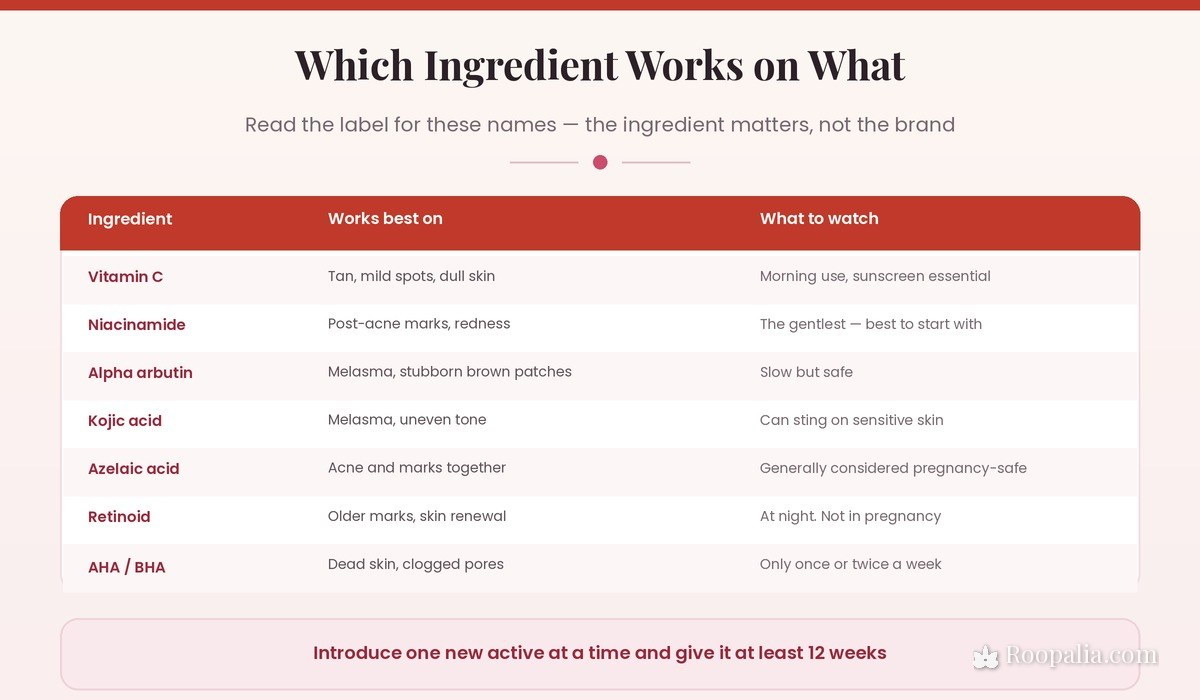
Starting from scratch, begin with niacinamide — the most forgiving active here. For tan and dullness, vitamin C in the morning. For melasma, alpha arbutin, kojic acid or azelaic acid — the last being useful in pregnancy, where retinoids are off the table.
One: introduce a single new active at a time. Change three things at once and you will never know which one helped and which one stung.
Two: give it twelve weeks minimum before judging.
Three: patch test behind the ear for two days first. It costs two minutes and saves months.
The sunscreen mistake almost everyone makes
People with deeper skin are routinely told sunscreen is optional for them. It is the most expensive misconception in this subject. Melanin offers a little protection, nowhere near enough, and pigmentation is more stubborn in darker skin, not less.
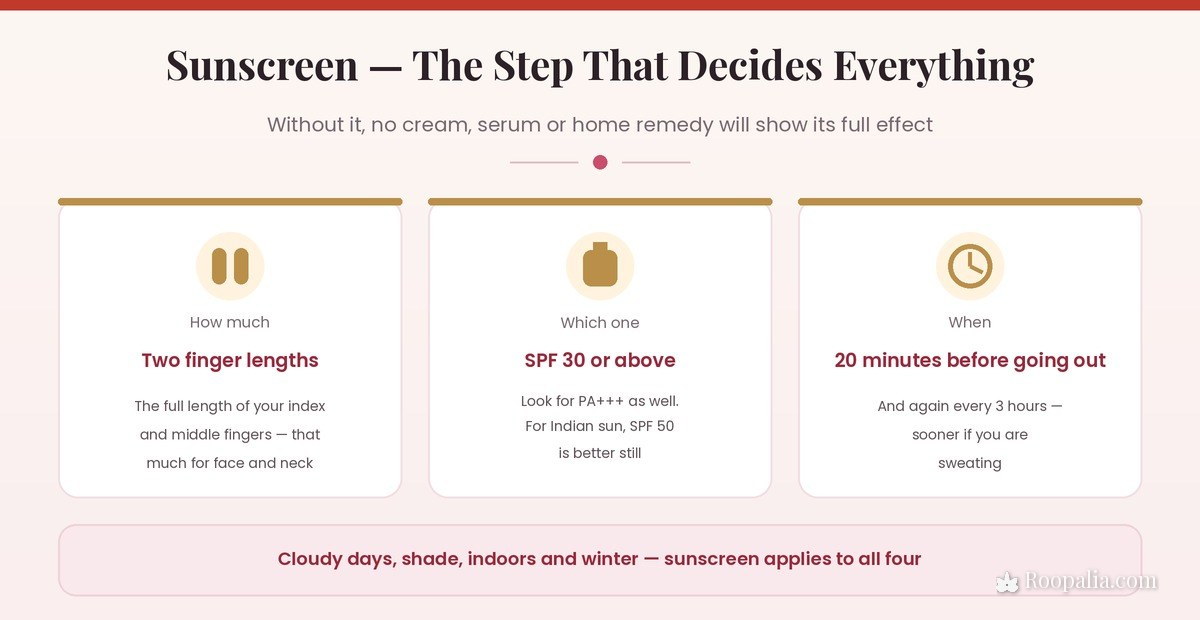
Quantity is where it falls apart. A pea-sized blob achieves little; face and neck need roughly two full finger-lengths. It will feel like far too much the first time — that is the correct amount. Reapply every three hours, and yes on overcast days, beside a window, and on a ten-minute walk. If melasma is your issue, a tinted sunscreen is measurably better: its iron oxides also screen visible light, which melasma reacts to.
A routine you will actually keep
| When | What |
|---|---|
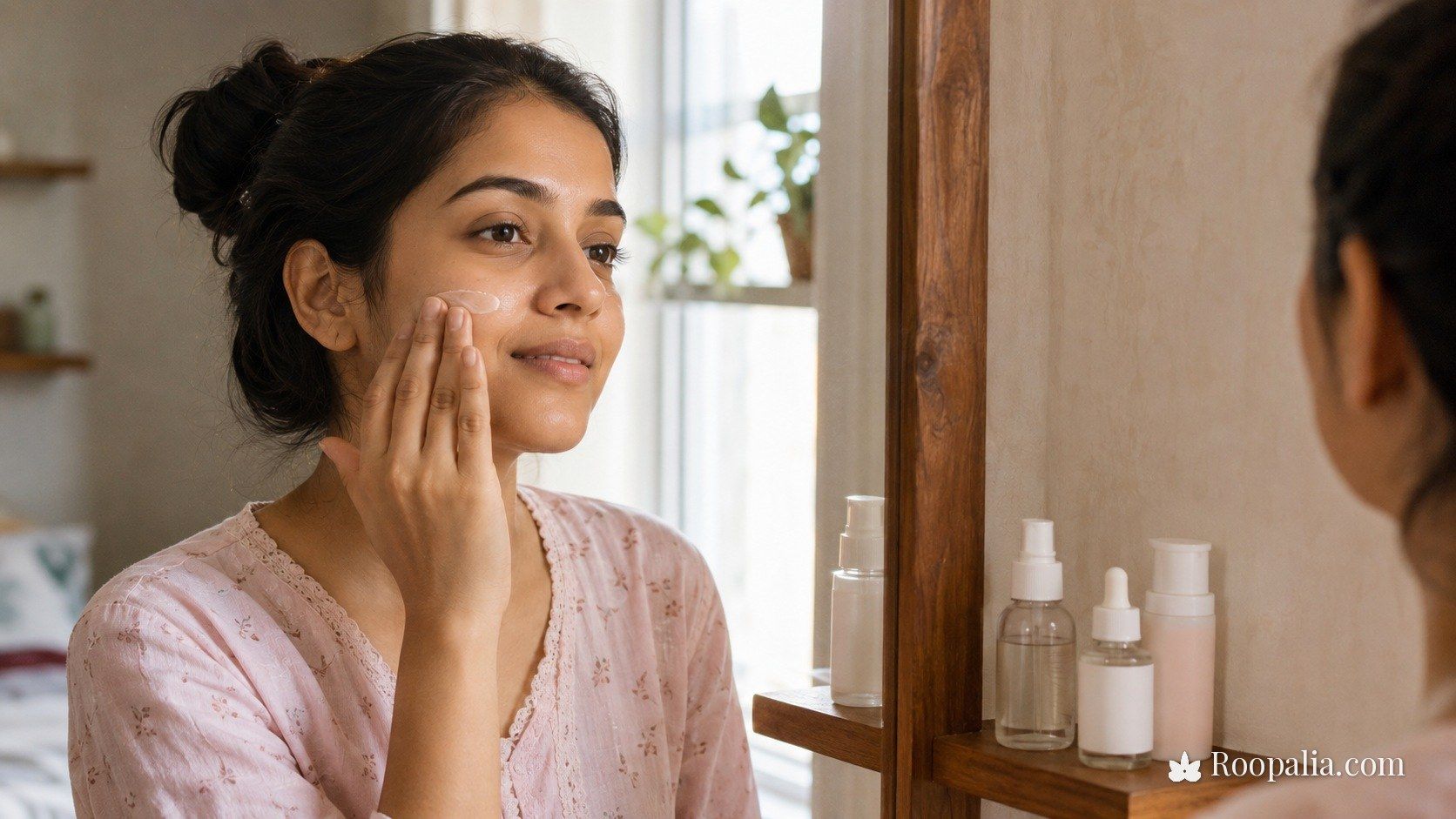
| Morning | Gentle cleanser → vitamin C or niacinamide → light moisturiser → sunscreen, two finger-lengths |
| Through the day | Reapply sunscreen every 3 hours — otherwise the morning application is wasted |
| Night | Remove makeup fully → your pigment active or prescribed cream → moisturiser |
| Once or twice a week | Gentle exfoliation or a traditional mask — no more than that |
| Once a month | Photograph your face in the same light. This is the only reliable progress tracker. |
Realistic timelines — and when to get help
Tan lifts in three to six weeks, recent acne marks in two to three months, older ones in six to twelve. Melasma usually improves at three to six months, with control rather than cure as the honest goal. Abandoning a product at week three is skincare's most expensive mistake — one turnover of the epidermis takes about a month, and pigment sits below that.
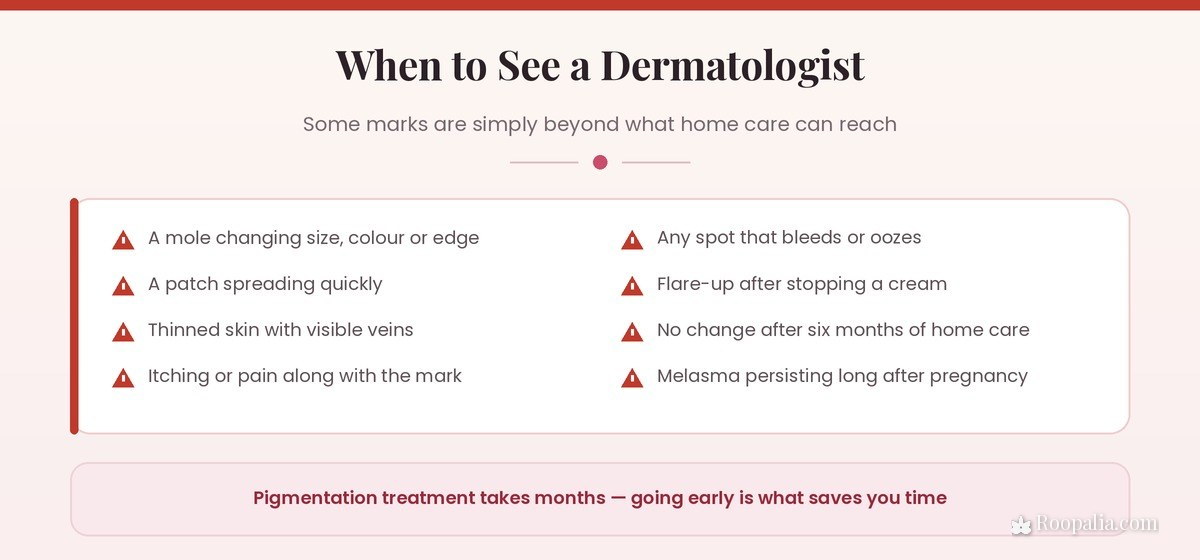
A first dermatology visit is less dramatic than people expect: an examination, sometimes a Wood's lamp to gauge how deep the pigment sits, occasionally bloodwork — and then, usually, a prescription cream. Peels and lasers come later, and with melasma clinicians are deliberately cautious, because wrong settings can rebound. That caution is exactly why a dermatologist beats a salon package.
Identify it, protect it, then be patient with it
There is no single cream that fixes pigmentation, but there is a reliable sequence. Work out which mark you actually have. Make sun protection genuinely non-negotiable, because without it everything else operates at half strength. Then pick one active and give it an honest three months. The industry sells urgency; skin only understands consistency. 🌺
Frequently asked questions
How do I know if I have melasma or post-acne marks?
Can melasma be cured permanently?
What is the best ingredient for dark spots?
Does darker skin really need sunscreen?
Will pregnancy melasma go away after the baby is born?
Is lemon juice good for dark spots?
How long before I see a difference?
Are skin-lightening creams safe?
🩺 Medical disclaimer: this article is for general information and education and is not a substitute for examination, diagnosis or treatment by a qualified clinician. Patch test anything new before applying it to your face. If a mark is spreading quickly, a mole is changing, your skin is painful or broken, or you are pregnant or breastfeeding, seek personalised advice from a dermatologist.