
The face map — and what it does not mean
Search "face mapping" and you will find charts assigning each zone to an internal organ: forehead means digestion, cheeks mean lungs, and so on. Let's be straight about this — most of that is folklore, not evidence.
But there is a genuinely useful version of the idea, and it has nothing to do with organs. Different parts of your face have different oil-gland density, and — more importantly — different things touch them. That is why location really does narrow down the cause.
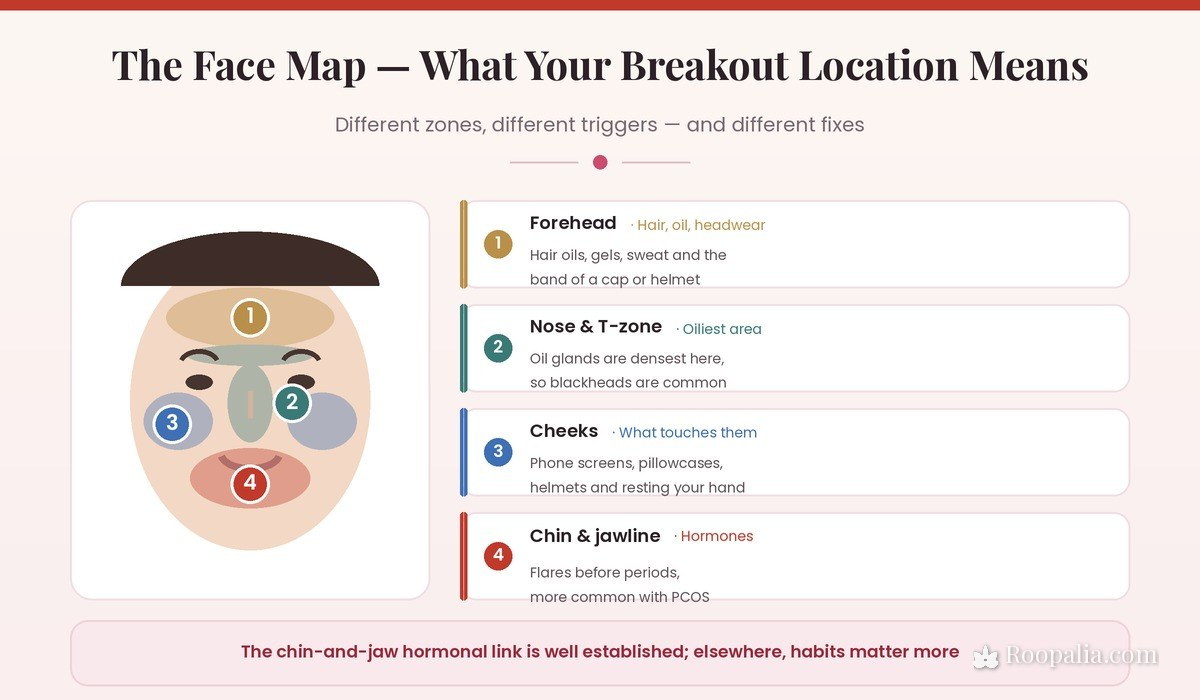
Forehead. Nearly always about what goes in your hair. Oils, serums, styling gel, dry shampoo — all of it migrates onto the forehead overnight or with sweat. Add a cap, a helmet strap or a fringe and you have a reliable recipe.
Nose and T-zone. The densest concentration of oil glands on the face, which is why blackheads congregate here more than anywhere else.
Cheeks. This is the contact zone. Phone screens, pillowcases, helmet padding and — the one almost nobody notices — resting your chin or cheek on your hand while you think. If your breakouts favour one side, check which ear you hold your phone to and which side you sleep on.
Chin and jawline. Here the hormonal connection is real and well documented. Deep, tender spots that flare in the week before a period follow a very recognisable pattern, and they are more common with PCOS. If irregular cycles or unwanted facial hair come along with them, that combination is worth raising with a doctor.
Four types — and why it matters which you have
Treating all spots as one thing is the most common mistake in acne care. Surface-level and deep breakouts respond to completely different approaches.
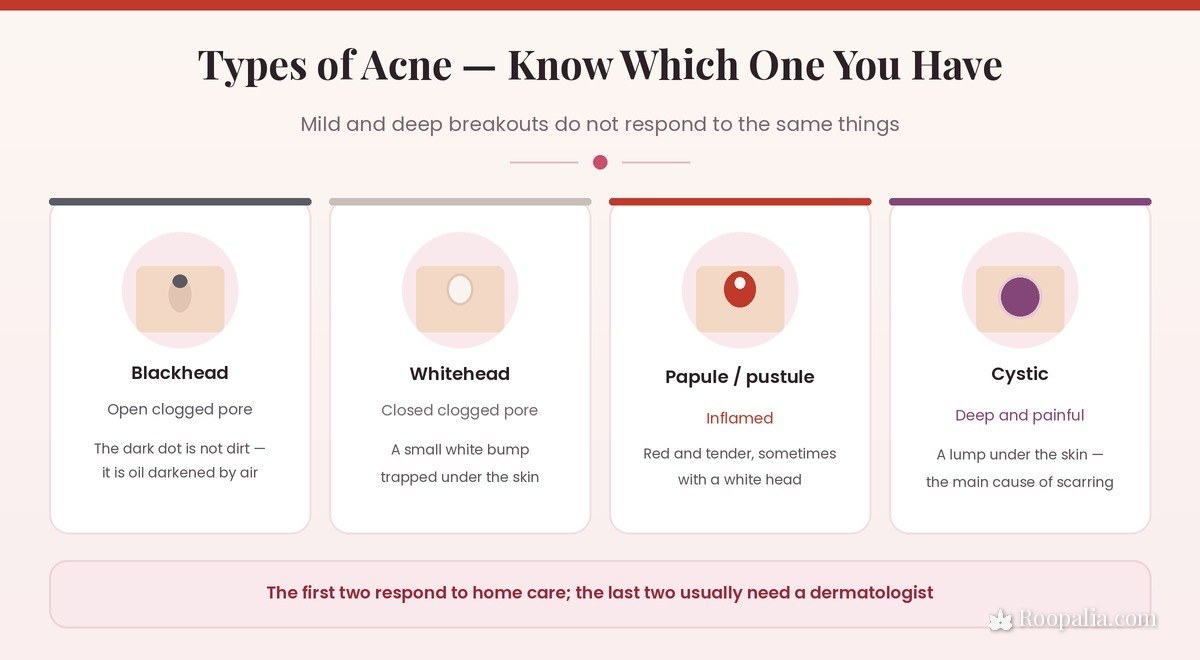
Worth clearing up one persistent myth: the dark colour of a blackhead is not dirt. It is oil that has oxidised on contact with air. No amount of scrubbing removes it — that is a job for a specific ingredient, not effort.
At the other end sit cystic spots: firm lumps under the skin, painful, with no head to them. No home remedy touches these, and they are the main source of permanent pitting. Spending six months trying products on cystic acne is six months of scarring you can't undo.
How a spot actually forms
Four things have to line up. Understanding that sequence explains why washing your face harder achieves nothing.
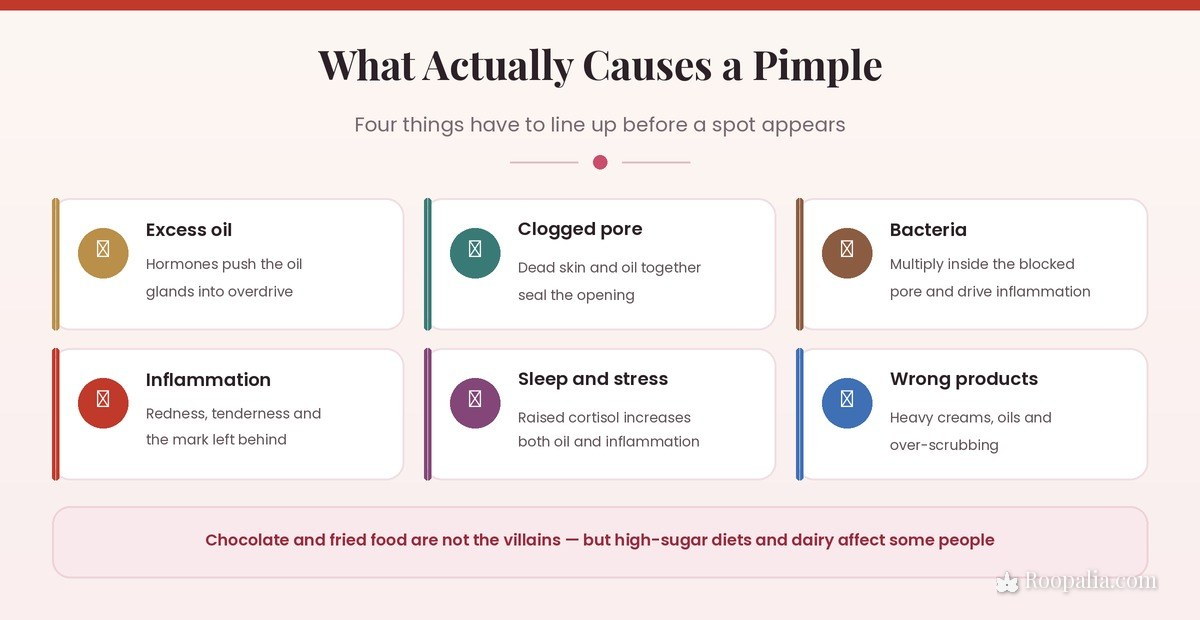
Hormones drive the oil glands harder. Dead skin cells and oil combine and seal the pore. Bacteria multiply in that sealed environment. Inflammation follows — and that inflammation is the red, tender bump you can see.
Now the diet question, which everyone asks and few sources answer honestly. Greasy food does not directly cause acne; one plate of fried food will not produce a spot. What the research does point to is high-glycaemic diets — lots of sugar and refined carbohydrates — and, in some studies, skim milk specifically. Neither applies to everyone. If you suspect something, drop it for three weeks and watch. Do not overhaul your entire diet on a hunch.
Home remedies — the honest audit
Some kitchen-cupboard remedies hold up. Many don't, and a few actively cause damage. The internet is full of fifteen-minute-fix promises, and a fair number of them involve putting something acidic or abrasive on inflamed skin — which is how a two-week spot becomes a six-month mark.

Neem is the oldest answer in Indian skincare and its antibacterial properties have genuine research behind them; a neem rinse or a light neem-and-turmeric paste once or twice a week is reasonable. Aloe vera calms inflammation and pairs well with the dryness that benzoyl peroxide causes. Honey is mildly antibacterial and, unlike most spot treatments, does not strip the skin.
Tea tree oil is the one natural ingredient with reasonably solid evidence in mild acne — but never apply it neat. Always diluted in a carrier oil or moisturiser, and only on the spot itself.
These make things worse
- Picking and squeezing — pushes inflammation deeper into the skin. This is where pitted scars are made.
- Toothpaste on a spot — irritation now, a darker mark later.
- Neat lemon juice — strips the barrier and can cause a phototoxic reaction in sunlight.
- Washing four times a day — stripped skin compensates by making more oil. Twice is enough.
- Gritty scrubs and cleansing brushes — on inflamed skin, this is petrol on a fire.
Which ingredient for which spot
Ignore the brand on the front of the bottle and read the actives on the back. The molecule does the work, and the same molecule turns up at wildly different prices.
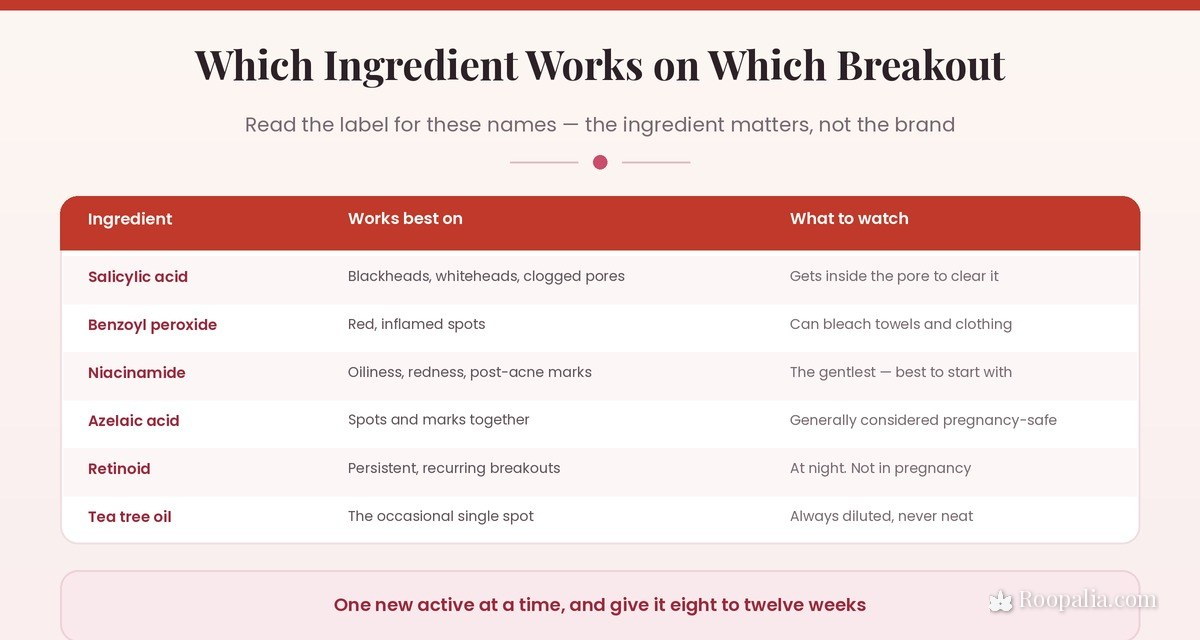
The rule is simple: clogged pores and blackheads call for salicylic acid; red, inflamed spots call for benzoyl peroxide. Start with the lowest strength you can find and use it every other day rather than daily — higher percentages are not more effective, just more irritating.
One: one new active at a time. Layer two or three and you will end up with a stripped barrier and no idea which one caused it.
Two: a short "purge" in the first two or three weeks is normal with actives — don't abandon ship.
Three: every strong active needs a moisturiser alongside it. Dry skin produces more oil, not less.
When buying moisturiser or sunscreen, look for "non-comedogenic" on the label — meaning it is formulated not to clog pores. Our guide to dark spots and pigmentation covers sunscreen application in detail.
Mark or scar — what the spot left behind
Two very different outcomes, and only one of them fades on its own.
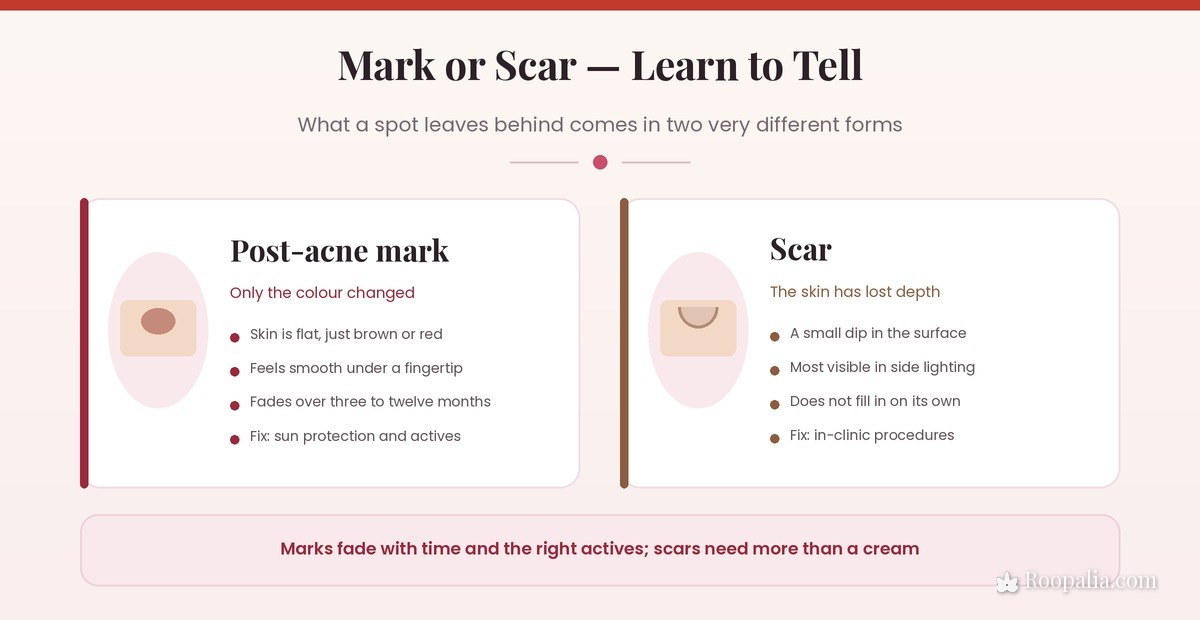
A mark is discolouration only — the skin stays flat and it fades over three to twelve months. A scar means the skin has actually lost structure, and no cream fills that in; it needs in-clinic treatment. Which brings us back to the same point: the single best scar treatment is not picking in the first place.
For fading the marks themselves — which ingredients help and how long each takes — see our detailed guide to dark spots and pigmentation.
The small habits that outperform most products

| Habit | Why it matters |
|---|---|
| Change pillowcases twice a week | Oil, sweat and hair product sit against your cheek all night |
| Wipe your phone screen daily | It presses directly on your cheek — a classic one-sided breakout cause |
| Tie oiled hair away from the forehead | The leading cause of forehead breakouts, and free to fix |
| Never sleep in makeup | A night of blocked pores becomes tomorrow's spots |
| Cleanse soon after sweating | Post-gym and post-helmet sweat should not be left to dry |
| Keep your hands off your face | Resting your chin on your hand is the most overlooked trigger of all |
Timelines, and when to stop experimenting
The honest answer is six to eight weeks. A single turnover of the epidermis takes roughly a month, and the spots surfacing today began forming weeks ago. Judging a product at week two is the most common and most expensive mistake in acne care.
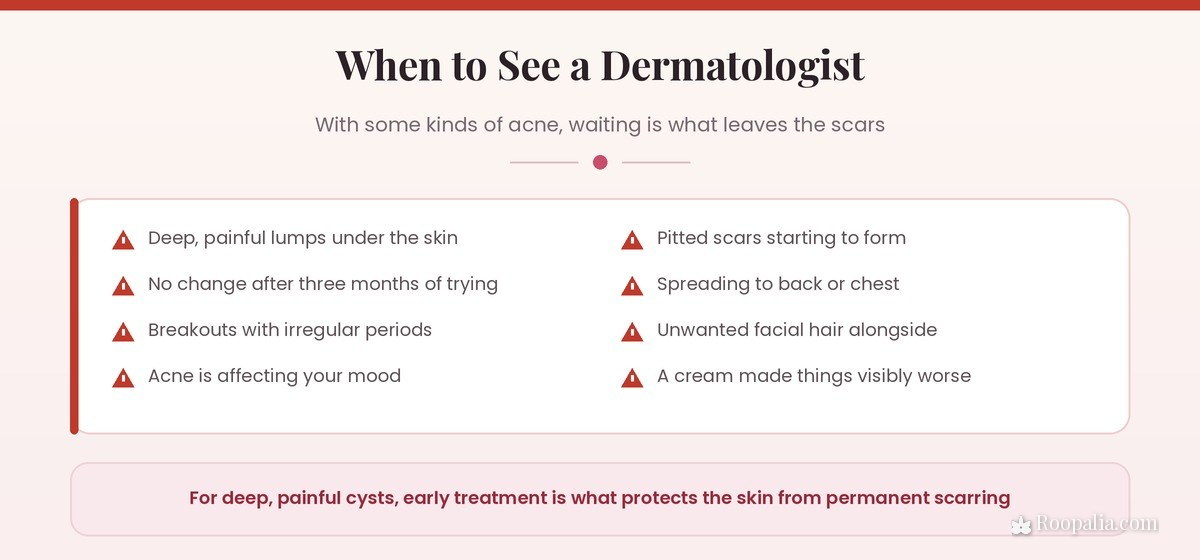
A first dermatology appointment is far less intimidating than people expect: an examination, sometimes hormonal or thyroid bloodwork, and in most cases a prescription cream to begin with. Prescription options are also far more effective than anything on a shelf, so the visit often shortens the whole journey rather than lengthening it.
And one point that rarely gets said out loud: if breakouts are making you avoid photographs, cancel plans or feel low when you catch your reflection, that is reason enough on its own to see someone. The research on acne and mental health is unambiguous. This is not vanity.
Read the location, fix the habits, then pick one active
There is no miracle face wash. Start by noticing where you break out and what touches that spot. Then fix the three free things — pillowcase, phone, hair products — which quietly outperform most of what you could buy. Only then choose a single active and give it two honest months. And above all, leave it alone: every spot you squeeze trades a week of healing for a mark that lasts a year. 🌺
Frequently asked questions
How do I get rid of a pimple overnight?
Why do I only break out on my forehead?
What does chin and jawline acne mean?
Should I pop my pimples?
Salicylic acid or benzoyl peroxide — which should I use?
Does diet cause acne?
Does acne get worse before it gets better?
Can acne scars be removed at home?
🩺 Medical disclaimer: this article is for general information and education and is not a substitute for examination, diagnosis or treatment by a qualified clinician. Patch test anything new before applying it to your face. If spots are deep and painful, scarring is starting, a product has visibly worsened your skin, or you are pregnant or breastfeeding, seek personalised advice from a dermatologist.